Isolation Transformer connections

Thread Starter

AlbertHall

Joined Jun 4, 2014
12,619
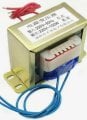
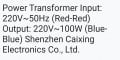
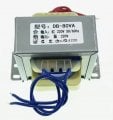
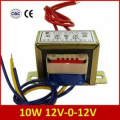
I have a 100W mains (220V) isolation transformer (CXT76326C-C2). One winding has red connecting wires while the other has blue wires.
There is no identification of which winding is the input.
Does it matter which way I connect it?
 

MrChips

Joined Oct 2, 2009
34,626
It should not matter since it is a 1:1 transformer.
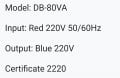
Edit: The step-down transformers shown on ebay have red on the primary side.

1771506796936.png
 

Pyrex

Joined Feb 16, 2022
501
I have a 100W mains (220V) isolation transformer (CXT76326C-C2). One winding has red connecting wires while the other has blue wires.
There is no identification of which winding is the input.
Does it matter which way I connect it?
The primary winding of the transformer should have lower resistance than the secondary. Take a multimeter and measure the resistances; the resistance of one winding will be slightly lower than the other. This winding will be primary
 

ronsimpson

Joined Oct 7, 2019
4,645
The primary winding of the transformer should have lower resistance than the secondary.
If the transformer in post #2 is correct, the primary will have the highest resistance.
Example: The transformer looks to be 220V to 12+12V. The primary will have low current so small wire. The secondaries will have higher current and larger wire. Say the primary has 220 turns and the secondaries will have 12 turns. A long 220 turns of thin wire will have more resistance.
 

MaxHeadRoom

Joined Jul 18, 2013
30,557
If just isolation type. with primary an secondary equal voltage rating, I would expect each might be the same, Take a look at the actual gauge if you can, side on to the transformer, generally the intended primary side is wound on first.
 

eetech00

Joined Jun 8, 2013
4,704
Isolation transformer primary and secondary windings will have the same voltage ratio, but will not have the same power capacity.
The wire sizes used for each winding will be different, so the DC resistance for each will be different.
 

crutschow

Joined Mar 14, 2008
38,316
Assuming it's a 1:1 transformer wound with the same gauge wire on both windings, then I would expect the secondary to have a few more turns to compensate for the load voltage drop due to the winding resistance.
That would make the secondary have a slightly higher resistance.
 

Thread Starter

AlbertHall

Joined Jun 4, 2014
12,619

Ian0

Joined Aug 7, 2020
13,097
If it is designed for 220V in 220V output, the output will have slightly more turns. This is because it will be specified to produce 220V on the output at a certain load, and off load it will need slightly more volts to compensate for resistive losses.
 

BobTPH

Joined Jun 5, 2013
11,463
The one I have looks just like that. The red wires read 197Ω, the blue wires read 202Ω.
I will use the red as primary and blue as the secondary.
Thanks all.
That cannot be right. A 100W transformer at 220 is carrying .4A RMS.

If the windings are 200Ω, at that current they drop 90V and dissipate 40W.

Is it maybe 2 Ohms?

If I am wrong, can someone please explain.
 

Thread Starter

AlbertHall

Joined Jun 4, 2014
12,619
That cannot be right. A 100W transformer at 220 is carrying .4A RMS.

If the windings are 200Ω, at that current they drop 90V and dissipate 40W.

Is it maybe 2 Ohms?

If I am wrong, can someone please explain.
Well spotted! They are actually 19.7 and 20.2
 

schmitt trigger

Joined Jul 12, 2010
2,027
“It is only a decimal point!” my son argued back when I was attempting to explain to him that the teacher was correct to fail his exam.
Thus I admonished him: “How about I change your weekly allowance from five dollars to half a dollar? It is only a decimal point!”
He understood.
 
Top