What's happened to math education?

Thread Starter

WBahn

Joined Mar 31, 2012
32,702
MOD NOTE: This was split off from the Does anyone read books anymore? thread.

This is the same thing that happened with calculators back in the 1970s and 1980s and it's what I've been expecting to happen with tablets and online learning (and I've seen some of this happening in local charter schools around here).

When handheld calculators finally got cheap enough for schools to either supply then to students or require that students have them, there was a national wave of "technology in the classroom" rushes and school districts raced to have students become "technology literate" starting in first grade. The results were disastrous, as least for students that eventually went on to fields like engineering, because they were unprepared to comprehend and apply underlying fundamentals to problem solving. Where first became aware of this was when I was taking a microcontroller course in 1990. We were given an in-class assignment to write an assembly language program to perform 32-bit multiplication and division on the 8-bit MC68HC11. For me, it was a simple task because I just equated a byte with a decimal digit and then looked at how I manipulated individual digits when doing multiplication and division by hand and translated that into an algorithm. When the instructor asked who was finished, I raised my hand, expecting that he was just trying to get a sense of when everyone was done so that he could continue the lecture. Instead, he asked for those that had finished to help those that were struggling. When I turned around (I always sat in the front), I was shocked to discover that nearly the entire class was struggling. It didn't take long to notice that the people that were going around helping others were all, like me, "non-traditional students" (i.e., we where there straight out of high school). I was three years older than the traditional students because I had had to take a three-year break to serve a call to active duty. As I worked with several students, it became apparent that the underlying problem was that they had no clue how to do multiplication and division by hand. It was a foreign concept to them. Some caught on pretty quickly and others didn't catch on at all. One person I worked with seemed to grasp the concept, but couldn't work through an example because they didn't know their single-digit multiplication tables.

It was many years (about a decade) before the Internet got mature enough for me to explore the likely explanation and it was then that I discovered the national rush to introduce calculators at first grade that occurred in the early-1970s, just about the time I was in third grade. So I missed it by a year or two and, hence, just that three-year difference between me and the bulk of the class made all the difference. I was extremely fortunate, by pure chance, that I progressed through school while the math classes were still doing it the old way. No calculators and we used log and trig tables (I missed using slide rules by one year), so we had to internalize the fundamental concepts and skills. But the science classes allowed scientific calculators, so we also got introduced to using them to do the grunt work on practical problems. Now, I have little doubt that all of the students coming up behind me had been "taught" multi-digit multiplication and division by hand, but it is now often just a one or two week module at some grade level and once that test is taken, it's back to using calculators for everything.

Over the next three years, as I was a graduate student teaching the control systems lab course, I say a rabid decline in reasoning ability each year, to the point that I had to cut the lab projects in half and provide significant hand-holding and still having most students being unable to finish the labs without coming into the lab on their own, when before most students were able to complete them within the three-hour weekly lab session. I believe that this is reflective of schools adapting to the consequences of having students become reliant on calculators from the beginning not by reducing calculator usage (they had too much face involved in pushing them to admit it was a mistake), but by reducing the level of follow-on classes to reflect the lower competency of the students. And, to be fair and honest, that was exactly what I was doing in my course, so I was every bit as much a part of the problem in that sense.

Eventually, some districts did recognize the impact for what it was and changed policies, usually prohibiting calculators until middle school. But this was piecemeal and not all at once, so eventually you ended up with a hodgepodge quilt of incoming freshman, some of whom have good fundamentals and many of whom have essentially no fundamentals (to the point of literally having to count out loud on their fingers to add five and seven and sometimes still getting it wrong because the answer goes past ten). To make matters worse, it is a swinging pendulum with many districts going back and forth on whether calculators are banned or required and at what grade level. One of the big things that I looked at when we were deciding where to send our daughter to school was their first-grade calculator policy. Any school that required them (which was about half) was immediately eliminated from consideration. If it allowed them, they were down on the list of possibilities and we would have prohibited our daughter from using them. But our top choices were those that prohibited them throughout elementary school. Fortunately, we found a charter school that had that policy. They also used a cursive-first approach, teaching cursive handwriting in kindergarten and not introducing printing until about second or third grade. The result is that our daughter has the most beautiful handwriting.

So we are now seeing the same kind of realizations regarding the use of tablets and digital content and adjustments being made. That's good. I expect we will also see the same kind of over-reactions (and the Denmark case may be an example of that) and then eventual pendulum-swinging that we have seen with calculators.
 
Last edited:

Thread Starter

WBahn

Joined Mar 31, 2012
32,702
Haha!
This is what a punctuation in the wrong place and missing words wholly changes the meaning.
I wrote: “That was then, about 8 years ago.”
Which implies that I am young, which I ain’t. Therefore I should have written:
“That was back then. Then about 8 years ago,” and the sentence continues.
And example exercise from 8th grade that I will always remember was the following:

Which of the following two sentences has cannibalistic overtones?

#1 We will stop and eat, John, before we take another step.
#2 We will stop and eat John before we take another step.

It was partway through an in-class assignment and you could tell how quickly students were working through it by went they started laughing.
 

Thread Starter

WBahn

Joined Mar 31, 2012
32,702
This is the same thing that happened with calculators back in the 1970s and 1980s and it's what I've been expecting to happen with tablets and online learning (and I've seen some of this happening in local charter schools around here).

When handheld calculators finally got cheap enough for schools to either supply then to students or require that students have them, there was a national wave of "technology in the classroom" rushes and school districts raced to have students become "technology literate" starting in first grade. The results were disastrous, as least for students that eventually went on to fields like engineering, because they were unprepared to comprehend and apply underlying fundamentals to problem solving. Where first became aware of this was when I was taking a microcontroller course in 1990. We were given an in-class assignment to write an assembly language program to perform 32-bit multiplication and division on the 8-bit MC68HC11. For me, it was a simple task because I just equated a byte with a decimal digit and then looked at how I manipulated individual digits when doing multiplication and division by hand and translated that into an algorithm. When the instructor asked who was finished, I raised my hand, expecting that he was just trying to get a sense of when everyone was done so that he could continue the lecture. Instead, he asked for those that had finished to help those that were struggling. When I turned around (I always sat in the front), I was shocked to discover that nearly the entire class was struggling. It didn't take long to notice that the people that were going around helping others were all, like me, "non-traditional students" (i.e., we where there straight out of high school). I was three years older than the traditional students because I had had to take a three-year break to serve a call to active duty. As I worked with several students, it became apparent that the underlying problem was that they had no clue how to do multiplication and division by hand. It was a foreign concept to them. Some caught on pretty quickly and others didn't catch on at all. One person I worked with seemed to grasp the concept, but couldn't work through an example because they didn't know their single-digit multiplication tables.

It was many years (about a decade) before the Internet got mature enough for me to explore the likely explanation and it was then that I discovered the national rush to introduce calculators at first grade that occurred in the early-1970s, just about the time I was in third grade. So I missed it by a year or two and, hence, just that three-year difference between me and the bulk of the class made all the difference. I was extremely fortunate, by pure chance, that I progressed through school while the math classes were still doing it the old way. No calculators and we used log and trig tables (I missed using slide rules by one year), so we had to internalize the fundamental concepts and skills. But the science classes allowed scientific calculators, so we also got introduced to using them to do the grunt work on practical problems. Now, I have little doubt that all of the students coming up behind me had been "taught" multi-digit multiplication and division by hand, but it is now often just a one or two week module at some grade level and once that test is taken, it's back to using calculators for everything.

Over the next three years, as I was a graduate student teaching the control systems lab course, I say a rabid decline in reasoning ability each year, to the point that I had to cut the lab projects in half and provide significant hand-holding and still having most students being unable to finish the labs without coming into the lab on their own, when before most students were able to complete them within the three-hour weekly lab session. I believe that this is reflective of schools adapting to the consequences of having students become reliant on calculators from the beginning not by reducing calculator usage (they had too much face involved in pushing them to admit it was a mistake), but by reducing the level of follow-on classes to reflect the lower competency of the students. And, to be fair and honest, that was exactly what I was doing in my course, so I was every bit as much a part of the problem in that sense.

Eventually, some districts did recognize the impact for what it was and changed policies, usually prohibiting calculators until middle school. But this was piecemeal and not all at once, so eventually you ended up with a hodgepodge quilt of incoming freshman, some of whom have good fundamentals and many of whom have essentially no fundamentals (to the point of literally having to count out loud on their fingers to add five and seven and sometimes still getting it wrong because the answer goes past ten). To make matters worse, it is a swinging pendulum with many districts going back and forth on whether calculators are banned or required and at what grade level. One of the big things that I looked at when we were deciding where to send our daughter to school was their first-grade calculator policy. Any school that required them (which was about half) was immediately eliminated from consideration. If it allowed them, they were down on the list of possibilities and we would have prohibited our daughter from using them. But our top choices were those that prohibited them throughout elementary school. Fortunately, we found a charter school that had that policy. They also used a cursive-first approach, teaching cursive handwriting in kindergarten and not introducing printing until about second or third grade. The result is that our daughter has the most beautiful handwriting.

So we are now seeing the same kind of realizations regarding the use of tablets and digital content and adjustments being made. That's good. I expect we will also see the same kind of over-reactions (and the Denmark case may be an example of that) and then eventual pendulum-swinging that we have seen with calculators.
I ran across this video which has specific citations for when and how the hamster came off the wheel.


cmartinez

Joined Jan 17, 2007
8,722
I was taught how to calculate a square root back in primary school. And I actually liked the learning process and wanted to know more. For years, I searched a way to calculate the sin function, but I eventually gave up due to lack of resources ... there was no internet back then, or at least none available to me, and of course, my teachers knew zilch about the subject ... :(
 

Thread Starter

WBahn

Joined Mar 31, 2012
32,702
I was taught how to calculate a square root back in primary school. And I actually liked the learning process and wanted to know more. For years, I searched a way to calculate the sin function, but I eventually gave up due to lack of resources ... there was no internet back then, or at least none available to me, and of course, my teachers knew zilch about the subject ... :(
Sadly, I wasn't. By the time I started school the "new math" movement was well on its way. It was also tied up with the move to "open concept" schools, which were a dismal failure. Fortunately, I came up through the single K-12 path in my county that was closed-concept all the way -- and it wasn't by accident. My father moved the family when I was partway through kindergarten precisely to get away from the open-concept disaster and almost moved us again when a new elementary school opened up a few blocks from my house where I was supposed to transfer to, but which was open concept. My dad had to fight the school board to get an exemption for me to stay where I was.

One criticism that is always laid at the foot of teach long division (and other things) is that it is an example of rote memorization. I could never understand that claim, because the way I was taught it was based on understanding how and why it worked and not just memorizing a bunch of steps that you blindly followed. It wasn't until much later that I discovered how often it is taught by rote with no effort to understand the fundamentals, and even later that I discovered that part of the reason for this is that a large fraction of the people teaching it don't understand the fundamentals of what it is or why it works they way it does. Of course, this charge is not unique to "old math" and I've seen it across the board -- namely topics that are easily understood based on underlying fundamentals are presented as disjointed things that have to just be memorized and regurgitated.

Even if you go and look at the many videos out there for taking the square root of a number by hand, most just present an algorithm that you have to memorize and apply, without once talking about where the algorithm comes from or why it works. If that's how it was presented back when it was a standard part of the curriculum, then the charges laid against it have merit. But the solution isn't to throw out the baby with the bathwater, the solution is to adjust the curriculum so that the focus is on the fundamentals, which means that the assessments need to be designed to test comprehension of the fundamentals and less the ability to crank through a memorized algorithm -- and designing and administering these kinds of assessments is a LOT more work than just giving a bunch of problems with multiple-choice answers that get bubbled in. It also means that the people teaching the topics need to have a firm grasp of the fundamentals, and this is where the real roadblocks come into play.

I think that people on both sides of the "new math" debate are largely wrong, and this is because both sides tend to gravitate toward highly polarized and extreme camps in which the other side has absolutely no redeeming qualities.
 

Futurist

Joined Apr 8, 2025
720
When I was a kid let's say 8 in 1967, I clearly recall how arithmetic dominated "mathematics" in my school. I dreaded it, it had no meaning too, just endless dull numeric problems. I later discovered that arithmetic was a miniscule aspect of mathematics, and will even go so far as to say it shouldn't even be classed as mathematics in school, but something else like "life skills" or something and a focus on physical, tangible, problems.

I'm nothing special but did later teach myself (with great thoroughness) trigonometry, algebra, calculus and even some tensor calculus and non-Euclidean geometry with absolutely zero help from schools or teachers, just libraries and books. The vast bulk of that didn't even need arithmetic proficiency. It didn't have to be that way, the meaningless drudgery of arithmetic alienated me for years.

Recall the fussing over the arrival of calculators in the 70s? the cries of doom how kids will no longer develop good mathematics skills? That was ridiculous, one doesn't need a calculator for algebra or calculus, there was very little use for calculators in genuine mathematics education.
 
Last edited:

Thread Starter

WBahn

Joined Mar 31, 2012
32,702
When I was a kid let's say 8 in 1967, I clearly recall how arithmetic dominated "mathematics" in my school. I dreaded it, it had no meaning too, just endless dull numeric problems. I later discovered that arithmetic was a miniscule aspect of mathematics, and will even go so far as to say it shouldn't even be classed as mathematics in school, but something else like "life skills" or something.

I'm nothing special but did later teach myself (with great thoroughness) trigonometry, algebra, calculus and even some tensor calculus and non-Euclidean geometry with absolutely zero help from schools or teachers, just libraries and books. It didn't have to be that way, the meaningless drudgery of arithmetic alienated me for years.

Recall the fussing over the arrival of calculators in the 70s? the cries of doom how kids will no longer develop good mathematics skills? That was ridiculous, one doesn't need a calculator for algebra or calculus, there was very little use for calculators in genuine mathematics education.
Your last paragraph seems to be self contradictory. I agree that you don't need a calculator for algebra or calculus. The problem is that the pervasiveness of calculators has eroded numeracy skills to the point that people can't do the arithmetic that is involved. For example, how do you factor something like x²-2x+63 x²-2x-63 if you don't even know the single-digit multiplication table? I've had PhD students that could not factor that for just that reason. They needed a calculator so that they could guess and use trial and error. Now consider how having to take an approach like that turns a simple task into pure torture. Yet those same students were proud of their inability to identify the factors of 63 by inspection because it meant that they hadn't wasted their time memorizing useless facts.

EDIT: Fixed a typo that was pretty significant (and embarrassing, when all was said and done).
 
Last edited:

Futurist

Joined Apr 8, 2025
720
Your last paragraph seems to be self contradictory. I agree that you don't need a calculator for algebra or calculus. The problem is that the pervasiveness of calculators has eroded numeracy skills to the point that people can't do the arithmetic that is involved. For example, how do you factor something like x²-2x+63 if you don't even know the single-digit multiplication table? I've had PhD students that could not factor that for just that reason. They needed a calculator so that they could guess and use trial and error. Now consider how having to take an approach like that turns a simple task into pure torture. Yet those same students were proud of their inability to identify the factors of 63 by inspection because it meant that they hadn't wasted their time memorizing useless facts.
I see no contradiction. First I never said arithmetic should not be taught only that it shouldn't come under "mathematics" but some other subject like say "life skills". Your example is a quadratic equation, the solutions to which and the derivation is mathematics.

I might not have made myself clear though. The point I was stressing is that by decoupling arithmetic and mathematics in schools then being poor at the former (or simply totally disinterested) would not impede one's progress in the latter. I became very good at mathematics by 16, yet wasn't anything impressive arithmetically.

If I'd not found books and libraries and fascinating problems that inspired me, I'd never have developed any mathematics skill at all, because the door closes if one is poor at arithmetic. Our arithmetic teachers were simply not interesting and if a subject doesn't interest a child don't expect them to be good at it.

The PhD, students you cite might have a point.

As for calculators, back in the 70s they were useless for algebra and calculus and mathematics in general. When I interviewed for the two year full time electronics and telecommunications certificate at a big technical college I got very high marks in the mathematics tests, thus proving my point.

Let me say one more thing too. As a kid, the term "maths" (British term) in my mind meant arithmetic, so any mention of the term in any context, would simply scare me off, it was only in my mid teens I learned that mathematics is not arithmetic, I'd been lied to, those PhD students you speak of might have a point!
 
Last edited:

Thread Starter

WBahn

Joined Mar 31, 2012
32,702
I see no contradiction. First I never said arithmetic should not be taught only that it shouldn't come under "mathematics" but some other subject like say "life skills". Your example is a quadratic equation, the solutions to which and the derivation is mathematics.

I might not have made myself clear though. The point I was stressing is that by decoupling arithmetic and mathematics in schools then being poor at the former (or simply totally disinterested) would not impede one's progress in the latter. I became very good at mathematics by 16, yet wasn't anything impressive arithmetically.

If I'd not found books and libraries and fascinating problems that inspired me, I'd never have developed any mathematics skill at all, because the door closes if one is poor at arithmetic. Our arithmetic teachers were simply not interesting and if a subject doesn't interest a child don't expect them to be good at it.

The PhD, students you cite might have a point.

As for calculators, back in the 70s they were useless for algebra and calculus and mathematics in general. When I interviewed for the two year full time electronics and telecommunications certificate at a big technical college I got very high marks in the mathematics tests, thus proving my point.

Let me say one more thing too. As a kid, the term "maths" (British term) in my mind meant arithmetic, so any mention of the term in any context, would simply scare me off, it was only in my mid teens I learned that mathematics is not arithmetic, I'd been lied to, those PhD students you speak of might have a point!
So, again, please explain how someone that has extremely poor arithmetic skills is going to factor something as simple as x²-2x+63. You insist that being poor at arithmetic is not going to impede their progress in math and that factoring that expression is math, so how are they going to do it?
 

Futurist

Joined Apr 8, 2025
720
So, again, please explain how someone that has extremely poor arithmetic skills is going to factor something as simple as x²-2x+63. You insist that being poor at arithmetic is not going to impede their progress in math and that factoring that expression is math, so how are they going to do it?
The term is actually "factorize" one factorizes (verb) and the outcome is one or more factors (noun). I must ask where did I write "extremely poor"?

Being able to compute to 8 decimal places 123/17 is not mathematics, it is arithmetic. One can develop a proof for the surface area of a sphere as a function of its radius without being adept at arithmetic.

Insisting that a child can only be allowed to participate in abstract mathematics only after they demonstrate the ability to emulate a calculator is not the best way of stimulating intellectual creativity. For some minds arithmetic abilities develop after more abstract mathematical abilities, the dogma that arithmetic skills are a non negotiable prerequisite to ever develop abstract mathematical skills is counter productive, even damaging.

Teaching Euclid and geometric proofs before arithmetic is - IMHO - a better way to fertilize young minds than the drudgery of long division.

I see your line of reasoning as akin to those who say only those who can read music can ever really become true musicians.

 
Last edited:

Thread Starter

WBahn

Joined Mar 31, 2012
32,702
The term is actually "factorize" one factorizes (verb) and the outcome is one or more factors (noun). I must ask where did I write "extremely poor"?
It may be on your side of the pond, but over here 'factor' is also a transitive verb being to resolve into factors.
From The American Heritage® Dictionary of the English Language, 5th Edition.
transitive verb: To determine or indicate explicitly the factors of.

Also, https://www.merriam-webster.com/dictionary/factor

Being able to compute to 8 decimal places 123/17 is not mathematics, it is arithmetic. One can develop a proof for the surface area of a sphere as a function of its radius without being adept at arithmetic.
I never said you couldn't.

Insisting that a child can only be allowed to participate in abstract mathematics only after they demonstrate the ability to emulate a calculator is not the best way of stimulating intellectual creativity. For some minds arithmetic abilities develop after more abstract mathematical abilities, the dogma that arithmetic skills are a non negotiable prerequisite to ever develop abstract mathematical skills is counter productive, even damaging.

Teaching Euclid and geometric proofs before arithmetic is - IMHO - a better way to fertilize young minds than the drudgery of long division.
So, you are tasked with taking someone that learning algebra before arithmetic, just like you want. How are you going to teach that person how to factor polynomials, using the one I offered as an example?

Why won't you explain how you would get them to do it if it is so preferable to have them learn algebra before arithmetic?

I see your line of reasoning as akin to those who say only those who can read music can ever really become true musicians.
Well, it's not. But your line of reasoning is very much akin to saying that we should not introduce reading music to anyone until after they have become true musicians.
 

Futurist

Joined Apr 8, 2025
720
It may be on your side of the pond, but over here 'factor' is also a transitive verb being to resolve into factors.
From The American Heritage® Dictionary of the English Language, 5th Edition.
transitive verb: To determine or indicate explicitly the factors of.

Also, https://www.merriam-webster.com/dictionary/factor


I never said you couldn't.


So, you are tasked with taking someone that learning algebra before arithmetic, just like you want. How are you going to teach that person how to factor polynomials, using the one I offered as an example?

Why won't you explain how you would get them to do it if it is so preferable to have them learn algebra before arithmetic?


Well, it's not. But your line of reasoning is very much akin to saying that we should not introduce reading music to anyone until after they have become true musicians.
With respect to the last paragraph, the record of our conversation shows that I advocated arithmetic be decoupled from mathematics, make it part of a life skills subject, I never said it should be taught in any order at all. And this is my point, one shouldn't have to become adept at long division before learning about more abstract mathematics, proofs, functions, etc. School isn't military training, 50 push ups, run 2 miles every day.

I was regarded by my school before age 11, as poor at mathematics, slow with arithmetic etc. That was a mistake as I later discovered. Had they concurrently introduced me to geometry, proofs, algebra I might well have excelled at that age rather then endless tiresome mind numbing arithmetic tests.

I have no trouble with arithmetic now, once I became intellectually self confident in my teens I quickly became adept, developing fast mental tricks like 9 * x is just 10 * x - x and all that stuff. So for some, the judgmental disciplinarian nature of arithmetic isn't necessarily the best way to develop mathematical understanding.

As for factoring/factorizing, it's a quadratic expression, it must be equal to a(x−r1)(x−r2) and since (already taught) there's a well known general solution, we can use that.

At 16 I knew what "geodesic" meant, at 17 I understood that parallel lines sometimes can intersect, understood that there are right angled triangles with three equal length sides. I understood that the axioms define the outcomes, none of that was taught in my school even in advanced mathematics. The history of mathematics reveals non conformist minds, those who broke with tradition, not obedient devotees to the religion of arithmetic long division!

I'm not insinuating I'm oh-so-clever, I'm showing you how a reasonably intelligent young mind can learn deep ideas without first becoming a human calculator, and sometimes when that condition is imposed many never develop their potential.

All of us know intelligent sharp people who say "Oh I hated math at school, I was terrible at doing long division and memorizing stuff". But how do you explain this apparent contradiction? It's pretty well known, the answer is usually that it was taught poorly, some minds form the belief that they are incapable in certain intellectual domains, but often that's the result of poor teaching, activities that lead to a lowered self esteem.

Now, your turn to answer a question. What would be undesirable in your view, about teaching arithmetic separately to mathematics? Concurrently, but decoupled, different class and different teacher?
 
Last edited:

Futurist

Joined Apr 8, 2025
720
I have quite a few older books on mathematics, some school level books, from the 19th century and early 20th, before WW2 a couple before WW1.

It is noteworthy just how much is devoted to arithmetic and reckoning and so on. At that time in history humans were employed by the truckload in offices to compute numerical values for accounting, banking, war and so on. It was a core aspect of the industrialized society back then.

I dare say few would advocate we go back to that kind of "math" teaching today. People were viewed back then as "resources" to be tailored for the "good" of the Empire, the Empire needed lots and lots of arithmeticians and that's largely why we developed this obsession with numerical calculating in schools and I dare say the early United States simply followed that tradition.

Arithmetic is algorithmic whereas mathematics is not, mathematics does not develop along algorithmic lines, it entails mental leaps and what ifs and alternative ways of perceiving patterns and so on. Mathematics can produce algorithms but the activity itself is highly creative.

1768587133318.png
 
Last edited:

Thread Starter

WBahn

Joined Mar 31, 2012
32,702
As for factoring/factorizing, it's a quadratic expression, it must be equal to a(x−r1)(x−r2) and since (already taught) there's a well known general solution, we can use that.
So instead of being able to look at an equation and factor 63 by inspection in a few seconds, you would have them spend a few minutes regurgitating a memorized equation and then only being able to actually solve it by having a calculator. And that's supposed to motivate them?

At 16 I knew what "geodesic" meant, at 17 I understood that parallel lines sometimes can intersect, understood that there are right angled triangles with three equal length sides. I understood that the axioms define the outcomes, none of that was taught in my school even in advanced mathematics.
Then it's unfortunate and sad that you went to a school with a very poorly constructed and implemented math curriculum -- and also that all too many schools are like that.

My memories of when specific things were taught to me is hit and miss, but I remember some specifics that serve as guideposts. In 8th grade (so age 14) we did a model rocketry portion in science and as part of that we learned how to calculate the altitude based on angle measurements taken from the ground (taking the measurement at the moment the ejection charge fired). We were introduced to basic trig relationships to do that. We started with a single-angle measurement with the assumption that the rocket went straight up and then learned how fragile that assumption was. Then we learned how to remove that assumption by having three people take measurements and solving for the 3-D location of the chute deployment relative to the launch pad. Then we learned how to do the same thing using two theodolites. For each of these, we had to do the work to figure out the equations, they weren't just handed to us. This was also the year that most of us were taking Algebra I. This pushed our abilities pretty hard, but it was doable and rewarding.

In 9th grade, we were introduced to geodesic domes, which were a fad back then. The teacher showed us a table that listed the lengths of the sides of the triangles needed to built a dome of several different radii. She then posed as a problem to the class for us to produce that table. She then showed us how to get started by taking an icosahedron whose vertices were touching an enclosing sphere and then finding the midpoint of each side and projecting it directly outwards to the surface of the sphere and having that be new endpoints of connecting sides. She used that as a motivation for explaining how to work with vectors in three dimensions. I remember laying in bed several nights in a row working on it, but how eye opening it was when I discovered that the dimensions for the largest dome in the table resulted is just the right size so that the triangle involved could be covered using two right triangles cut from a 8'x4' sheet of plywood.

Now, your turn to answer a question. What would be undesirable in your view, about teaching arithmetic separately to mathematics? Concurrently, but decoupled, different class and different teacher?
Where did I say that they couldn't be decoupled? Many of my initial exposures to various math concepts occurred in classes other than math, most particularly in physics and chemistry classes, but later also in electrical engineering classes. I'm a bit proponent of tying math to real world problems. If nothing else, contrive a realistic problem to fit the math concepts being taught, but far more ideal is to find non-math topics that lend themselves to incorporating math topics in a supporting role (like how the topic was model rocketry, but it served as a natural way to incorporate basic trigonometry and algebra as a means to solve a problem of practical utility, not just doing it for the sake of doing it).

But I still maintain that people whose arithmetic skills are so bad that, as college students majoring in computer science, they can't tell you what 63 divided by 9 is -- and which you've indicated you don't see any problem with -- or that have to count out loud on their figures to add 5 and 7 (and still get a wrong answer), are so handicapped that it greatly hinders their ability to tackle more abstract concepts. It's great if you were the one-in-a-hundred-thousand for which that wasn't the case, but schools can't ignore the 99.99% by insisting that they must all learn the way that worked for you.
 

Futurist

Joined Apr 8, 2025
720
So instead of being able to look at an equation and factor 63 by inspection in a few seconds, you would have them spend a few minutes regurgitating a memorized equation and then only being able to actually solve it by having a calculator. And that's supposed to motivate them?


Then it's unfortunate and sad that you went to a school with a very poorly constructed and implemented math curriculum -- and also that all too many schools are like that.

My memories of when specific things were taught to me is hit and miss, but I remember some specifics that serve as guideposts. In 8th grade (so age 14) we did a model rocketry portion in science and as part of that we learned how to calculate the altitude based on angle measurements taken from the ground (taking the measurement at the moment the ejection charge fired). We were introduced to basic trig relationships to do that. We started with a single-angle measurement with the assumption that the rocket went straight up and then learned how fragile that assumption was. Then we learned how to remove that assumption by having three people take measurements and solving for the 3-D location of the chute deployment relative to the launch pad. Then we learned how to do the same thing using two theodolites. For each of these, we had to do the work to figure out the equations, they weren't just handed to us. This was also the year that most of us were taking Algebra I. This pushed our abilities pretty hard, but it was doable and rewarding.

In 9th grade, we were introduced to geodesic domes, which were a fad back then. The teacher showed us a table that listed the lengths of the sides of the triangles needed to built a dome of several different radii. She then posed as a problem to the class for us to produce that table. She then showed us how to get started by taking an icosahedron whose vertices were touching an enclosing sphere and then finding the midpoint of each side and projecting it directly outwards to the surface of the sphere and having that be new endpoints of connecting sides. She used that as a motivation for explaining how to work with vectors in three dimensions. I remember laying in bed several nights in a row working on it, but how eye opening it was when I discovered that the dimensions for the largest dome in the table resulted is just the right size so that the triangle involved could be covered using two right triangles cut from a 8'x4' sheet of plywood.


Where did I say that they couldn't be decoupled? Many of my initial exposures to various math concepts occurred in classes other than math, most particularly in physics and chemistry classes, but later also in electrical engineering classes. I'm a bit proponent of tying math to real world problems. If nothing else, contrive a realistic problem to fit the math concepts being taught, but far more ideal is to find non-math topics that lend themselves to incorporating math topics in a supporting role (like how the topic was model rocketry, but it served as a natural way to incorporate basic trigonometry and algebra as a means to solve a problem of practical utility, not just doing it for the sake of doing it).

But I still maintain that people whose arithmetic skills are so bad that, as college students majoring in computer science, they can't tell you what 63 divided by 9 is -- and which you've indicated you don't see any problem with -- or that have to count out loud on their figures to add 5 and 7 (and still get a wrong answer), are so handicapped that it greatly hinders their ability to tackle more abstract concepts. It's great if you were the one-in-a-hundred-thousand for which that wasn't the case, but schools can't ignore the 99.99% by insisting that they must all learn the way that worked for you.
Note:

x²-2x+63 != (x-7)(x-9) which is what you seem to be insinuating.

Are you aware? did you mean something else like x2+2x−63 ?

Hence I used the standard quadratic formula (your expression has a -ve discriminant).

But no matter, your example (even if it was meant to have real roots) has nothing to do with long division, but with recognizing whether some integer is prime (if c is prime, it can't be factored, period) or not. I see no value in cherry picking examples as somehow proving that being able see that 63 is 7 * 9, is very important, I don't see why, in the general case the number of quadratics of the form ax²+bx+c (where a, b and c are integers) that can be expressed as (x+m)(x+n) (where m and n are also integers) is vanishingly small and hence it has no practical value.

Being able to mentally solve 0.00000000000000000000000000000000000000000001% of cases is useful why?
 
Last edited:

Futurist

Joined Apr 8, 2025
720
Your last paragraph seems to be self contradictory. I agree that you don't need a calculator for algebra or calculus. The problem is that the pervasiveness of calculators has eroded numeracy skills to the point that people can't do the arithmetic that is involved. For example, how do you factor something like x²-2x+63 if you don't even know the single-digit multiplication table? I've had PhD students that could not factor that for just that reason.
As I pointed out above, it can't be factored as integers or even real numbers, so perhaps the student was on to something.
 

Thread Starter

WBahn

Joined Mar 31, 2012
32,702
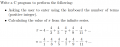
Was working with a college freshman computer science major last night who was struggling with the following assignment:

1772735094324.png

The first thing that tripped them up was what they were supposed to do with the two equations. Were they supposed to use them both? They couldn't spot that the first term in the second was merely the first term in the first, just written to emphasize the pattern of the denominators.

I walked them through incremental development of the terms and at each step they failed to recognize that the values being displayed didn't match what should be expected. It took a bit for me to realize it, but it was because they couldn't figure out what they expected the values to be, so had nothing to compare to what was being displayed, so they simply didn't consider whether the values displayed made any sense at all, even when every other term was being displayed as 0.000000. When I focused their attention on the third term, being displayed as zero, and asked what it should be, they didn't know. So I was more direct and asked them what 4/5 was as a decimal and they couldn't figure it out without a calculator. Had no clue. Was guessing numbers bigger than one, less than one -- it was effectively random (which was consistent with their general approach to program development). The same with 4/3. They did know that 1/3 was basically 0.333, but could not see how to use that to figure out what 4/3 was.

Once I realized this, their inability to see that the two equations in the problem statement were the same made more sense. I'm confident that they has no problem with the notion that 4 and 4/1 are the same. But their innumeracy was so great that an equation like that probably appeared to his brain as indecipherable hieroglyphics, so actually spotting the difference between the two and analyzing that difference was more effort than they were willing to put forth.

Their general approach to problem solving is extremely chaotic. They answer questions like a politician, using vague generalities as if hoping that it will mask the fact that they haven't got a clue. For instance, when asked how to calculate the diameter of a circle if you are given the radius, they'll say something like, "I'd use an expression," instead of "multiply the radius by two". They also use meaningless pronouns, like "it", when there is insufficient context to have any idea what "it" refers to, and when asked what it does refer to, you get another vague answer.

What I don't know is to what degree the innumeracy and the poor problem solving are related. Cause and effect? Which way? Just different symptoms of the a common underlying issue? Whatever might be the case, I think that the two feed off of each other.
 
Top