What's happened to math education?

Futurist

Joined Apr 8, 2025
801
Was working with a college freshman computer science major last night who was struggling with the following assignment:

View attachment 364254

The first thing that tripped them up was what they were supposed to do with the two equations. Were they supposed to use them both? They couldn't spot that the first term in the second was merely the first term in the first, just written to emphasize the pattern of the denominators.

I walked them through incremental development of the terms and at each step they failed to recognize that the values being displayed didn't match what should be expected. It took a bit for me to realize it, but it was because they couldn't figure out what they expected the values to be, so had nothing to compare to what was being displayed, so they simply didn't consider whether the values displayed made any sense at all, even when every other term was being displayed as 0.000000. When I focused their attention on the third term, being displayed as zero, and asked what it should be, they didn't know. So I was more direct and asked them what 4/5 was as a decimal and they couldn't figure it out without a calculator. Had no clue. Was guessing numbers bigger than one, less than one -- it was effectively random (which was consistent with their general approach to program development). The same with 4/3. They did know that 1/3 was basically 0.333, but could not see how to use that to figure out what 4/3 was.

Once I realized this, their inability to see that the two equations in the problem statement were the same made more sense. I'm confident that they has no problem with the notion that 4 and 4/1 are the same. But their innumeracy was so great that an equation like that probably appeared to his brain as indecipherable hieroglyphics, so actually spotting the difference between the two and analyzing that difference was more effort than they were willing to put forth.

Their general approach to problem solving is extremely chaotic. They answer questions like a politician, using vague generalities as if hoping that it will mask the fact that they haven't got a clue. For instance, when asked how to calculate the diameter of a circle if you are given the radius, they'll say something like, "I'd use an expression," instead of "multiply the radius by two". They also use meaningless pronouns, like "it", when there is insufficient context to have any idea what "it" refers to, and when asked what it does refer to, you get another vague answer.

What I don't know is to what degree the innumeracy and the poor problem solving are related. Cause and effect? Which way? Just different symptoms of the a common underlying issue? Whatever might be the case, I think that the two feed off of each other.
I have to say, that does sound like a disheartening experience. But I did notice that there's no clear connection between bullet point 1 and 2.

As written they are distinct and unrelated questions, I hope that doesn't sound like pedantry.

But as to the rest, its shocking, as if there's no desire to actually reason, but simply parrot some "way" of getting from A to B.

Was this an individual or group you were teaching?

Finally, I just noticed, but shouldn't your signature read:

There are 11 types of people in the world: those who understand binary, those who don't, and those who can work in any number base.
 
Last edited:

Thread Starter

WBahn

Joined Mar 31, 2012
32,936
I have to say, that does sound like a disheartening experience. But I did notice that there's no clear connection between bullet point 1 and 2.

As written they are distinct and unrelated questions, I hope that doesn't sound like pedantry.
I agree that the problem could have been worded better, but I also know that the professor for the course doesn't speak English as their native language. I've never conversed with them, so I don't know how fluent their English is.

The intent of problem is pretty obvious, none-the-less. Furthermore, the problem statement included example output that makes it even more apparent:

1772754543395.png

Notice that one thing that the "official" problem statement didn't indicate was that the program is to validate the input and repeatedly ask for input until a valid input is received. This behavior has to be inferred from the example output and it would be an open question of what would happen if a school-house lawyer didn't do that and then objected to having points deducted since it wasn't explicit in the problem specification. The issue comes down to whether or not the example output (which was given as part of the problem statement) is reasonably considered part of the specification.

But as to the rest, its shocking, as if there's no desire to actually reason, but simply parrot some "way" of getting from A to B.
In many cases I've seen, it's exactly that. There is NO desire to actually learn or accomplish anything beyond doing the minimum necessary to check a box on their graduation requirements checklist so that they can get a piece of paper that they believe will automatically result in some company throwing lots of money at them. In some cases, they are actually pretty open about that. But in most cases its seems more indicative of simply being indifferent to whether they learn or not. A large fraction of students, particularly in computer science for a variety of reasons, didn't choose their major because of a passion about the field.

Was this an individual or group you were teaching?
An individual.
 

panic mode

Joined Oct 10, 2011
5,037
I have to say, that does sound like a disheartening experience.
...
But as to the rest, its shocking, as if there's no desire to actually reason, but simply parrot some "way" of getting from A to B.
participation trophy culture... not surprised.

i recall student team working on their graduation project. that is not an individual but a group of 4 students ready to get their diplomas. for 4 years they solved various problems including countless circuits.
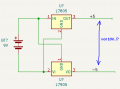
the major problem they got stuck on was that their circuit did not work at all. they used pair of linear regulators (LM7805/7905) that were both powered from a single 9V battery.
and apparently regulators did work - individually both produced expected output relative to their gnd pin... but... measuring across both outputs did not add up to 10V... not even close.
i tried to explain but it was not well received. then i asked them where is the reference point, they said they did not need one - circuit is battery powered, there is no ground.
then i suggested them to use separate batteries for each regulator but they refused and kept arguing amongst themselves, measuring voltages and repeating the same over and over. would not even TRY suggestions...

this is what they conceived and could not figure out:
1772760098777.png
 

Thread Starter

WBahn

Joined Mar 31, 2012
32,936
participation trophy culture... not surprised.

i recall student team working on their graduation project. that is not an individual but a group of 4 students ready to get their diplomas. for 4 years they solved various problems including countless circuits.
the major problem they got stuck on was that their circuit did not work at all. they used pair of linear regulators (LM7805/7905) that were both powered from a single 9V battery.
and apparently regulators did work - individually both produced expected output relative to their gnd pin... but... measuring across both outputs did not add up to 10V... not even close.
i tried to explain but it was not well received. then i asked them where is the reference point, they said they did not need one - circuit is battery powered, there is no ground.
then i suggested them to use separate batteries for each regulator but they refused and kept arguing amongst themselves, measuring voltages and repeating the same over and over. would not even TRY suggestions...

this is what they conceived and could not figure out:
View attachment 364272
I've seen similar things many times -- and it's not something that's new, either.

In 1992 I was asked to help a team of four students that where trying to get their year-long senior design project working. They basically had nothing at all. When all was said and done, they were simply trying to slave the motor driving conveyer belt to the speed of another conveyer belt such that the slaved belt was always a set speed faster than the first. Their demo was supposed to be a small working model, but when push came to shove and time was running out, it was agreed that they could just demonstrate having two motors such that one's speed was determined by a potentiometer and have the second one always run at a fixed speed faster than the first, even as the first was loaded down. I had designed and built some desktop motor generator sets for the controls lab in which a small DC motor with an integral tachogenerator was connected to another DC motor that acted like a generator and I had power resistors that could be switched in and out to act as loads. I told them that they could use two of those stations for their demo. The needed circuitry to slave one to the other and provide a controllable offset speed was trivial -- and the four of them couldn't come close to figuring out anything that came close to working. They ended up with nothing to demo and a design write-up that was pathetic, yet they all graduated.

A couple years later I was asked to help out another group of four that were supposed to be making the electronic controls for a blow-down combustion bomb. The idea was that when the pressure in the chamber reached a certain value, their circuit would open the exhaust valve after a preset time delay. After a year (well, about eight months), they couldn't get it to work. I took one look at their design and saw that they were using am LM319 comparator without a pullup on the output. So I took one of them down to the electronics lab and pulled out the databook and showed her where it showed that the output was open-collector and how to deal with that. I mentioned that she was going to need to be able to reference device data sheets if she was going to be a design engineer. She just looked at me and said, quite unapologetically, "You don't really think that I'm ever going to be a design engineer, do you?" What can I say? She had a point -- and some credit to her for at least being aware of it.

And it's not as clear cut as it might seem like it has to be.


There are several reasons why someone that should know some topic to a certain level of competence doesn't. But I do think the fraction of students graduating with degrees that they are not actually qualified for has increased significantly. Worse, in my opinion, is that the educational value that the competent and even best students get is diminished because courses are constantly being dumbed down and expectations lowered to make them "more accessible" to anyone and everyone that is willing to pay for that degree.
 

Futurist

Joined Apr 8, 2025
801
Frankly, all these stories make me wonder if genuinely hard working students have it made, when 80% of their classmates are so lackluster, it can only make them shine more. Who'd be happy if the 80% were just as good or better than oneself.
 

panic mode

Joined Oct 10, 2011
5,037
this is another example (sorry, not math...)

the question was what would be current between two switches if SW1 is moved to top position (1-3), to bottom position (4-3) and what would happen if BT2 was 12V?
1772806832841.png
the answers were overwhelmingly:
in first case (SW1 in top or 1-3 position): no current
in second case (SW1 in bottom position or 4-3): short circuit
and if BT was 12V, both cases would be short circuit...

sigh...
 

Thread Starter

WBahn

Joined Mar 31, 2012
32,936
Frankly, all these stories make me wonder if genuinely hard working students have it made, when 80% of their classmates are so lackluster, it can only make them shine more. Who'd be happy if the 80% were just as good or better than oneself.
On the one hand, it definitely does make it easier for a good student to appear to shine brighter. Certainly, for some, that is good enough and it makes them feel great about themselves, but it's also its own form of participation trophy, and, like all participation trophies, it gives them a false sense of accomplishment. In my experience, the true students (which I define broadly as people that are there to really learn) want to be pushed and want to be surrounded by people that are at least as good as they are. Those students are much like athletes in that regard -- they might be at the top of their division, but they would still prefer to move up and compete at a higher level, even if it means being near the bottom or in the middle of the pack.
 

davehoug

Joined Jul 5, 2025
15
Sadly, I wasn't. By the time I started school the "new math" movement was well on its way. It was also tied up with the move to "open concept" schools, which were a dismal failure. Fortunately, I came up through the single K-12 path in my county that was closed-concept all the way -- and it wasn't by accident. My father moved the family when I was partway through kindergarten precisely to get away from the open-concept disaster and almost moved us again when a new elementary school opened up a few blocks from my house where I was supposed to transfer to, but which was open concept. My dad had to fight the school board to get an exemption for me to stay where I was.

One criticism that is always laid at the foot of teach long division (and other things) is that it is an example of rote memorization. I could never understand that claim, because the way I was taught it was based on understanding how and why it worked and not just memorizing a bunch of steps that you blindly followed. It wasn't until much later that I discovered how often it is taught by rote with no effort to understand the fundamentals, and even later that I discovered that part of the reason for this is that a large fraction of the people teaching it don't understand the fundamentals of what it is or why it works they way it does. Of course, this charge is not unique to "old math" and I've seen it across the board -- namely topics that are easily understood based on underlying fundamentals are presented as disjointed things that have to just be memorized and regurgitated.

Even if you go and look at the many videos out there for taking the square root of a number by hand, most just present an algorithm that you have to memorize and apply, without once talking about where the algorithm comes from or why it works. If that's how it was presented back when it was a standard part of the curriculum, then the charges laid against it have merit. But the solution isn't to throw out the baby with the bathwater, the solution is to adjust the curriculum so that the focus is on the fundamentals, which means that the assessments need to be designed to test comprehension of the fundamentals and less the ability to crank through a memorized algorithm -- and designing and administering these kinds of assessments is a LOT more work than just giving a bunch of problems with multiple-choice answers that get bubbled in. It also means that the people teaching the topics need to have a firm grasp of the fundamentals, and this is where the real roadblocks come into play.

I think that people on both sides of the "new math" debate are largely wrong, and this is because both sides tend to gravitate toward highly polarized and extreme camps in which the other side has absolutely no redeeming qualities.
YESSSSS, once you understand the definition of a volt, amp, ohm then the basic math facts can re-create Volts = Amps X ohms to find the missing item. Also and WHY the series & parallel formulas for resistors & capacitors are structured that way.

Think parallel resistors are parallel conductances of mhos and parallel capacitors are just wider plates of one capacitor.

Learning just exactly why the Sin of angle X varies (many good You-Tubes) as it does, because of just exactly what it is measuring is always going to stick longer thru life than looking up a formula.
 

Thread Starter

WBahn

Joined Mar 31, 2012
32,936
YESSSSS, once you understand the definition of a volt, amp, ohm then the basic math facts can re-create Volts = Amps X ohms to find the missing item. Also and WHY the series & parallel formulas for resistors & capacitors are structured that way.

Think parallel resistors are parallel conductances of mhos and parallel capacitors are just wider plates of one capacitor.

Learning just exactly why the Sin of angle X varies (many good You-Tubes) as it does, because of just exactly what it is measuring is always going to stick longer thru life than looking up a formula.
I don't know that knowing the definition of volt, amp and ohm, in and of itself, is enough to understand why the series and parallel formulas for resistors, capacitors, (and inductors) are what they are. For that, you need to understand the constitutive equation for each device coupled with the constraints placed and the voltages and currents in series and parallel components. But, with though fundamentals in hand, deriving the equations is a simple matter. Also, sanity checking them, using reasoning like you mention, can catch a lot of stupid mistakes that even competent people are going to make on an all-too-frequent basis.

Tracking units will also catch many of these mistakes, too. I can't begin to count the number of times that someone messed up an equation of the form (A·B)/(A+B) by having the numerator and denominator flipped. That completely screws up the units, allowing the mistake to be caught immediately (even if the work is still purely symbolic at that point). But too few people bother to even consider whether the units are working out at the symbolic level, and then when they get to actually plugging in values, they throw the units away and crank the numbers, guaranteed to end up with a wrong result, and just tack on the units that they want the answer to have. And, of course, if they've done such a poor job of exercising due diligence up to this point, they seldom then bother to ask if they final answer makes any sense whatsoever, even if their answer is orders of magnitude off or if they get a negative value for something that is inherently non-negative.
 

Thread Starter

WBahn

Joined Mar 31, 2012
32,936
Finally, I just noticed, but shouldn't your signature read:

There are 11 types of people in the world: those who understand binary, those who don't, and those who can work in any number base.
Just realized that I never responded to this.

My usual comeback when someone points this out, is that it indicates that you are in the first group, but not the third (which is a strict superset of the first).
 

davehoug

Joined Jul 5, 2025
15
I don't know that knowing the definition of volt, amp and ohm, in and of itself, is enough to understand why the series and parallel formulas for resistors, capacitors, (and inductors) are what they are. For that, you need to understand the constitutive equation for each device coupled with the constraints placed and the voltages and currents in series and parallel components. But, with though fundamentals in hand, deriving the equations is a simple matter. Also, sanity checking them, using reasoning like you mention, can catch a lot of stupid mistakes that even competent people are going to make on an all-too-frequent basis.

Tracking units will also catch many of these mistakes, too. I can't begin to count the number of times that someone messed up an equation of the form (A·B)/(A+B) by having the numerator and denominator flipped. That completely screws up the units, allowing the mistake to be caught immediately (even if the work is still purely symbolic at that point). But too few people bother to even consider whether the units are working out at the symbolic level, and then when they get to actually plugging in values, they throw the units away and crank the numbers, guaranteed to end up with a wrong result, and just tack on the units that they want the answer to have. And, of course, if they've done such a poor job of exercising due diligence up to this point, they seldom then bother to ask if they final answer makes any sense whatsoever, even if their answer is orders of magnitude off or if they get a negative value for something that is inherently non-negative.
 

davehoug

Joined Jul 5, 2025
15
Exactly. With basic math down pat, an estimate of the SIZE of the answer should be evident to realize if a digit got dropped resulting in way too high or low a calculator result.

Walking thru units canceling gives an understanding of power per time, rate per second per second and such.

"The man who knows how will always have a job. The man who knows why will be his boss."
 

davehoug

Joined Jul 5, 2025
15
How many understand a slide rule is just adding or subtracting logarithms? We got to the moon on 3 digit slide rule calculations. I recall free paper calculators that slide miles driven and gallons consumed to show your Miles Per Gallon. A fine way to understand division, ratios, estimating and such.
 

Thread Starter

WBahn

Joined Mar 31, 2012
32,936
How many understand a slide rule is just adding or subtracting logarithms? We got to the moon on 3 digit slide rule calculations. I recall free paper calculators that slide miles driven and gallons consumed to show your Miles Per Gallon. A fine way to understand division, ratios, estimating and such.
The more fundamental question these days is how many people have ever heard of a slide rule, let alone what it is used for, and even less so how it is used or why it works. Then the real clincher. How many people could set about and construct a slide rule, even a crude one capable of doing just one- or two-digit calculations starting with nothing more than basic drafting tools such as a divider, straight edge, and compass?
 

joeyd999

Joined Jun 6, 2011
6,337
How many people could set about and construct a slide rule, even a crude one capable of doing just one- or two-digit calculations starting with nothing more than basic drafting tools such as a divider, straight edge, and compass?
Don't ask me. I'm the one who's been trying to trisect an angle since 7th grade, using the same.
 

Futurist

Joined Apr 8, 2025
801
How many understand a slide rule is just adding or subtracting logarithms? We got to the moon on 3 digit slide rule calculations. I recall free paper calculators that slide miles driven and gallons consumed to show your Miles Per Gallon. A fine way to understand division, ratios, estimating and such.
With all the talk about people "not understanding" we should recall that a slide rule or log book are just early forms of modern calculators. I bet there was a time when some apprentice pulling out a slide rule at work would have elicited condemnation and cries of "cheat! - learn how to multiply son." from the older guys in the factory.
 
Last edited:

Thread Starter

WBahn

Joined Mar 31, 2012
32,936
With all the talk about people "not understanding" we should recall that a slide rule or log book are just early forms of modern calculators. I bet there was a time when some apprentice pulling out a slide rule at work would have elicited condemnation and cries of "cheat! - learn how to multiply son." from the older guys in the factory.
Very possible. The same might have been said about people using Napier's log tables,

And the criticism is not entirely without merit.
 

Futurist

Joined Apr 8, 2025
801
Very possible. The same might have been said about people using Napier's log tables,

And the criticism is not entirely without merit.
Once I begin to actually study mathematics, after the epiphany I experienced at age 15, I rather quickly began to see that proficiency in algebra and calculus and more, had absolutely nothing to do with arithmetic. My hatred of arithmetic (which was then, not now) had alienated me from anything and everything to do with mathematics.

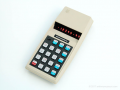
This was a huge revelation for me. I bought this calculator in like 1977:

1779974762251.png

I'd already started to become confident with arithmetic and with the calculator my arithmetic improved because I could verify it using the calculator.

Who wants to divide 34672 by 27.8 by hand anyway? I'd go so far as to say kids should be taught algebra much earlier, in parallel with arithmetic rather than as something that requires arithmetic first.

Also 34672 ÷ 27.8 can be approximated quickly by dividing by 25, which is dividing by 100 then multiplying by 4. One can even adjust that result by using the 2.8 we subtracted and so on. I used to do that a lot to get ballpark answers, if one needs precision use a calculator.
 
Last edited:

LvW

Joined Jun 13, 2013
2,031
With all the talk about people "not understanding" we should recall that a slide rule or log book are just early forms of modern calculators. I bet there was a time when some apprentice pulling out a slide rule at work would have elicited condemnation and cries of "cheat! - learn how to multiply son." from the older guys in the factory.
But the slide rule had one major advantage:
The user had to determine the order of magnitude of the result on their own.
And besides, they learned that by applying logarithms, multiplication can be reduced to simple addition.
 
Top