What does it mean to "know"?

cmartinez

Joined Jan 17, 2007
8,768
I know you said you don't want to get into flies and lizards but this all started with a plant seed and that's still where I am. I think this might tie into another of my fascinations, long unresolved, about how society seems to arbitrarily assign value to the lives of other creatures (human > dog > rabbit> fish > mosquito). I will try not to drag you into the weeds.

Do you credit this field of consciousness with informing the seed that it should grow, and in which direction?
A more fundamental question is, do I credit this field of consciousness with the creation of life itself? ... and yes, my answer is affirmative. I think that said "field" is driven by purpose. I find that easier to believe than to accept that life, and all of its implications, is nothing more than a chemical reaction indistinguishable in principle from the formation of molecules of water or CO2 out of individual atoms.

It's funny how people in general (and atheists in particular) accept that DNA "wants" to reproduce and evolve to higher levels of complexity, and yet they don't stop to think that in order for something to "want" something it needs to have a sense of will.
 

BobTPH

Joined Jun 5, 2013
11,521
A seed knowing which way to grow is a completely different meaning from a conscious entity knowing a fact.

I have heard it stated that a thermostat (the old mercury switch kind) is the simplest conscious entity because it "knows" when to turn the heat on. I.e. is aware of the environment and able to manipulate it. I think this is simply an abuse of language.
 

MaxHeadRoom

Joined Jul 18, 2013
30,665
On a similar note:
For me all Life itself, animal or vegetable, was never intended, it originally occured due to pure accident, which turned into an ambitious huge ,(still going on) experiment , purely by chance ,
Many developed a control mechanism in the form of a brain where some life forms had the ability to reason
"Cogito, ergo sum" (Descartes).
On an allied subject, I recently watched a program that assessed different animals on their ability to reason., as opposed to those that acted mostly on what we call Instinct
For the dog lovers, the canine species was at the bottom, as far as reason was concerned, surprisingly and among those that show showed some amazing feats of logic, were some species of birds. So much for "'Bird Brain'

It has been about 12yrs since the Fenton Youtube clip at Regents Park London.
But I can't resist watching occasionally, and I think shows exactly why dogs are instinctive rather than use reason.


Thread Starter

strantor

Joined Oct 3, 2010
6,875
A more fundamental question is, do I credit this field of consciousness with the creation of life itself? ... and yes, my answer is affirmative. I think that said "field" is driven by purpose. I find that easier to believe than to accept that life, and all of its implications, is nothing more than a chemical reaction indistinguishable in principle from the formation of molecules of water or CO2 out of individual atoms.

It's funny how people in general (and atheists in particular) accept that DNA "wants" to reproduce and evolve to higher levels of complexity, and yet they don't stop to think that in order for something to "want" something it needs to have a sense of will.
I do not call myself an Atheist. I capitalized that on purpose because I consider it a proper noun. The way I see it, Atheism is a religion just like any other, and its adherents practice anti-every-other-religion with religious fervor, just like zealots of other religions. I do not align myself with that. I was raised in a religious home and I took away from it all the positives and left behind the mysticism. I lack the capacity to believe, but I do not seek to tear down those who don't.

I do see a pattern in the world, in the universe. Intentional design, I see it. Accepting that this is all the result of random chance, requires more belief than accepting that the God of the Israelites made it. I think there is an answer to the question of life, but I don't think that any religion, including Atheism, currently has that answer.

If DNA "wants" to reproduce (and it seems that it does) then, to me, that implies an imperative that is central to its design. A seed grows upward because that's how it was designed. Who is the designer? I don't claim to know. Is there only one? It seems implausible that ticks and mosquitoes share a creator with horses and elephants. Your consciousness field theory is just as plausible as anything else, the only difference is "everything else" includes a lot of things I've had years to consider and your theory is brand new to me.

Anyway, that is not the can of worms that I've tried to open this time around. Assuming a seed is designed (by God or a consciousness field, if those are two different things) to grow upwards, the can of worms is this: what is the specific mechanism by which it happens? Does the seed itself "know" (or "want") to grow in opposition to gravity? Or is it drawn upwards by some kind of cosmic capillary action? What's the deal? Does DNA "want" to reproduce or is its reproduction simply something that happens as part of a system set in motion by a higher power (God, anti-god, consciousness field, etc.). I definitely want a hamburger right now. I'm pretty sure my dog wants one too. But do my white blood cells want to find a tasty cootie to eat? What confirms internal cognition? Is it as simple as having a brain? If so, what explains the seemingly deliberate actions of organisms that don't have a brain?

I asked my 10 y/o daughter last night just to see what she would say. Sometimes kids' perspectives are surprising, but even when they're not, they're usually entertaining. Plus she's smarter than I am. She said, seeds must have some kind of basic thinking ability even if they don't have a brain, because they adapt to their environments. Simple, hard to argue with. I am starting to think she is right. They must have some kind of rudimentary control system. Some respond to touch, and their response mechanisms can be pretty complex. A Venus fly trap has sensors that let it know when to close. If there is any disagreement, please discuss.
 

cmartinez

Joined Jan 17, 2007
8,768
I do not call myself an Atheist. I capitalized that on purpose because I consider it a proper noun. The way I see it, Atheism is a religion just like any other, and its adherents practice anti-every-other-religion with religious fervor, just like zealots of other religions. I do not align myself with that. I was raised in a religious home and I took away from it all the positives and left behind the mysticism. I lack the capacity to believe, but I do not seek to tear down those who don't.

I do see a pattern in the world, in the universe. Intentional design, I see it. Accepting that this is all the result of random chance, requires more belief than accepting that the God of the Israelites made it. I think there is an answer to the question of life, but I don't think that any religion, including Atheism, currently has that answer.

If DNA "wants" to reproduce (and it seems that it does) then, to me, that implies an imperative that is central to its design. A seed grows upward because that's how it was designed. Who is the designer? I don't claim to know. Is there only one? It seems implausible that ticks and mosquitoes share a creator with horses and elephants. Your consciousness field theory is just as plausible as anything else, the only difference is "everything else" includes a lot of things I've had years to consider and your theory is brand new to me.

Anyway, that is not the can of worms that I've tried to open this time around. Assuming a seed is designed (by God or a consciousness field, if those are two different things) to grow upwards, the can of worms is this: what is the specific mechanism by which it happens? Does the seed itself "know" (or "want") to grow in opposition to gravity? Or is it drawn upwards by some kind of cosmic capillary action? What's the deal? Does DNA "want" to reproduce or is its reproduction simply something that happens as part of a system set in motion by a higher power (God, anti-god, consciousness field, etc.). I definitely want a hamburger right now. I'm pretty sure my dog wants one too. But do my white blood cells want to find a tasty cootie to eat? What confirms internal cognition? Is it as simple as having a brain? If so, what explains the seemingly deliberate actions of organisms that don't have a brain?

I asked my 10 y/o daughter last night just to see what she would say. Sometimes kids' perspectives are surprising, but even when they're not, they're usually entertaining. Plus she's smarter than I am. She said, seeds must have some kind of basic thinking ability even if they don't have a brain, because they adapt to their environments. Simple, hard to argue with. I am starting to think she is right. They must have some kind of rudimentary control system. Some respond to touch, and their response mechanisms can be pretty complex. A Venus fly trap has sensors that let it know when to close. If there is any disagreement, please discuss.
IMHO, seeds, like every living thing that we know of, have code in them. The "lines" of code are written with molecules. But it's code, nevertheless. DNA contains every step needed to produce a fully grown organism with the capability to reproduce, survive, improve and pass those improvements (and its errors too, although those tend to die out) on to its descendants. And in our case at least, said code includes the capacity to reason and to experience reality through our consciousness. And, following your line of argumentation. If there's code, then there's gotta be a Coder too.
 

boostbuck

Joined Oct 5, 2017
1,043
Atheism is a religion just like any other, and its adherents practice anti-every-other-religion with religious fervor, just like zealots of other religions.
As an atheist, I would have to disagree. "Atheism, in the broadest sense, is an absence of belief in the existence of deities. "

I lack the capacity to believe, but I do not seek to tear down those who don't.
Except atheists, perhaps?
 

cmartinez

Joined Jan 17, 2007
8,768
Fact is, both Atheism and Religion require a sense of belief without definite proof to be qualified as such. I think that's the point that strantor was trying to make.
 

Thread Starter

strantor

Joined Oct 3, 2010
6,875
Atheism, in the broadest sense, is an absence of belief in the existence of deities.
I agree that is what the definition should be, but in practice I observe it to be the belief in the nonexistence of deities.
I lack the capacity to believe, but I do not seek to tear down those who don't
Except atheists, perhaps?
If you took offense to that then have I attacked your beliefs or your lack of beliefs? If the latter, I'm not sure what I attacked; something that is purportedly nonexistent, so please don't take offense to my attack of nothing.
 

nsaspook

Joined Aug 27, 2009
16,330
I do not call myself an Atheist. I capitalized that on purpose because I consider it a proper noun. The way I see it, Atheism is a religion just like any other, and its adherents practice anti-every-other-religion with religious fervor, just like zealots of other religions. I do not align myself with that. I was raised in a religious home and I took away from it all the positives and left behind the mysticism. I lack the capacity to believe, but I do not seek to tear down those who don't.

I do see a pattern in the world, in the universe. Intentional design, I see it. Accepting that this is all the result of random chance, requires more belief than accepting that the God of the Israelites made it. I think there is an answer to the question of life, but I don't think that any religion, including Atheism, currently has that answer.

If DNA "wants" to reproduce (and it seems that it does) then, to me, that implies an imperative that is central to its design. A seed grows upward because that's how it was designed. Who is the designer? I don't claim to know. Is there only one? It seems implausible that ticks and mosquitoes share a creator with horses and elephants. Your consciousness field theory is just as plausible as anything else, the only difference is "everything else" includes a lot of things I've had years to consider and your theory is brand new to me.

Anyway, that is not the can of worms that I've tried to open this time around. Assuming a seed is designed (by God or a consciousness field, if those are two different things) to grow upwards, the can of worms is this: what is the specific mechanism by which it happens? Does the seed itself "know" (or "want") to grow in opposition to gravity? Or is it drawn upwards by some kind of cosmic capillary action? What's the deal? Does DNA "want" to reproduce or is its reproduction simply something that happens as part of a system set in motion by a higher power (God, anti-god, consciousness field, etc.). I definitely want a hamburger right now. I'm pretty sure my dog wants one too. But do my white blood cells want to find a tasty cootie to eat? What confirms internal cognition? Is it as simple as having a brain? If so, what explains the seemingly deliberate actions of organisms that don't have a brain?

I asked my 10 y/o daughter last night just to see what she would say. Sometimes kids' perspectives are surprising, but even when they're not, they're usually entertaining. Plus she's smarter than I am. She said, seeds must have some kind of basic thinking ability even if they don't have a brain, because they adapt to their environments. Simple, hard to argue with. I am starting to think she is right. They must have some kind of rudimentary control system. Some respond to touch, and their response mechanisms can be pretty complex. A Venus fly trap has sensors that let it know when to close. If there is any disagreement, please discuss.
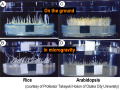
1720834844293.png
https://global.jaxa.jp/article/special/kibo/takahashi_e.html
When plants migrated from the sea approximately 450 million years ago, they became land organisms. To do so, however, they had to overcome various environmental stresses, such as drought, in their terrestrial life. In order to avoid such stresses, sessile terrestrial plants evolved strategies to perceive light, water and gravity, and to respond to them by changing their growth orientation. Among these adaptive strategies, is gravimorphogenesis, in which plant growth is influenced by gravity. Examples of this phenomenon are: gravitropism, where roots grow downward and stems grow upward; circumnutation, where the stem or the root tips display helical or spiral movement (for example, a climbing vine shows remarkable circumnutation); and peg formation, which helps cucurbitaceous seedlings shed their seed coats . The space environment is an ideal place to study these mechanisms of gravity-dependent growth in the development of plants.
[/quote[
https://en.wikipedia.org/wiki/Gravitropism
Plants modified their actions to be lazy in the action of growing in X environment while specializing due to environmental conditions.
 
Last edited:

MaxHeadRoom

Joined Jul 18, 2013
30,665
Dr Neil deGrasse Tyson:- " I hate it when people describe me as an 'Athiest, Which supposedly describes me as something I am not. rather what I am and really believe in."
:cool:
 
At some point we doesn’t control anything. The life is similar to video and probably feelings are true only a bit. Nothing really exists. You can’t see nothing you can’t touch nothing your body is just imagine. Also time doesn’t exist, otherwise how would you explain dejavu.

At lower levels you control all with feelings.
 
Top