What does this notation mean in schematic design?

Thread Starter

Kayto99

Joined Feb 26, 2023
12
Does this notation (highlighted below) in a schematic mean that 3 of these caps will need to be placed in parallel?
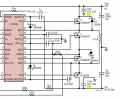
1742691247166.png

Seen in an Analog Devices datasheet where they are detailing a typical application schematic. Sorry if this question has been asked before. I can't seem to find an answer anywhere. Thanks in advance.
 

WBahn

Joined Mar 31, 2012
32,746
Does this notation (highlighted below) in a schematic mean that 3 of these caps will need to be placed in parallel?
Yes. Often, the three capacitors would be spread out around the PCB to provide distributed bulk-energy storage, but that may not be the case based on what it looks like that circuit is for.
 

LowQCab

Joined Nov 6, 2012
5,101
Yes, it means a quantity of 3.

And, at 22uF, that's a little confusing,
because there's already a 330uF Electrolytic in parallel with them,
and because, a 22uF Ceramic-Capacitor is starting to get into the fairly expensive zone.

But maybe their testing showed that it was necessary to use 3
to tame the Output-Noise down to an acceptable level
and, at the particularly chosen Frequency,
and, with the other specified Filter-Components in the mix.
.
.
.
 
Last edited:

MrChips

Joined Oct 2, 2009
34,690
Yes, x3 means three capacitors.
Three 3.3 μF capacitors in parallel is not the same as one single 10 μF capacitor.

Note that Cin and Cout are electrolytic capacitors. The others are ceramic.
 

crutschow

Joined Mar 14, 2008
38,390
Yes ,that appears to show the number of capacitors of those values to be placed in parallel.
Parallel electrolytic capacitors are often used in switching regulators to reduce the capacitor ESR and thus capacitor dissipation loss due to that resistance from the high frequency ripple currents.
Generally the ESR of two or more capacitors in parallel is less than that of one larger capacitor.
 
Last edited:

tonyStewart

Joined May 8, 2012
231
N parallel caps will consume more space than 1 of equivalent value so it is not a space conserving choice. Rather as already told, it is to reduce ESR. Generally in the same model type, package size and voltage rating, different C values will exhibit a constant ESR*C=Tau value. Thus N x parallel C’s of a smaller value consume more space but will have an N times smaller ESR than the net C values in one package.

cheers, Tony
EE since 1975
 

MisterBill2

Joined Jan 23, 2018
27,271
In addition to the other CORRECT responses, it ALSO spreads the heat produced from rapid charge/discharge cycling. I have seen the exploded results of a large photoflash capacitor when a high power flash system somehow started trying to be a fast strobe instead. Incredibly messy.
 

schmitt trigger

Joined Jul 12, 2010
2,052
In addition to all the correct responses please make sure that, if the schematic is to be used to draw a PWB layout, this practice should NOT be done.

CAD packages require individual component designators to create the correct amount of footprints and connected to the correct nodes.
Whoever drew this schematic, only used this practice to avoid clutter.
 

meth

Joined May 21, 2016
302
I have seen parallel capacitors in audio applications. I even talked with a designer of amplifiers, he claimed that the sound was better that way without any actual backup argument ..
 

sparky 1

Joined Nov 3, 2018
1,218
Nice circuit, this is a good example that shows better way to use these X7R. Should measure 3 on strip board for equivalent resistance
Cout has some squarewave and also the resistive sense divider could be affected by an increase in aged capacitor ESR.
3 X7R SMA mounted in a row from via trace to ground plane also they use 2 on Cin there is also other component positioning.
See figure 10 p.24 of the revised datasheet
LTC3780 (Rev G)
 
Last edited:

crutschow

Joined Mar 14, 2008
38,390
I have seen parallel capacitors in audio applications. I even talked with a designer of amplifiers, he claimed that the sound was better that way without any actual backup argument ..
It's often difficult to get a logical explanation from audiophiles with their golden ears of why their magical circuit designs and components make better sound.:rolleyes:
 

MisterBill2

Joined Jan 23, 2018
27,271
I have seen the results of a rather impressive capacitor failure in a2000 watt audio amplifier. The capacitor was simply too small physically to survive the heat from the current flowing thru the "ESR". Evidently the amp was delivering full rated power at the time.
 

sparky 1

Joined Nov 3, 2018
1,218
In choosing the right capacitor it is important to read the data sheet for the capacitor.
Both the temperature coefficient and the voltage coefficient and package size also not exactly what most think and buy crapisium dielectric.
In this buck boost application the controller needs 1% voltage sense resistor (ESR contributing RC) then you have X7R +/-15% sometimes.
Temperature and Voltage Variation of Ceramic Capacitors, or Why Your 4.7µF Capacitor Becomes a 0.33µF Capacitor | Analog Devices

Possibly the 1210 package figure 10 may not be to scale an 805 might crack with thermal shock if the temperature exceeds the ratings,
I solve thermal problems in simulation however this method really checks. I bought an orange digital thermometer $12 shows me where
the heat is what the dissipation is in the surrounding copper and where more heat sink is needed. It is not strange and esoteric geometry
that causes distortion. Simply keep your components cool and in spec even if geometry might be involved at a molecular level.
Since current is the nature of supplied power must maintain an acceptable temperature range as per data sheet of a DC converter design
You cannot wish away all these later multitudinous converters having ESR and temperature issues and relentlessly finding and replacing worthless
and corrupting capacitors profoundly lacking the technical specifications necessary.


1742924663432.png
 
Last edited:

LowQCab

Joined Nov 6, 2012
5,101
You forgot the massive-Sound-Stage, and projection, and warmth, without any harshness, it goes on and on.
It embarrasses me to say that I actually know how to build Low-Distortion-Speakers.
A Distortion that You happen to like on a particular style of music is still Distortion.
.
.
.
.
.
.
 

MisterBill2

Joined Jan 23, 2018
27,271
Certainly L Q C makes a very important point in post #18. Even a "perfect, zero distortion" HiFi system ceases to be "perfect" when the tone control deviates from perfectly flat frequency response.
 

LowQCab

Joined Nov 6, 2012
5,101
What normally passes for "Speakers", ( Direct-Radiators ), are very poor, and inefficient, "Transducers".

The required Electrical-to-Air "Impedance" transformation is a massive hurdle to overcome.

This equates to roughly ~8% to ~25% overall Distortion, ( in many different forms ), in most Speakers,
this completely swamps any difference Capacitor-Types or placements may have.

Horn-Loaded-Speakers can do a "passable" job of it,
and "can" have extremely low distortion levels when done correctly,
( in the range of ~2% to ~5% distortion )
but many Horn designs are heavily compromised.

As long as there are "Swamp-root-Snake-Oil" salesmen,
there will be suckers who pay them huge Money for what is basically BS.
.
.
.
 
Top