Want to make an Electromyography amplifier circuit

Thread Starter

Abhishek Dhiman

Joined Oct 20, 2017
40
Hi

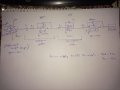
I am trying to make an Electromyography amplifier circuit using the differential amplifier ic AD620 and the operational amplifiers TL072. I want to take my biceps voltage for this project. I am using a 5V DC supply from Arduino to power my amplifiers.

I have uploaded the circuit diagram for my project, please check it and suggest me any changes that I need to consider. Please suggest me some way to test it. I am trying to measure my biceps voltage but there is no response in the multimeter.

I have sent the amplified output to the A0 Pin of ArduinoIMG_0810.JPG
 

DickCappels

Joined Aug 21, 2008
10,661
Looks pretty reasonable. I take it that the feedback resistor on your output amplifier is 220k (or could it be 220 ohms?), The former is ok, the latter might be too low depending upon your signal amplitude.

Remember to add plenty of power supply bypass capacitors, such as 100 uf electrolytic in parallel with a low value (.01 uf) ceramic. This may be doubly important since you are going to use a power supply from a digital circuit. Additional power supply filtering might be needed, but you will soon know about that :)
 

Thread Starter

Abhishek Dhiman

Joined Oct 20, 2017
40
Looks pretty reasonable. I take it that the feedback resistor on your output amplifier is 220k (or could it be 220 ohms?), The former is ok, the latter might be too low depending upon your signal amplitude.

Remember to add plenty of power supply bypass capacitors, such as 100 uf electrolytic in parallel with a low value (.01 uf) ceramic. This may be doubly important since you are going to use a power supply from a digital circuit. Additional power supply filtering might be needed, but you will soon know about that :)
Thank you, sir, for your response, it is definitely helpful to me. I want to ask you what does additional power supply filter means? I am new to this term. If you can shed some light on it, it will be really helpfull to me. Or i can use 9V Dc batteries for Vcc supply.
 

AlbertHall

Joined Jun 4, 2014
12,636
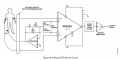
You do not not have anything to set the DC level of the AD620 inputs to keep them within the common mode range. Below is a circuit from the datasheet which uses another op-amp to keep that voltage correct.
upload_2017-10-21_11-17-13.png
 

Alec_t

Joined Sep 17, 2013
15,126
The AD620 expects a dual-polarity supply, so if you have only a +5V supply the inputs will need a virtual-earth bias arrangement. The minimum supply is rated ±2.3V, so using just +5V gives very little headroom.
 

Thread Starter

Abhishek Dhiman

Joined Oct 20, 2017
40
The AD620 expects a dual-polarity supply, so if you have only a +5V supply the inputs will need a virtual-earth bias arrangement. The minimum supply is rated ±2.3V, so using just +5V gives very little headroom.
Ok, Thank you. I will use a dual supply of 9V here.
 

DickCappels

Joined Aug 21, 2008
10,661
(some text removed for claritiy) I want to ask you what does additional power supply filter means? I am new to this term. If you can shed some light on it, it will be really helpfull to me. Or i can use 9V Dc batteries for Vcc supply.
Power supply filtering would probably be in the form of an LC low pass filter so that noise it filtered out of the power supply lines. That was an idea for when running from an Arduino's power supply. If you are going to run from a pair of 9V batteries the then filter would probably not be needed.

Still, it is good practice to put 10 uf or 100 uf electrolytic capacitors to ground from each power supply and a 0.01 uf ceramic capacitor from each power line to ground.
 

Thread Starter

Abhishek Dhiman

Joined Oct 20, 2017
40
Power supply filtering would probably be in the form of an LC low pass filter so that noise it filtered out of the power supply lines. That was an idea for when running from an Arduino's power supply. If you are going to run from a pair of 9V batteries the then filter would probably not be needed.

Still, it is good practice to put 10 uf or 100 uf electrolytic capacitors to ground from each power supply and a 0.01 uf ceramic capacitor from each power line to ground.
If I replace the 5v with a dual 9V than my circuit is complete and correct?
 

Thread Starter

Abhishek Dhiman

Joined Oct 20, 2017
40
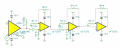
main circuit diagram.png Hello, I have redesigned my EMG circuit using instrumentation amplifier, a differential amplifier, and filters.
Components used:

INA106 Differential amplifier
TL072 differential amplifier
First order high and low pass filter.
low frequency cut off 16Hz and high-frequency cutoff 365Hz for EMG signal.

Please check it and suggest any changes that i need to consider
 

DickCappels

Joined Aug 21, 2008
10,661
I have four concerns, all except #3 below need not be addressed unless you observe an undesirable effect when testing.

1. You are looking at the myoelectric signal as a single-ended signal with one side grounded which is not the way I see ECG signals being sensed. ECG signals are sensed differentially to minimise pickup from external sources. If you have very large biceps maybe the signal-to-noise ratio will be acceptable. I suspect that in my case the signal would be lost in the noise :). How large of a signal do you expect to see?

2. The circuit only has a gain of 40X.Will this be enough for your application? Assuming a 3.3V Arduino ADC and working backwards, Full scale at the input would be 3.3V/40 = 82 mv peak-to-peak. Assuming you want to have the nominal peak at 50% of the input range, that means the signal amplitude would have to be 41 mv.

3. Your AC coupled signal is referenced to ground in the first TL072 stage. That means that your signal will be above and below ground. From that two concerns emerge:

Your Arudino's input pin can only withstand a few hundred millivolts below ground without exceeding the spec. sheet limits, so a resistors in series with the signal to limit current is a good idea.

When the signal into the A-to-D converter is at 0 volts the A-to-D's output will read zero. Any signal below that will be clipped at ground.

The simplest solution for both of the concerns immediately above is to bias the circuit to 1.65 volts above ground. You might want to re-evaluate whehther the use of two 9V batteries is still optimum.​

4. Be aware that connecting this circuit's ground and output to your Arduino may result in noise from the Arduino, or its power supply getting back to the input, particularly if you do not use shielded input leads. You may need to use signal isolation on the output, such as an optical isolator.

Note: Since you don't need much bandwidth, you might want to save some power and possibly increase your available dynamic range by increasing the feedback resistors by a factor of 10 or 20 and have the same resistance in series with the non-inverting inputs and their voltage reference (ground and output of the first TL072 stage) then adjust the high/low pass capacitors accordingly.
 

Thread Starter

Abhishek Dhiman

Joined Oct 20, 2017
40
Thank you, sir,
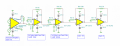
I have made some changes to my circuit.
I have given two inputs one of 50uV and 60uV both of frequencies 100Hz (EMG signal from the muscles).
At the output, I am getting 3.75V output. Which I could easily send to Arduino inputs for evaluation.
I have used two 1st order filters.
Now Please check it and suggest me necessary changes.
PLease suggest me some input EMG values with frequency. So that I can test my circuit in the simulator.
main circuit 2 supply 1.png
 

DickCappels

Joined Aug 21, 2008
10,661
Because the signal is AC coupled and referenced to ground at the input of the first TL072 the half of the signal below ground will clip at the A-to-D converter input and could damage the input circuit on your Arduino.

I will leave it to somebody with some experience in the field or to the internet to answer your question about test signals.
 

AlbertHall

Joined Jun 4, 2014
12,636
Lots of information here including: "Measured EMG potentials range between less than 50 μV and up to 20 to 30 mV, depending on the muscle under observation."
 

Alec_t

Joined Sep 17, 2013
15,126
Your amp's frequency response peaks around 75Hz. That is going to be a problem because of 50/60Hz mains interference. Methinks you will need much more sophisticated filtering to prevent your wanted signal being totally swamped by noise.
 

Thread Starter

Abhishek Dhiman

Joined Oct 20, 2017
40
Your amp's frequency response peaks around 75Hz. That is going to be a problem because of 50/60Hz mains interference. Methinks you will need much more sophisticated filtering to prevent your wanted signal being totally swamped by noise.
Is INA106 is a good instrumentation amplifier here?
 

Thread Starter

Abhishek Dhiman

Joined Oct 20, 2017
40
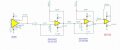
I have used two-second order filter one HIgh Pass and the other one is Low Pass. Please have a look at this circuit and suggest me some changes.
I Will replace INA106 with AD620 keeping filters and the noninverting amplifier as it is.
main circuit 2nd order.jpg
 
Top