Class AB Amplifier

crutschow

Joined Mar 14, 2008
38,563
That is a simple design that will not give anywhere near the theoretical 7W output with reasonable distortion.

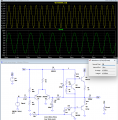
Below is the sim of a slightly more complex Marleys circuit, which uses a differential input stage with negative AC and DC feedback from the output to stabilize the output bias point at 1/2 the supply voltage, and reduce the distortion.
D1 and C6 bootstrap the output bias voltage to increase the positive output voltage before clipping occurs.
It's 4W maximum output with about 0.2% harmonic distortion, is likely about as good as you can do with a reasonably simple circuit and a single 20V supply.
To see the distortion value, look at the Spice Error Log after doing the simulation.

1782923993198.png
 

Attachments

Last edited:

MrChips

Joined Oct 2, 2009
34,920
Power output depends on the supply voltage and loudspeaker impedance. Do the math.
20 VDC supply will give about 6 VRMS output.

P = V x V / R = 6V x 6V / 8Ω = 4.5 W

4 W output is very loud for comfortable listening to music in an averaged sized room.
 
Power output depends on the supply voltage and loudspeaker impedance. Do the math.
20 VDC supply will give about 6 VRMS output.

P = V x V / R = 6V x 6V / 8Ω = 4.5 W

4 W output is very loud for comfortable listening to music in an averaged sized room.
The REALLY BAD NEWS is that there are a whole lot of folks who choose MUCH GREATER room sound levels. (96 Decibels on a B&K sound level meter.) Certainly, 80dB is quite uncomfortably loud by my evaluation. JUST AS CERTAINLY , though, I have no intention of forcing my choices on others. I have repaired a 700 watt audio amp for a person who was quite willing to pay for the repair. My checkout to verify it was fixed did not involve full volume listening.
 

Thread Starter

hobby2026

Joined Jun 13, 2026
6
Power output depends on the supply voltage and loudspeaker impedance. Do the math.
20 VDC supply will give about 6 VRMS output.

P = V x V / R = 6V x 6V / 8Ω = 4.5 W

4 W output is very loud for comfortable listening to music in an averaged sized room.
Hi

How did you get the 6 volts MrChips?
 

crutschow

Joined Mar 14, 2008
38,563
20V is a convenient voltage since it is near what laptop supplies output.
But if you want more power, I have versions of the Marleys circuit that operate with a higher supply voltage.
 

Thread Starter

hobby2026

Joined Jun 13, 2026
6
Power output depends on the supply voltage and loudspeaker impedance. Do the math.
20 VDC supply will give about 6 VRMS output.

P = V x V / R = 6V x 6V / 8Ω = 4.5 W

4 W output is very loud for comfortable listening to music in an averaged sized room.
That is a simple design that will not give anywhere near the theoretical 7W output with reasonable distortion.

Below is the sim of a slightly more complex Marleys circuit, which uses a differential input stage with negative AC and DC feedback from the output to stabilize the output bias point at 1/2 the supply voltage, and reduce the distortion.
D1 and C6 bootstrap the output bias voltage to increase the positive output voltage before clipping occurs.
It's 4W maximum output with about 0.2% harmonic distortion, is likely about as good as you can do with a reasonably simple circuit and a single 20V supply.
To see the distortion value, look at the Spice Error Log after doing the simulation.

View attachment 368925
Hi Crutschow

Can you tell me what kind of feedback is provided by C6 and D1 and how these values were arrived at?

What do R11 and C3 do and how these values were arrived at?

What do C2, R4 and R5 do and how these values were arrived at?

I want to understand how this amplifier works before I build it.

Thanks.
 

crutschow

Joined Mar 14, 2008
38,563
Can you tell me what kind of feedback is provided by C6 and D1 and how these values were arrived at?
They do not provide "feedback" as such.
They generate a bootstrap voltage by charging C6 to Vcc through D1 when the output signal is at a low peak.
The C6 voltage then rises above Vcc to provide base drive to Q5, even when the peak output gets close to Vcc.
The value of C6 was just selected for its voltage to not drop significantly during a low frequency output as shown by the simulation results.
What do R11 and C3 do and how these values were arrived at?
They provide collector-base negative feedback rolloff at high frequencies for a smooth high frequency rolloff with no peaking.
The values were determined by looking at the AC Bode frequency plot and adjusting their values for the desired response.
What do C2, R4 and R5 do and how these values were arrived at?
They provide AC and DC negative feedback from the output.
The gain of 1 DC feedback keeps the output voltage at 1/2 the supply voltage as determined by the differential input voltage generated by voltage divider R1 and R8.
The AC feedback reduces the distortion and determines the circuit gain.
R5 was selected to not have a significant voltage drop due to Q2's base bias current.
R4 was selected for an input-output AC circuit gain as determined by the R5/R4 ratio to give about 8V peak output for a 1V peak input voltage.
C2 is make large enough to not have a significant impedance compared to the value of R4 at the lowest desired circuit frequency (typically 20Hz).
 
Last edited:

Thread Starter

hobby2026

Joined Jun 13, 2026
6
The do not provide "feedback" as such.
They generate a bootstrap voltage by charging C6 to Vcc when the output signal is low.
The C6 voltage then rises above Vcc to provide base drive to Q5, even when the peak output gets close to Vcc.
The value of C6 was just selected for its voltage to not drop significantly during a low frequency output as shown by the simulation results.
They provide collector-base negative feedback rolloff at high frequencies for a smooth high frequency rolloff with no peaking.
The values were determined by looking at the AC Bode plot frequency response and adjusting their values for the desired response.
They provide AC and DC negative feedback from the output.
The DC feedback keeps the output voltage at 1/2 the supply voltage as determined by the differential input voltage generated by voltage divider R1 and R8.
The AC feedback reduces the distortion and determines the circuit gain.
R5 was selected to not have a significant voltage drop due to Q2's base bias current.
R4 was selected for a input-output circuit gain as determined by the R5/R4 ratio to give about 8V peak output for a 1V peak input voltage.
C2 is make large enough to not have a significant impedance compared to the value of R4 at the lowest desired circuit frequency (typically 20Hz).
Thanks very much!
 
Top