Designing a Class AB Audio Amplifier

Thread Starter

sadiaco

Joined May 17, 2025
5
Hello everyone, this is my first post in this forum.
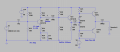
I am making this post because i am unable to make this class AB amplifier, its a homework i need to make and im having trouble designing the second stage of it. I think the pre amp stage worked fine until i connected the second stage, after that i tried making a buffer in between but still no luck. Can anyone give me some pointers on where are my mistakes?

Thanks in advance.
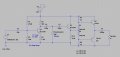
Screenshot 2025-05-17 151222.jpg
 

BobTPH

Joined Jun 5, 2013
11,463
There is no DC bias on Q7. So the input to the final stage essentially be at ground, which will not bias Q2 and Q3 for AB operation. The input of that stage should be at 6V for proper biasing.

The second stage is normally a CE amp with the two diodes connected in series between the collector and collector resistor. Then the two bases are connected to the opposite sides of the two diodes.
 

Thread Starter

sadiaco

Joined May 17, 2025
5
There is no DC bias on Q7. So the input to the final stage essentially be at ground, which will not bias Q2 and Q3 for AB operation. The input of that stage should be at 6V for proper biasing.

The second stage is normally a CE amp with the two diodes connected in series between the collector and collector resistor. Then the two bases are connected to the opposite sides of the two diodes.
Awesome, will try those modifications, thanks!
 

Thread Starter

sadiaco

Joined May 17, 2025
5
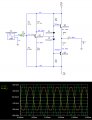
Following up on this thread, this is my current design, which amplifies for different input voltages and i also tested for different frequencies. Seems to be enough for my current requirements, Voltage gain is around 18. Thanks to everyone who replied1748104218269.png
 

MrChips

Joined Oct 2, 2009
34,628
Since you are now learning about the design of audio amplifiers, you should learn about the benefits of negative feedback and various ways to implement negative feedback.

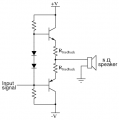
The first and simple way to apply negative feedback is to insert a series resistor at the emitter junction.
The value of the emitter resistor is very low, from 0.1 Ω to less than 10 Ω, so as to minimize the drop in power output.

1748130604549.png
 

Thread Starter

sadiaco

Joined May 17, 2025
5
Since you are now learning about the design of audio amplifiers, you should learn about the benefits of negative feedback and various ways to implement negative feedback.

The first and simple way to apply negative feedback is to insert a series resistor at the emitter junction.
The value of the emitter resistor is very low, from 0.1 Ω to less than 10 Ω, so as to minimize the drop in power output.

View attachment 349864
Thanks for the insight, i'll definetly give it a look.
 

MrChips

Joined Oct 2, 2009
34,628
What are the benefits of negative feedback?

1) Provides temperature stability and prevents thermal runaway.
2) Makes circuit performance less dependent on actual transistor parameters.
3) Makes the circuit more tolerant of mismatched output transistors.
4) Reduces output signal distortion.
 

MrChips

Joined Oct 2, 2009
34,628
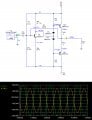
Here is negative feedback from output to the driver stage via feedback resistor R7. Note that the driver is DC coupled to the output stage.

Audio amplifier2.jpg
 
Top