Voltage Sensing and Switching

ScottWang

Joined Aug 23, 2012
7,501
Before I used the relay to be the output control, during that time the details is not clear, and I was used N/P mosfet to designed the circuit, but I found out there were problems happened, whether I used the N ch mosfet or P ch mosfet, they will happen in common 12V or common Ground, because two batteries caused these kinds of problems and I'm still not figure out yet.
 

ScottWang

Joined Aug 23, 2012
7,501
The P mosfet circuit was what I designed before the Relay output control, you could try to calculate the watts of mosfet and it was not so much, if you don't know how to calculate then I will calculate for you, I just thought that the positive power is not connected together, it could be cause something wrong, so I didn't post the circuit.

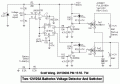
Two12V25ABatDetectorAndSwitcherPfet-02_timmfisk_ScottWang.gif
 

Thread Starter

timmfisk

Joined Jun 5, 2015
25
The P mosfet circuit was what I designed before the Relay output control, you could try to calculate the watts of mosfet and it was not so much, if you don't know how to calculate then I will calculate for you, I just thought that the positive power is not connected together, it could be cause something wrong, so I didn't post the circuit.

View attachment 86916
I really like the change into the discrete semiconductor... and they are very inexpensive. Very nice choice. It is much lighter and smaller than a mechanical Relay, and with that, there is less risk for failure. Outstanding choice. How you guys keep-up with all these components is amazing.

The QuadCopter uses 12V batteries and 30A motors, bringing the potential max Wattage running across this component to 420W.

According to the spec sheet, the AON6411 appears to have a Max of 7.3W... but at the same they list an operating Voltage of 20V and 47A (940W).

Is the spec sheet stating that the max watts on the switching/control side is 7.3W, allowing the component to control high-energy devices such as the QuadCopter?
 

dl324

Joined Mar 30, 2015
18,329
I think this has already been pointed out, but using MOSFETs that way will cause the backup battery to charge the primary battery through the parasitic diode in Fet1.
 

Thread Starter

timmfisk

Joined Jun 5, 2015
25
I really like the change into the discrete semiconductor... and they are very inexpensive. Very nice choice. It is much lighter and smaller than a mechanical Relay, and with that, there is less risk for failure. Outstanding choice. How you guys keep-up with all these components is amazing.

The QuadCopter uses 12V batteries and 30A motors, bringing the potential max Wattage running across this component to 420W.

According to the spec sheet, the AON6411 appears to have a Max of 7.3W... but at the same they list an operating Voltage of 20V and 47A (940W).

Is the spec sheet stating that the max watts on the switching/control side is 7.3W, allowing the component to control high-energy devices such as the QuadCopter?
I think this has already been pointed out, but using MOSFETs that way will cause the backup battery to charge the primary battery through the parasitic diode in Fet1.
Just spitballing here:
Would Diodes on Pins D resolve this question?
 

ScottWang

Joined Aug 23, 2012
7,501
Rectifier Diode RURU80100 80A/1000V TO-218 High Current.
Using The high current mosfet and rectifier diode, they always follow the heat and size issue, and the diode will bring high Vf, the symbol of mosfet has body diode in it, but is not the zener diode, last time I forgot to change them.

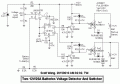
Two12V25ABatDetectorAndSwitcherPfet-02_timmfisk_ScottWang.gif
 

Thread Starter

timmfisk

Joined Jun 5, 2015
25
Rectifier Diode RURU80100 80A/1000V TO-218 High Current.
Using high current current mosfet and rectifier diode, they always follow the heat and size issue, and the diode will bring high Vf, the symbol of mosfet has body diode in it, but is not the zener diode, last time I forgot to change them.

View attachment 86952
Scott, DL32 and AnalogKid: thanks for keeping on top of this thread. It is really appreciated how Scott designed this circuit and makes the changes to the schematic as the discussion progresses while DL324 and AnalogKid makes their suggestions while providing valuable insights freely. Your efforts have been very educational from my perspective. And thanks to everyone who contributed as they see fit.
 
Last edited:

Thread Starter

timmfisk

Joined Jun 5, 2015
25
Maybe this should be a new Thread but it is pertinent to the design of this Circuit.

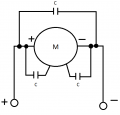
There was discussion earlier about putting Capacitors on each of the 4 Motors.

Here is what I am working with:

  1. Each individual Brushless Motor has its own ESC (Electronic Speed Control) which employs PWM (Pulse Wave Modulation). Currently, I do not have the ESC's in hand to provide any technical details such as chipsets.

    The way I have this project set up, the Motors running on 12Volt Batteries will produce 148Watts of power at an RPM of 8820 consuming 12.3Amps capable of moving a total of 8lbs GVW. Of course, this scope does not consider Motor Start-Up, Physical Loads and Flight Characteristics (lift-off, headwinds, temperatures, barometric pressure, air density, etc).


  2. This RC project operates on a 2.4ghz Carrier Signal. In any case, a charged Capacitor(s) on the Motor would seem to aid in dampening RFI generated through the Motor. I could provide some concise information about this but I don't have an RF Spectrum Analyzer to determine all the aspects of the RF Energy produced by the Motor (Freq's, Modulation at various RPM's, Amplitude and the Power of Modulations) along with any potential Harmonic interferences. I do however have an Oscilloscope and a Frequency Counter so maybe I can find some algorithms to calculate these parameters for this project.

    In any case, considering the cost of materials vs benefits, I am almost convinced that I should shroud most of the components and the Motors with Copper RF Shields.

  3. The hope is that when this Voltage Sensing component switches power sources, the Capacitors will discharge in a way that keeps the entire RC unit functioning without resetting everything... which is part of the primary goal.
Questions:
  1. As near as I can tell, the summary Switching Time for two AON6411 is about .5 Seconds. I intend on inserting a large Capacitor directly after the Voltage Sensing Unit to protect the entire system. What formula would be employed to calculate Capacitor size?

  2. Should the Capacitors for each Motor be fixed like this diagram depicts to help in reducing RFI?
  3. cSZed.png
  4. http://i.stack.imgur.com/cSZed.png
  5. Also, since the Motors are Brushless, should I use a Capacitor that has a poly dielectric instead of metal? Again, how would I calculate the size of the Capacitors.
Thanks for your help.
 
Last edited:
Top