high voltage common mode differential sensing advice

Thread Starter

Darium

Joined Oct 4, 2025
3
hi,
I'm designing a high voltage precision (somewhat) sensing. the output swing around 100v to -30v using ina149 feed in to teensy 4.1 adc at 1MSPS.
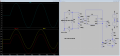
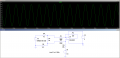
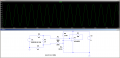
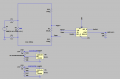
I come up with the following circuit.
still missing TVS protection, passive filtering etc, but this is a general idea, hope someone can give me advice on improving this
1759901477110.png
 

drjohsmith

Joined Dec 13, 2021
1,549
is the voltage your meassuring referenced to the same ground as your arduino ?
are you looking to use high voltage / safety resistors?
 

Ian0

Joined Aug 7, 2020
13,097
Why don't you just use an ordinary rail-to-rail op-am, run from 5V and 0V, and connect it as a 4-resistor differential amplifier, with a gain of 1/30. 300k input resistors, 10k resistor for feedback and ground. That gives a maximum common mode voltage for 100V in of 3.25V, well within the capabilities of an ordinary op-amp.
100V is probably a bit much for some of the smaller surface mount resistors but a 1206 size takes 200V.
Doesn't need much in the way of protection as there is only 300uA in the input resistors, which won't hurt the protection diodes.
 

schmitt trigger

Joined Jul 12, 2010
2,027
@Darium
Ast Irving and the INA149 datasheet show, both RefA and RefB should use the same voltage level.

Then why are you showing two different voltage levels for RefA and RefB in your original schematic?? Where did you get the idea.
 

Irving

Joined Jan 30, 2016
4,996
The major benefit of using an IN149 rather than an opamp and discrete 1% resistors is that the INA149 resistor network has a tighter tolerance, typically 0.02% gain error rather than the approx 0.13% with discrete parts. Whether that is sufficient accuracy is for the TS to decide (but is probably OK).
 

Irving

Joined Jan 30, 2016
4,996
@Darium
Ast Irving and the INA149 datasheet show, both RefA and RefB should use the same voltage level.

Then why are you showing two different voltage levels for RefA and RefB in your original schematic?? Where did you get the idea.
Possibly equation 2 on the data sheet (p13)? It shows VOUT = (+IN) – (–IN) + 20 × REFA – 19 × REFB, though Fig 44 above that simplifies it to VOUT = (+IN) – (–IN) + VREF, if REFA=REFB
 

Ian0

Joined Aug 7, 2020
13,097
The major benefit of using an IN149 rather than an opamp and discrete 1% resistors is that the INA149 resistor network has a tighter tolerance, typically 0.02% gain error rather than the approx 0.13% with discrete parts. Whether that is sufficient accuracy is for the TS to decide (but is probably OK).
As he has a resistive divider on the INA149 input, I think there will be very little difference. I usually use Microchip op-amps with 150uV offset, but I don‘t have SPICE models for them that actually work.
 

schmitt trigger

Joined Jul 12, 2010
2,027
Irving;
I agree with your statement.
However I was attempting to understand the TS assumptions and whether this was what he really intended.
But apparently, after a single initial post and no further response, he may have already bailed out, never to be heard from again.
 

Thread Starter

Darium

Joined Oct 4, 2025
3
@drjohsmith
Yes, the voltage is same reference to ground. those 1 meg resistors are actually 5 thru hole 200k resistors in series to prevent arching
@Ian0
analog circuit is not my strong suit. INA149 provides a simpler solution. so I uses it as the datasheet suggest
@Irving and schmitt trigger
I uses the equation from p13 like you said to come up with REFA REFB voltage. The required 0.761V offset is scaled up to 13.316v is to make fine tuning easier and have 2 separate vref is more flexible as I can jump a single tl431 if I need Vrefa=Vrefb
 

Thread Starter

Darium

Joined Oct 4, 2025
3
@Irving
Thank for the warm welcome :D
Okay I will change the design accordingly.
As for protection, I'm thinking putting a 130v TVS between +In and -In, and a 3.3v zener on the output but the opamp can output negative voltage, how can I prevent that ?
 
Top