Voltage Sensing and Switching

Thread Starter

timmfisk

Joined Jun 5, 2015
25
You should consider the fact that reliability can have an inverse relationship with complexity. It is possible for this circuit to fail in a manner that will cause a weak/dead battery to be selected... Wiring the batteries in parallel, possibly using diodes, is a simpler, more robust design.

I remember reading a disclaimer in a databook stating, to the effect, that that particular companies parts were not certified for use in applications where lives could be placed at risk and that any application of that type required written approval from the president of the company...
dl423:
Thanks for researching the mfg info, good to know.
 

Thread Starter

timmfisk

Joined Jun 5, 2015
25
It looks like we are really close on how the circuit should work.

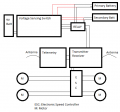
I was hoping that a relay could be inserted between the Primary/Back-Up Batter and the rest of the RC QuadCopter components.

[I hope to get Gold Stars for my diagram :) ]

In the attached diagram, the Red Lines are tapped into each battery. When the Primary Battery drops to a certain Voltage, then the Relay should switch over to the Secondary Battery.

It would be good to have a large Capacitor between the Relay and the RC QuadCopter so that there is not an interruption in power.

OR -- have 2 relays. One Relay would switch to the Back-Up Battery, THEN, the Primary Battery would be taken out of the loop.

Anyway, this is what I envisioned.

Like I said, your Schematic is very appealing and it looks like we are really close.

Thank-you for all the effort you have put into this, it is greatly appreciated.
 

Attachments

ScottWang

Joined Aug 23, 2012
7,501
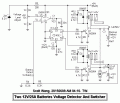
I was modified the power voltage of circuit from 12V to 9V, and the input voltage of comparator changed to Bat2 12V(1/2)=6V, so when you adjust the input voltage(2~10V) of OP1 then you should double them to comparing to the 12V(Bat2), the Bat3 also using charegr battery is better.

If you want to setup the Vref(2~10V) more higher as 6V to 10V then you can increase the R2 and reducing the VR1, those values adjustment let you to try.

Two12V25ABatDetectorAndSwitcherRelay-02_timmfisk_ScottWang.gif
 

Thread Starter

timmfisk

Joined Jun 5, 2015
25
That's a whole lot of unnecessary stuff (and, consequently, points of failure) for no clear benefit.
Well, that's a whole lot of unnecessary input (and, consequently, points of intellectual failure) for no clear benefit.

It seems the only people who want to help are the Moderators. Everyone else just wants to sit on their hands, not contribute, and be Arm-Chair Quarterbacks. Oh well, I guess we know who can give intelligent responses to a specific question.

I'm not trying to be completely offensive. I just don't understand what you want to get out of this line of questioning and comments.

Do you have anything to contribute to this like a real idea? Seriously?
 
Last edited:

Thread Starter

timmfisk

Joined Jun 5, 2015
25
I was modified the power voltage of circuit from 12V to 9V, and the input voltage of comparator changed to Bat2 12V(1/2)=6V, so when you adjust the input voltage(2~10V) of OP1 then you should double them to comparing to the 12V(Bat2), the Bat3 also using charegr battery is better.

If you want to setup the Vref(2~10V) more higher as 6V to 10V then you can increase the R2 and reducing the VR1, those values adjustment let you to try.

View attachment 86832
Thanks, I appreciate the modifications. I will test this out.
 

blocco a spirale

Joined Jun 18, 2008
1,546
Well, that's a whole lot of unnecessary input (and, consequently, points of intellectual failure) for no clear benefit.

It seems the only people who want to help are the Moderators. Everyone else just wants to sit on their hands, not contribute, and be Arm-Chair Quarterbacks. Oh well, I guess we know who can give intelligent responses to a specific question.

I'm not trying to be completely offensive. I just don't understand what you want to get out of this line of questioning and comments.

Do you have anything to contribute to this like a real idea? Seriously?
I am making a constructive contribution, the problem is that you're too arrogant to recognise it. As has already been stated; the sensible and reliable method, and the one used in safety-critical systems where power-supply redundancy is required, is simply to parallel the supplies using diodes. You have rejected this solution but have not stated why and instead opted for complexity. There are so many reasons why a more complex system involving electronics and relays is a bad idea, I almost don't know where to start.

Also, no one on this forum owes you anything or has any obligation whatsoever to assist you so your attitude of entitlement is entirely misguided. If you're not happy with the free advice given, there are plenty of consultants and engineers out there that you can employ and to whom you can legitimately complain if you're not happy with the service provided.
 

ScottWang

Joined Aug 23, 2012
7,501
Well, that's a whole lot of unnecessary input (and, consequently, points of intellectual failure) for no clear benefit.

It seems the only people who want to help are the Moderators. Everyone else just wants to sit on their hands, not contribute, and be Arm-Chair Quarterbacks. Oh well, I guess we know who can give intelligent responses to a specific question.

I'm not trying to be completely offensive. I just don't understand what you want to get out of this line of questioning and comments.

Do you have anything to contribute to this like a real idea? Seriously?
Please be nice to other members whom given you the ideas, they just tried to give you their thought that the best solutions, they may not suit what you want, but please note that no one owe you anything, if you don't want that answers, you just say thank you for them, sometimes there is a blind point between you and other members, but they just tried to help you, if your attitude is not that nice, who will want to help you?
 

ScottWang

Joined Aug 23, 2012
7,501
I am making a constructive contribution, the problem is that you're too arrogant to recognise it. As has already been stated; the sensible and reliable method, and the one used in safety-critical systems where power-supply redundancy is required, is simply to parallel the supplies using diodes. You have rejected this solution but have not stated why and instead opted for complexity. There are so many reasons why a more complex system involving electronics and relays is a bad idea, I almost don't know where to start.

Also, no one on this forum owes you anything or has any obligation whatsoever to assist you so your attitude of entitlement is entirely misguided. If you're not happy with the free advice given, there are plenty of consultants and engineers out there that you can employ and to whom you can legitimately complain if you're not happy with the service provided.
Please don't get angry, we just providing the methods to the TS, you already did your job, if they don't want the answer, that's their choice, we can't make any decision for them, unless they want you to do.
 

dl324

Joined Mar 30, 2015
18,329
The OP appears to be seeking an elegant solution to a perceived problem and is addressing that problem by opting for a solution that introduces more possible points of failure and, therefore, decreases overall reliability when the stated objective is to increase reliability. IMO we need to make sure the OP comprehends the potential for circuit malfunction/failure because, as he has pointed out, someone could be seriously injured if an 8 pound object hit them.

Motors create an electrically noisy environment, wiring can act like antennas; components can react adversely to radiated/injected noise or they could fail for other reasons. A fault tolerant system needs to take that into consideration. The OP can take the well intentioned schematic being offered to him and make it more unreliable simply by wiring it carelessly.

No offense Scott. It's true the OP can take or leave any suggestions offered. My concern is whether he can or will make an informed decision.
 

Thread Starter

timmfisk

Joined Jun 5, 2015
25
I am making a constructive contribution, the problem is that you're too arrogant to recognise it. As has already been stated; the sensible and reliable method, and the one used in safety-critical systems where power-supply redundancy is required, is simply to parallel the supplies using diodes. You have rejected this solution but have not stated why and instead opted for complexity. There are so many reasons why a more complex system involving electronics and relays is a bad idea, I almost don't know where to start.

Also, no one on this forum owes you anything or has any obligation whatsoever to assist you so your attitude of entitlement is entirely misguided. If you're not happy with the free advice given, there are plenty of consultants and engineers out there that you can employ and to whom you can legitimately complain if you're not happy with the service provided.
This is the most you have said in terms of what you think about this kind of circuit. Thanks. Seriously. Thanks. I appreciate your opinion when you can back it up. When you can back it up, let me know.

There is no sense of entitlement. Please refer to the original question:

Can someone suggest a schematic as a resource or possibly a commercial product?
Again, thanks for your input. A little more clarity goes a long way.

Thanks!
 
Last edited:

Thread Starter

timmfisk

Joined Jun 5, 2015
25
The OP appears to be seeking an elegant solution to a perceived problem and is addressing that problem by opting for a solution that introduces more possible points of failure and, therefore, decreases overall reliability when the stated objective is to increase reliability. IMO we need to make sure the OP comprehends the potential for circuit malfunction/failure because, as he has pointed out, someone could be seriously injured if an 8 pound object hit them.

Motors create an electrically noisy environment, wiring can act like antennas; components can react adversely to radiated/injected noise or they could fail for other reasons. A fault tolerant system needs to take that into consideration. The OP can take the well intentioned schematic being offered to him and make it more unreliable simply by wiring it carelessly.

No offense Scott. It's true the OP can take or leave any suggestions offered. My concern is whether he can or will make an informed decision.
Hmmm... I never considered this. I understand a little about RFI, Harmonics and CrossTalk, so thank you for enumerating the possibilities. Good Stuff!

As I said earlier:

I am pretty good at reading schematics but an engineer I am not.

I'm gonna have to roll this over a little.

Scott: thanks for all the time you spent on this.
 
Last edited:

Thread Starter

timmfisk

Joined Jun 5, 2015
25
Please be nice to other members whom given you the ideas, they just tried to give you their thought that the best solutions, they may not suit what you want, but please note that no one owe you anything, if you don't want that answers, you just say thank you for them, sometimes there is a blind point between you and other members, but they just tried help you, if your attitude is not that nice, who will want to help you?
Understood Scott. No offense intended to the Forum. Places like this is where people should learn and that will not happen without insights. People who offer input with only criticism make it hard to make progress... whats the point in it? It does not make any sense, in my mind, for someone to kick down an idea/question without offering a reason(s) that is directly related to the question.... like what DL324 did. DL324 did an excellent job of explaining the Cons of such a circuit.

Thanks.
 

AnalogKid

Joined Aug 1, 2013
12,139
If using relays for batt switching (or power MOSFETs for better efficiency), I recommend a large capacitor across the motor to carry it through the switching time. If your intent is to run one battery most of the way down before switching over to the fresh one, you can control the relay timing such that both batteries never are connected at the same time, or you'll get a large current spike from the fresh batt into the dead one. One way to prevent this is to use both sides of one SPDT, which guarantees no cross-conduction. Power MOSFETS require less power to operate and probably weigh less than a 30 A relay, which might offset the slightly greater power loss due to Rdson. I agree with SW - power the control system from a power source independent of the motor power.

ak
 

Thread Starter

timmfisk

Joined Jun 5, 2015
25
OK, so I am a Programmer (15+ years in all kinds of areas). So, the programmer in me said: Well, if it is redundancy we need, then redundancy we will get.

The approach was something based upon an UPS. And in the programming world, an UPS Object has a few Methods and Properties that are desirable... not a whole lot of Code to write to achieve an UPS in written Code. The Code would take only a few lines and would create a robust Object... without concern for RFI, Harmonics, CrossTalk or physical weight. And the best part: reusable Code!

This kind of design (programming and physical components) is used widely in Aeronautics, Medical and Space Flight applications... it goes all the way back to the Apollo Missions. In this particular situation, it serves not only for motors but for all circuits.

As for RFI, Harmonics and CrossTalk: an RFI Shield could circumvent these issues.

Thanks to all who put their time into this: DL324 and especially Scott.

Spirale: hope to hear from you soon under better circumstances.
 
Last edited:

Thread Starter

timmfisk

Joined Jun 5, 2015
25
If using relays for batt switching (or power MOSFETs for better efficiency), I recommend a large capacitor across the motor to carry it through the switching time. If your intent is to run one battery most of the way down before switching over to the fresh one, you can control the relay timing such that both batteries never are connected at the same time, or you'll get a large current spike from the fresh batt into the dead one. One way to prevent this is to use both sides of one SPDT, which guarantees no cross-conduction. Power MOSFETS require less power to operate and probably weigh less than a 30 A relay, which might offset the slightly greater power loss due to Rdson. I agree with SW - power the control system from a power source independent of the motor power.

ak
EXACTLY! I suggested that earlier because of the time it takes for a physical Relay to engage.

From a design standpoint it would be best to engage the Back-Up Battery before disengaging the Primary.

I'm guessing that is where Spirale's suggestion of incorporating a Diode would be necessary? ... see, I was paying attention ;)

Thanks for your input.
 
Last edited:

AnalogKid

Joined Aug 1, 2013
12,139
If I were designing this as a pc board project, I'd use a pair of Linear Tech ideal diode controllers. They might not handle your voltage and current levels directly, but they are smart and fast. Still, I would incorporate a short, intentional dead time between the two FETs and cover it with a holdup cap.

ak
 

Thread Starter

timmfisk

Joined Jun 5, 2015
25
If I were designing this as a pc board project, I'd use a pair of Linear Tech ideal diode controllers. They might not handle your voltage and current levels directly, but they are smart and fast. Still, I would incorporate a short, intentional dead time between the two FETs and cover it with a holdup cap.

ak
Good points. Thanks! Lots to think about here. Scott did a good job and it looks like this can grow smartly.
 
Last edited:

Thread Starter

timmfisk

Joined Jun 5, 2015
25
OK, "stupid question time":

I spent 12 years in the US Navy (RM2(SW); 6yrs Reserves -then- 6yrs Active Duty). WRT Antenna Theory, if the Antenna was not of the correct WaveLength (esp HF and lower freqs), or if the Coupler was not Tuned correctly, then the signal Reflects back into the Coupler/Transmitter and causes all kinds of problems.

I know that Diodes allow electrical flow in only one direction.

IRT this kind of circuit (all elements of Ohms Law), does the specific placement of a Diode serve the same principal purpose of keeping electricity from reflecting back into the circuit?
 
Last edited:

AnalogKid

Joined Aug 1, 2013
12,139
Reflecting isn't the right term, and only vaguely the right concept. Reflection is a defining property of a wave, and in the description in your post, happens when the characteristic impedance of the transmission line does not equal the characteristic impedance of the antenna. There are no direct corollaries in a DC power system. In DC systems you want as big a mismatch as possible between the transmission medium impedance (wire resistance) and the load (motor) so all of the energy is dissipated in the load.

Without getting into details like leakage, diodes prevent reverse current (electron flow in the unintended direction). While motors can generate noise that does travel as a wave, it is a fair simplification to consider your system as simple power sources and loads. No reflections anywhere; electrons flow anywhere there is a voltage difference between two points. Including between the two batteries if they are not at the exact same potential, unless you do something to keep them disconnected when one has more charge than the other, such as a relay, diodes, or controlled solid state switches. Diodes are simple, brainless, and work. Specifically, a diode in series with each battery will prevent a dead battery from accepting charge from a live battery when you really want all of that charge to go to the motor. A great idea, but at 25 amps even a Shottkey diode will have enough of a voltage drop to dissipate watts of wasted energy as heat. That is why the added complexity of adding a controller chip to a power MOSFET to synthesize a near-perfect diode is worth the effort.

One diode (or active equivalent) in series with each battery, and the two cathodes (or MOSFETs) tied together to power all loads, solves the reverse current problem and combines the two batteries with no control goop. The problem is that it automatically discharges both batteries equally until they both are dead at the same time. An external voltage monitor can give you advance warning of this by measuring the voltage against a trip point, but that is it for control. If you want to use MOSFETs and you want individual on/off control, it takes two MOSFETs back-to-back for each battery.

It turns out that a MOSFET has a diode in it from source to drain, and this sometimes causes more problems than it solves. A MOSFET can have an incredibly low "on" resistance, but that resistance is not unidirectional as it is in a saturated bipolar transistor. So when using a single power MOSFET as a power switch, it has two states. ON means it is a very low value resistor, allowing electron flow in both directions. OFF means it is a diode, allowing electron flow in one direction and dissipating about 1 watt per amp. The two-FETs-back-to-back idea dates back to a Siliconix app note in the 60's. Back then they were talking about high isolation analog switches for audio.

There is no perfect answer here. Life is choice. Choice is risk.

ak
 
Top