I'm sorry, but using "resistance" as a measure of the capacitors slowing charge rate as its voltage rises, is not an appropriate use of that word, and likely confusing to a newbie.
Inductance has always been one thing that confuses me. I chose resistance because it lends itself to an understanding via ohms law. Yes, it's the wrong term - but for me it represents what's going on. The capacitor resists current as it's charge goes higher. That may be due to its inductance. But I think in simple terms.
It's not due to inductance (although that is present too). It is the decreasing voltage drop across a fixed resistance, which causes the current and capacitor charge rate to decrease asymptotically.
Sorry but you've over simplified.
The capacitor doesn't resist current, it's the reduction in charge current due to the source resistance.
Nothing to do with inductance.
Resistance has a meaning of "opposition" in layman's terms.
AAC is All About Circuits. Let us prohibit lay usage when we talk about resistance.
When we refer to resistance we are referring to ohmic resistance. A capacitor does not "resist" the flow of current. The one thing we can say with respect to capacitors and resistors is that a capacitor has finite and measurable series resistance and inductance.
All connecting wires have finite and measurable resistance and inductance. Both of these will affect the charging behavior of a capacitor.
Hello. I am learning electronics and I have 3 questions.
1) How does behave the voltage in a capacitor when I connect it to a DC power supply, for example 10V? Is instantly 10V or is raising until is charged?
2) If I connect a capacitor to a AC power supply, at for example 60hz, the capacitor charge and discharge constantly. Is it possible that if I disconnect the capacitor will be without charge because in that exactly moment it was in the discharge moment?
You say you used a small transformer and what else after it?
Could you show the actual circuit including the tea to and the capacitor under test as well?
You say you used a small transformer and what else after it?
Could you show the actual circuit including the tea to and the capacitor under test as well?
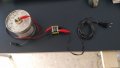
The plug goes to 220VAC and the transformer gives 6V I tried connecting the alligator different times and every time the voltmeter gives different values and different polarities
A transformer has an AC input and an AC output. AC makes positive, negative, positive, negative, over and over. The polarity of the capacitor voltage and its amount of voltage depends on the moment the AC power or your voltmeter is disconnected.
The plug goes to 220VAC and the transformer gives 6V I tried connecting the alligator different times and every time the voltmeter gives different values and different polarities
I was triying to discover if I was right when I think that the voltage and the polarity of a capacitor changing depending on the moment I discconect the AC power supply.
The capacitor is rated for 330VAC. Why is what I was doing a bad idea?
I was triying to discover if I was right when I think that the voltage and the polarity of a capacitor changing depending on the moment I discconect the AC power supply.
The capacitor is rated for 330VAC. Why is what I was doing a bad idea?
Because when you connect the supply to the capacitor they are almost always at different potentials and so you get a quick and large spike of current that isn't good for the capacitor or the transformer. At the voltage you are working at and with that size capacitor, it shouldn't be too bad, but abusing electronic components is a bad habit to get into (not that we haven't all done it, both intentionally and unintentionally).
The plug goes to 220VAC and the transformer gives 6V I tried connecting the alligator different times and every time the voltmeter gives different values and different polarities
Yes, I think I know the difference. In DC the current allways follow the same direction and in AC changes, The times per second that it changes is the frecuency. 50hz in europe and 60hz in the USA for example. Right?
The Darwin Awards are a tongue-in-cheek humor, originating in Usenet newsgroup discussions around 1985. They recognise individuals who have supposedly contributed to human evolution by selectingthemselves out of the gene pool via death or sterility by their own actions.
... meaning you win this award when you kill yourself doing something you should not be doing.
You have not told us the capacitance value.
100μF @ 50Hz would have a reactance of 32Ω.
The Darwin Awards are a tongue-in-cheek humor, originating in Usenet newsgroup discussions around 1985. They recognise individuals who have supposedly contributed to human evolution by selectingthemselves out of the gene pool via death or sterility by their own actions.
... meaning you win this award when you kill yourself doing something you should not be doing.
You have not told us the capacitance value.
100μF @ 50Hz would have a reactance of 32Ω.
Yes, I know this awards, for example the guy who killed himself with a 9V battery. Resistance is Futile
But I didn´t understand why he mentioned them. If is for risk, I am quite familiarised with 220 VAC. I worked as builder before I started the university and I have set up dozens of electric installations in houses. I learned about RCD´s phase, neutral ground and that kind of things, but I only learned the practical side. In any case, I know the risks.
The Darwin Awards are a tongue-in-cheek humor, originating in Usenet newsgroup discussions around 1985. They recognise individuals who have supposedly contributed to human evolution by selectingthemselves out of the gene pool via death or sterility by their own actions.
... meaning you win this award when you kill yourself doing something you should not be doing.
You have not told us the capacitance value.
100μF @ 50Hz would have a reactance of 32Ω.

 Facebook
 Google
 GitHub
 Linkedin