Current and capacitor voltage calculation with IC in Razavi's book

Thread Starter

Nadav Reichler

Joined Apr 4, 2017
13
I started to read "Design of Analog CMOS Integrated Circuits", Second Edition, by Behzad Razavi and found this circuit in chapter 2 ("Basic MOS Device Physics") question 2.10a, page 40:
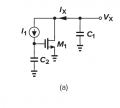
1758809662766.png
I had a question regarding its transient response. It's described in detail here
 

Thread Starter

Nadav Reichler

Joined Apr 4, 2017
13
And that question is . . . ?

ak
Hi, thanks for the reply. The full decription is in the link in the post, but basically I got a complex ODE describing the circuit, that I'm not sure how to solve, and I also don't think the point of the exercise was solving it. So I wanted to know whether there's a way to determine the number of zero crossings and max/mins without solving it. A spice simulation showed slightly different behaviour for differen parameters. Small caps relatively to the current for example showed ringing, but large didn't. But it seemed like there was always 1 zero crossing. I understood why there has to be 1, but coildn't fogure out how to tell that there won't be more than that
 

MrAl

Joined Jun 17, 2014
13,667
Hi, thanks for the reply. The full decription is in the link in the post, but basically I got a complex ODE describing the circuit, that I'm not sure how to solve, and I also don't think the point of the exercise was solving it. So I wanted to know whether there's a way to determine the number of zero crossings and max/mins without solving it. A spice simulation showed slightly different behaviour for differen parameters. Small caps relatively to the current for example showed ringing, but large didn't. But it seemed like there was always 1 zero crossing. I understood why there has to be 1, but coildn't fogure out how to tell that there won't be more than that
If you want to plot the wave then you have to solve it.

It's a nonlinear ODE so it will be harder to solve. You can try separation of variables. If it gets too hard to do you may have to resort to a numerical solution. Numerical solutions are good when the solutions get very difficult. You can then solve for multiple points and then plot the points, or solve for one point at a time and plot each point as they are found.
There are different methods for the numerical solutions like Rung Kutta RK4. There is also a version that uses a 4th order RK then checks with a higher order method: RKF45.
You can find these methods in software packages or you can roll your own in a program if you can program in any decent language, even as lowly as Basic :)
 

panic mode

Joined Oct 10, 2011
4,864
... I had a question regarding its transient response. It's described in detail here
when posting textbook or exam problem, i would strongly suggest to post photo of the problem (including text). do not use your own words to "translate" what you think that question is asking. that may remove important clues giving others tunnel vision of the problem. i certainly do not care about "descriptions" of the problem...
 

MrAl

Joined Jun 17, 2014
13,667
when posting textbook or exam problem, i would strongly suggest to post photo of the problem (including text). do not use your own words to "translate" what you think that question is asking. that may remove important clues giving others tunnel vision of the problem. i certainly do not care about "descriptions" of the problem...
Yes I agree, the link was too hard to decipher so I gave up. We need a better text to be able to read the formulations better.
 

sparky 1

Joined Nov 3, 2018
1,218
The specific values will change the results of applying a textbook equation
such as a general form of transient response first order which is helpful as introductory.
We wouldn't take just part of Ravazi's book as a done deal without applying it in an expanded sense.

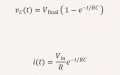
1761865268218.png

Exponential rise/decay with time constant τ = RC \ τ = RC.

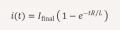
1761865760817.png

that goes into 2nd order with dampening ratio of the specifics.
Just as the RC specific values set the time constants and damping.

The numbers fix the speed and shape of the transient case specific.
Getting dynamic using a stepped source, produce a plot over a range of interest.
A practical use is to apply dampening and stabilization techniques by employing spice for problem solving.
 
Last edited:

MrAl

Joined Jun 17, 2014
13,667
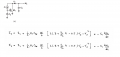
The only thing I did not like was the way the equation was written out. I hate reading handwritten equations.
Here's my interpretation of the original equation that appears first, then the 'fixed' version last.
That equation may be able to be transformed into a regular ODE, but a numerical solution is easier unless we can find a form that it can be transformed into.

I included the circuit with it.
 

Attachments

Top