Capacitor Voltage Sign notation

Thread Starter

Vihaan@123

Joined Oct 7, 2025
220
1764168145171.png
1764160619089.png
Fig1
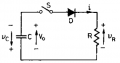
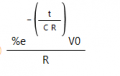
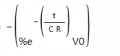
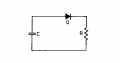
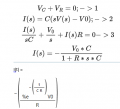
I am bit confused of the arrow direction of Vc and V0. The derivation is as below
1764168014521.png

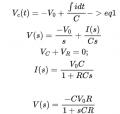
I get that -Ve sign which is not available in the answer.
And in equation 2, should it be -V0 or +V0 for 250V initial voltage. Please guide me to write the correct equations.
 

WBahn

Joined Mar 31, 2012
32,703
The diagram tells you the polarity of Vo (the initial voltage). It's magnitude is given in the problem.

Your equation has V(s) in it, but that is not defined anywhere.

Look at the circuit and, without doing any math, ask yourself whether you expect the current i to be positive or negative given the initial voltage on the capacitor.
 

Thread Starter

Vihaan@123

Joined Oct 7, 2025
220
The capacitor equation i converted to Laplace transform.
1764170207513.png
The current direction shall be the same as shown in the circuit but i get negative it means it is flowing in the opposite direction to the one shown in the diagram which i feel is not correct.
 

WBahn

Joined Mar 31, 2012
32,703
The capacitor equation i converted to Laplace transform.
View attachment 359511
The current direction shall be the same as shown in the circuit but i get negative it means it is flowing in the opposite direction to the one shown in the diagram which i feel is not correct.
Look at your starting point there.

If i(t) is positive, your equation says that dV/dt is positive, and therefore the voltage on the capacitor, v_c, is increasing (algebraically going from less positive to more positive).

Now look at the circuit and the definitions of i(t) and v_c(t) and see if that makes sense.
 

Thread Starter

Vihaan@123

Joined Oct 7, 2025
220
Thank you very much for the continuous support.
1764215385722.png
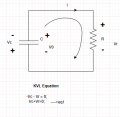
I will explain the way i learnt KVL equation, if i go in the direction of arrow of current there will be drop in capacitor voltage Vc and hence it is +ve at lower side and -ve at the upper side and similarly for the resistor.
For V0 i assume it is a kind of DC source for the current to be in the direction taken, the -Ve will be at the bottom and +Ve at the top as indicated. Am i correct up to this point? I do not draw the arrows as indicated in the problem diagram and do not know how to do it for the voltages. 1764216112840.png
The KVL equation is
-Vc-Vr=0 => Vc+Vr=0 ->eq1

The capacitor equation in this case
i = Cdv/dt -> eq 2 even voltage is decreasing but maintaining the same current direction i am writing it as positive is it correct?

If i solve the equation with i = -Cdv/dt i am not getting the correct answer.
The only way i am getting the correct sign and magnitude is when i put
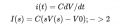
I(s) = C(sV(s) + V0) -> eq3. instead of I(s) = C(sV(s) - V0)
So i am confused on the initial conditions shall i put V0 or -V0, how do i know? Or some other fundamental mistake i am making can you help please.
 

Attachments

Thread Starter

Vihaan@123

Joined Oct 7, 2025
220
If i(t) is positive, your equation says that dV/dt is positive, and therefore the voltage on the capacitor, v_c, is increasing (algebraically going from less positive to more positive).
There is something wrong if i calculate the voltage equation i am getting +Ve but the answer is -Ve. I need to re work again.
 

WBahn

Joined Mar 31, 2012
32,703
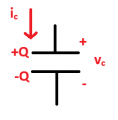
Let's start with the fundamentals.

1764218728802.png
By the definition of capacitance, we have

\(
Q(t) \; = \; C \cdot v_c(t)
\)

But Q is just the time integral of i(t) and, if we have an initial charge of Qo at t=0, then

\(
Q(t) \; = \; Q_0 \; + \; \int_0^t i_c(t) \; dt \\
\frac{Q(t)}{C} \; = \; \frac{Q_0}{C} \; + \; \frac{1}{C}\int_0^t i_c(t) \; dt \\
v_c(t) \; = \; V_0 \; + \; \frac{1}{C}\int_0^t i_c(t) \; dt
\)

Now take the Laplace Transform of both sides:

\(
V_c(s) \; = \; \frac{V_0}{s} \; + \; \frac{I_c(s)}{Cs} \\
I_c(s) \; = \; Cs \cdot V_c(s) - CV_0
\)

This is for i_c(t), v_c(t), and Vo defined as shown above.

Carefully express the quantities defined in the diagram in terms of these quantities and you should get the correct answer.
 

Thread Starter

Vihaan@123

Joined Oct 7, 2025
220
Let's start with the fundamentals.

View attachment 359562
By the definition of capacitance, we have

\(
Q(t) \; = \; C \cdot v_c(t)
\)

But Q is just the time integral of i(t) and, if we have an initial charge of Qo at t=0, then

\(
Q(t) \; = \; Q_0 \; + \; \int_0^t i_c(t) \; dt \\
\frac{Q(t)}{C} \; = \; \frac{Q_0}{C} \; + \; \frac{1}{C}\int_0^t i_c(t) \; dt \\
v_c(t) \; = \; V_0 \; + \; \frac{1}{C}\int_0^t i_c(t) \; dt
\)

Now take the Laplace Transform of both sides:

\(
V_c(s) \; = \; \frac{V_0}{s} \; + \; \frac{I_c(s)}{Cs} \\
I_c(s) \; = \; Cs \cdot V_c(s) - CV_0
\)

This is for i_c(t), v_c(t), and Vo defined as shown above.

Carefully express the quantities defined in the diagram in terms of these quantities and you should get the correct answer.
Yes now i got the correct values
1764228332140.png
i(t) =
1764228386475.png
vc(t) =
1764228407593.png
 

MrAl

Joined Jun 17, 2014
13,667
View attachment 359508
View attachment 359505
Fig1
I am bit confused of the arrow direction of Vc and V0. The derivation is as below
View attachment 359507

I get that -Ve sign which is not available in the answer.
And in equation 2, should it be -V0 or +V0 for 250V initial voltage. Please guide me to write the correct equations.
Hello there,

This looks like they are giving the initial condition voltage with initial polarity, and also giving the voltage measurement polarity.
The initial condition voltage is Vo with positive on top.
The way they want you to measure the cap voltage Vc though is with the positive on bottom.
This means that the initial voltage is actually -Vo.
If Vo=2v then Vc=-2v.
If Vo=-2v then Vc=+2v.
Any solution to the cap voltage has to conform to the measurement of Vc. If you used a voltmeter the positive lead would be connected to the bottom of the cap and the negative lead connected to the top of the cap.

For example, normally we would see a cap charging expression as:
Vc=Vc0*(1-e^(-t/RC))

but if the measurement was taken in reverse like the problem you are doing, it would be:
Vc=-Vc0*(1-e^(-t/RC))

So the polarity of the initial condition voltage may be different than the measurement of that voltage.
This is also true with initial condition currents and measurements.
In general, the measurement polarity can be different than anything else in the circuit because it has its own convention.

In some cases we don't see any voltage polarity indications at all. In those cases we usually infer the polarities based on the ground connections and anything else that might give us a clue such as a positive or negative power supply voltage.

As to the diode current arrow, that tells us we are measuring current from left to right in the diode, so from anode to cathode which is the forward current. If that forward current was 1 amp then i=+1 amp. If that arrow was reversed, then the forward current would be measured at -1 amp.
If we said that the current from anode to cathode was -1ua, then that would be a leakage current.

As a quick illustration, take a look at the attachment.
Then, ask how do we measure the capacitor voltage, the diode current, and the voltage across the resistor.
 

Attachments

Top