Capacitor-diode voltage multiplier

Thread Starter

TexasTony

Joined Jul 15, 2010
52
I'm playing with making a villard cascade voltage multiplier circuit. It takes an AC voltage, using capacitors and diodes, and multiplies up the output voltage.

Start with a 3.3v source, multiply about 10 times to get 33v out. I need about 30-50 mA out. I look at the equations two ways, and I don't know which (if either!) is correct. Let's say I use 100uF caps. Ok, E= 1/2 x C x V^2. Great. E (joules) = 1/2 x 100u x 33^2. Or 0.054 joules... convert to watts & I get 15uW. And that gives me about 0.45 uA. Nowhere near my 30mA goal!

But then I thought... I want to cycle at 30kHz. So really I'm doing this 30k times a second, so does my power (and hence my current) scale up? 30k x .45uA = 14mA. At least the right ballpark.

So is my thinking right that frequence scales up the power (hence current)? Yes, there will be inefficiencies, but 10 or 20% is something I can work with. 30 thousand times off target... well that won't work and I'm not going to use monster big capacitors. If my thinking is right, then 50kHz would be even higher power (scale with frequency). I know, the caps won't work out into the MHz range.

I appreciate any guidance!
Thank you (in advance)
 

Ian0

Joined Aug 7, 2020
13,097
Or 0.054 joules... convert to watts & I get 15uW.
Where did you get that from?
If it is supplying 0.054 Joules per pulse, and 30,000 pulses per second, then you have 1620 Watts.

But don't forget that if you want 33V @ 50mA output, then you need 3.3V @ 500mA input before you start allowing for efficiency.
A flyback circuit would be more efficient.
 

MrChips

Joined Oct 2, 2009
34,628
Let's begin with the math. 33 V x 30 mA = 1 W
At 100% efficiency, you would need 300 mA @ 3.3 V.

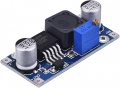
Get one of these XL6009 DC-to-DC boost converters.

1767474211785.png
 

WBahn

Joined Mar 31, 2012
32,703
Hello,

@WBahn , he is talking about a villard multiplier:
https://en.wikipedia.org/wiki/Voltage_multiplier

Bertus
We don't know that the circuit he is trying to implement is exactly the one that you referenced, in particular that it has the same component values for everything.

I don't think it is too much to ask that someone asking for free help on the Internet (which we are all more than willing to provide) not expect those helping him to go out and divine what circuit they might be talking about.
 

MisterBill2

Joined Jan 23, 2018
27,164
The firm reality is that, no matter what, you can not get more power out than you put into a circuit. And the bad news is that some schemes work, BUT they are not very efficient. Worse, some of them have very poor regulation. Diode/capacitor voltage multipliers can work, but beyond doublers they are not very well regulated.
 

Thread Starter

TexasTony

Joined Jul 15, 2010
52
Interesting! But it's not quite what I want... let me explain more.
Basically I'm making a mini bug zapper... but I don't want to actually kill them, just irritate them a bit. My understanding is that it takes about 30-50Vac, and 10-50mA . I'm not sure of frequency yet, I'll start at 30k & go up & down to see where it works best.

Now a simple boost buck regulator would work. It could give me 35Vdc. From there I could take a 30kHz source and drive a FET. I don't really care if it's a square wave. Add a series resistor to limit current. If I say 20mA, 35v, call it 1800 ohms. Attach one side of my zapper to 35v. Other side to the 1800 ohms. Resistor's other end to the drain of the FET. I wonder if a capacitor from ground to the zapper-resistor terminal wouldn't smooth out the waveshape? (worth an experiment) Gotta make sure I don't overheat the cap. Does that make sense?

It is insane that I can buy the regulators on ebay at $10 for 3, with free shipping! It would cost me $4 to ship them, $0.50 for the envelope, and $5-10 each for the circuits!

But this makes sense. I can order the sample boards. I've got the clock source, I'll need to pick a FET, but that'll take 10 minutes.

If you see a flaw in my comments, please chime in. But I think I'm ready to start bugging some bugs!
(and thanks again for the ideas...)
 

Thread Starter

TexasTony

Joined Jul 15, 2010
52
You voltage multiplier circuit outputs DC, so the insects won't know the frequency that the input runs at.
You have no idea how smart some bugs are! :) But... dang... you're right! I was thinking frequency in... frequency out. but of course not... (sigh). All the more reason to use this boost buck circuit, drive an oscillator (at 3v) and run the FET from the oscillator to get my 30v square wave. Thanks.
 

MisterBill2

Joined Jan 23, 2018
27,164
If you take the output for bug zapping between the POSITIVE OUTPUT and the NEGATIVE INPUT when you have30 VDC out, you will have 10VAC on top of it.. Admittedly that is a cheap trick, but it should work.
 

Thread Starter

TexasTony

Joined Jul 15, 2010
52
Now that we know the application is a bug zapper, you don't need a lot of current.
This circuit will do it.

View attachment 361601
I like the other method better ( 30v buck boost with FET switching the output). My reasoning is that if this works, I want to be able to run maybe 10 of these in parallel (yes, aggravating a bunch of bugs!). The FET design will be easier/cheaper to replicate.

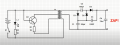
Not withstanding, the cleverness of this circuit still has me a little fooled. I'm assuming as Q1 turns on/off, the current through R1 from Q1 Base is causing it to oscillate? Without any connection to the negative terminal of the battery? I'm confused... if no current can loop through it, how does it inject power into the circuit? I just don't see much if any power coming through? This is more curiousity.
 

MisterBill2

Joined Jan 23, 2018
27,164
How could I have missed that the input oscillator has no return current connection??? THAT is a fatal flaw!!
Probably the circuit line to the secondary was supposed to connect to the bottom of the primary. Or the whole bottom line was a goof by somebody who had no clue when re-drawing the circuit. We know it was not a technical person because the connection of the battery negative to the bottom of the transformer secondary. THAT MAKES NO SENSE
 
Top