Can you drive an LED from a capacitor diode voltage multiplier?

Thread Starter

realflow100

Joined Apr 17, 2016
16
I want to take a low voltage 1.2v AC of any frequency and use some capacitors and diodes to increase the voltage up to about 3 to 4v (to drive an LED
and using another diode and then a capacitor to get smoothed DC output from it.
and use a reasonable value resistor to power the LED

but I was wondering if I could take it further. and power an even higher voltage LED like about 8 to 10v (3 in series) ?
Will it be more efficient than using a tiny transformer. a bridge rectifier. and an output smoothing output capacitor?
 

MrChips

Joined Oct 2, 2009
34,628
Just bear in mind that you can't get something from nothing. Everytime you double the voltage, you get less than half the current owing to loss in efficiency. Hence total power output diminishes at every stage.
 

Tonyr1084

Joined Sep 24, 2015
9,744
I want to take a low voltage 1.2v AC of any frequency
Where are you getting 1.2 VAC from? If it's AC then you can use a transformer to up the voltage. Then rectify it for DC operation - OR let the LED do the rectification. For a purer light you'd add a capacitor across the LED. But keep in mind, power in versus power out - you DO lose something. So if you have 1.2 VAC at 100 mA and you double the voltage to 2.4 volts you'll only get (in theory) 50 mA. Actually due to line losses and inefficiencies in the transformer you won't get the full 50 mA. Of course, an LED might need as little as 10 mA, so you might not suffer too much from the losses. But if you up the voltage 4 times from 1.2 to 4.8 volts then you can (again in theory) expect 25 mA out. Line loss and inefficiency means you might actually see 15 to 20 mA. Again, probably enough, but possibly not.
 

RichardO

Joined May 4, 2013
2,270
but I was wondering if I could take it further. and power an even higher voltage LED like about 8 to 10v (3 in series) ?
You can use a MAX232 or the ilk to get several volts at low current. You don't have to use the transmitters or receivers in the chip but it might be convient to use the transmitter to drive the LED (at a reduced voltage, however).


edit: Oops. I missed the 1.2 volts AC part of the question. The answer by @MrChips is much better.
 
Last edited:

k7elp60

Joined Nov 4, 2008
562
I want to take a low voltage 1.2v AC of any frequency and use some capacitors and diodes to increase the voltage up to about 3 to 4v (to drive an LED
and using another diode and then a capacitor to get smoothed DC output from it.
and use a reasonable value resistor to power the LED

but I was wondering if I could take it further. and power an even higher voltage LED like about 8 to 10v (3 in series) ?
Will it be more efficient than using a tiny transformer. a bridge rectifier. and an output smoothing output capacitor?
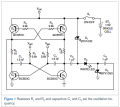
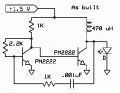
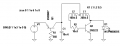
Here are a couple of circuits. The one with the inductor I have not tried. The other one is of my design.boost-schematics.gif
boost-schematics.gif
lv_flasher.jpg
 

Audioguru

Joined Dec 20, 2007
11,248
A solar garden light charges a 1.2V Ni-MH cell then boosts its voltage to about 3.5V to light a white or colors-changing LED. It uses an IC and an inductor. The solar panel is used to detect ambient light then turn off the LED and turn on the charging.
 

Thread Starter

realflow100

Joined Apr 17, 2016
16
im not using a DC or battery power source
I can use much smaller capacitors and it will still do the job just fine
but I wanted to to simply take the headphone output from my pc. and use a diode capacitor voltage multiplier to power an LED (of various voltages) (ive done it with a transformer before and a capacitor. (capacitor is to make it more efficient and more better match the impedance of the headphone output)
it doesnt need much more than 1mA or so maybe even less or more it doesnt matter as long as you can see it produce light.
I just want to make it light up just enough so you can see its lit.
and I wanted to do it all without transistors or other special components. with only diodes and capacitors.

Do I need non-polarized capacitors or polarized ones?
It seems like if I used polarized capacitors i'd need diodes going reverse across each capacitor to prevent them from getting a high negative voltage on them. but that wouldn't affect operation of the circuit much.
and i'd have a diode coming from the output. and a capacitor to hold the charge
 

Papabravo

Joined Feb 24, 2006
22,058
A solar garden light charges a 1.2V Ni-MH cell then boosts its voltage to about 3.5V to light a white or colors-changing LED. It uses an IC and an inductor. The solar panel is used to detect ambient light then turn off the LED and turn on the charging.
Welcome back!
 

DickCappels

Joined Aug 21, 2008
10,661
Do you need to light a white LED or would a red one be ok?

How did you determine that the voltage available is 1.2 VAC.

Another way to ask is: How can you best describe the 1.2 VAC signal?

Normally 1.2 VAC refers to the RMS value of a sine wave, which means that it would be 1.2V x 2.82 =3.38 V P-P.

I think you can achieve your goal but it might take many simple diode-capacitor stages. In the case of simple diode multiplier the value of the capacitor is not critical -in general the larger the better. For the diodes I would use small signal Schottky diodes like the 1N60P or 1N5711. This way you would loose about 400 millivolts per half wave stage. It would take a lot of stages.

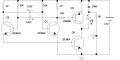
Most if not all of the voltage boost circuits shown in this thread should work if powered from the PNP peak detector shown in the schematic below. The voltage drop across the peak detector is about 100 millivolts -that's why uses a transistor instead of a diode.

The circuit below can drive a white LED from a 2V P-P audio signal, probably as low as 1.5 VP-P on a good day.

upload_2017-9-23_18-2-13.png
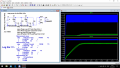
In image below the white signal is a 2V P-P sine wave and the green signal is current through a white LED in milliamps.
upload_2017-9-23_18-4-14.png
 
Top