Voltage Divider

Thread Starter

Jibebuoy

Joined Nov 5, 2025
59
Hi - I made a voltage divider circuit to 'make' 5 V dc from 12V. I tested it on the bench and got the 5v I was looking for. When I installed it sourcing 12v, I only got 3.5v. When it was installed, I did not attach any loads or sensors to it. Just power. The only difference between the installed location and the bench was the power supplies. I'm guessing there is something going on there but I don't understand since the sourced voltage is the same - 12 V in both locations. Any ideas on why I would see a voltage drop would be appreciated. Thanks.
 

WBahn

Joined Mar 31, 2012
32,777
Hi - I made a voltage divider circuit to 'make' 5 V dc from 12V. I tested it on the bench and got the 5v I was looking for. When I installed it sourcing 12v, I only got 3.5v. When it was installed, I did not attach any loads or sensors to it. Just power. The only difference between the installed location and the bench was the power supplies. I'm guessing there is something going on there but I don't understand since the sourced voltage is the same - 12 V in both locations. Any ideas on why I would see a voltage drop would be appreciated. Thanks.
What were the power supplies at the bench and at the installed location? Need specifics, preferably make and model, but at least what current they are rated for. Were either of these wall-wart type supplies?

How is the power at the installed location routed to this voltage divider?

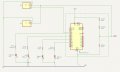
What was the actual voltage divider circuit? Provide a schematic (a sketch is fine) with component values.

Even more important that all of this is whether such a divider is going to work for you at all. What will it be supplying 5 V to? How much current is needed? What is the allowed tolerance on the 5 V? Is it really acceptable to continuously dissipate about ten times the amount of power that your load needs under peak conditions in order to get even a modestly stiff 5 V output?

Is there a reason you aren't using a cheap DC-DC switcher? Or at least a fixed 7805-type voltage regulator circuit?
 

xox

Joined Sep 8, 2017
936
Hi - I made a voltage divider circuit to 'make' 5 V dc from 12V. I tested it on the bench and got the 5v I was looking for. When I installed it sourcing 12v, I only got 3.5v. When it was installed, I did not attach any loads or sensors to it. Just power. The only difference between the installed location and the bench was the power supplies. I'm guessing there is something going on there but I don't understand since the sourced voltage is the same - 12 V in both locations. Any ideas on why I would see a voltage drop would be appreciated. Thanks.

What is the voltage reading at the point where the voltage divider connects to the power supply? If it is appreciably less than 12V then the answer is that your power supply has a lot of internal resistance.

Either way, trying to use a divider for anything other than a voltage reference or at most a source for a very small amount of current probably isn't going to work so well.
 

Thread Starter

Jibebuoy

Joined Nov 5, 2025
59
What is the voltage reading at the point where the voltage divider connects to the power supply? If it is appreciably less than 12V then the answer is that your power supply has a lot of internal resistance.

Either way, trying to use a divider for anything other than a voltage reference or at most a source for a very small amount of current probably isn't going to work so well.
It was 12 v.
 

Thread Starter

Jibebuoy

Joined Nov 5, 2025
59
What were the power supplies at the bench and at the installed location? Need specifics, preferably make and model, but at least what current they are rated for. Were either of these wall-wart type supplies?

How is the power at the installed location routed to this voltage divider?

What was the actual voltage divider circuit? Provide a schematic (a sketch is fine) with component values.

Even more important that all of this is whether such a divider is going to work for you at all. What will it be supplying 5 V to? How much current is needed? What is the allowed tolerance on the 5 V? Is it really acceptable to continuously dissipate about ten times the amount of power that your load needs under peak conditions in order to get even a modestly stiff 5 V output?

Is there a reason you aren't using a cheap DC-DC switcher? Or at least a fixed 7805-type voltage regulator circuit?
I am powering a break beam sensor that draws 25mA. The power supplies are not warts. I believe the vernacular is a laptop brick. The bench supply can provide a variable output voltage. The supply at the installed location that is giving me a low voltage reading on my voltage divider is 12 v 5A. It is an accessory power supply from my model train set.
 

Jon Chandler

Joined Jun 12, 2008
1,573
[EDIT – info about the current draw was added while I was typing. Based on the discussion below, it should be clear. It ain't gonna work.]

A key question is how much current do the IR sender (LED?) and IR receiver draw.

For sake of discussion, the LED in the sender might draw 10mA.

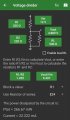
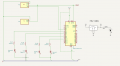
The first picture shows the voltage divider without considering the load current. Vout = 4.9v. Current consumption is 22mA.

Screenshot_20251229_060359_Electrodoc Pro.jpg

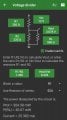
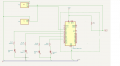
The second picture shows the situation with the load current considered. A 500 ohm resistor with 5 volts across it draws 10mA. With that load, Vout drops to 3.9 volts. If the LED current is greater, the output voltage drops even further.

Screenshot_20251229_060450_Electrodoc Pro.jpg

A linear voltage regulator like an LM7805 will be a far better option.

What exactly is the IR sender? Could it be operated from the 12v supply with a dropping resistor?
 
To add to Jon's excellent explanation - with your 330Ω/220Ω divider and 25mA load (equivalent to ~200Ω), your 220Ω bottom resistor ends up in parallel with the load, giving only ~105Ω effective resistance. That drops your output to around 2.9V under load.

You can verify this and experiment with different values using a voltage divider calculator that accounts for load current: https://www.schemalyzer.com/en/tools/voltage-divider-calculator

For model train sensors, a small buck converter module (like MP1584) would be ideal - they're cheap, efficient, and won't waste power as heat like an LDO would with that 7V drop.
 

panic mode

Joined Oct 10, 2011
4,947
if the load is fixed voltage divider principle can still be used. the problem is that many loads are not simple devices, they contain electronics and as such current draw is inconsistent. so for powering devices voltage regulator is the correct solution. if current draw is low, or voltage difference between input and output is reasonably low (few volts). linear regulators are the best choice.
a bit cheaper is to use resistor and zener diode.
but...

when the voltage difference is high and load current is not low, switching regulators are the way to go.
there are switching mode regulators that are equivalent to 7805. they do cost more but make life so much simpler.

examples:
https://www.digikey.ca/en/products/detail/xp-power/RBT05W24S05/26667098
https://www.digikey.ca/en/products/detail/recom-power/R-78CK5-0-0-5/21284893
https://www.digikey.ca/en/products/detail/recom-power/R-78K5-0-0-5/18093025
https://www.digikey.ca/en/products/detail/recom-power/R-78K5-0-1-0/18093047
https://www.digikey.ca/en/products/detail/murata-power-solutions-inc/OKI-78SR-5-1-5-W36-C/2259781

etc.
 

Jon Chandler

Joined Jun 12, 2008
1,573
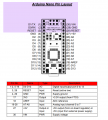
Use the 5 volt output pin #27.
In my sleepy-eyed earlier response, I didn't notice the +12v is powering an Arduino nano. I believe it's recommended that you power a nano with < 9 volts to prevent overheating the voltage regulator.... even w/o powering an additional 25mA load.

In this case I do recommend a 5 volt buck converter to power both the nano and the IR modules.
 

sghioto

Joined Dec 31, 2017
8,634
In my sleepy-eyed earlier response, I didn't notice the +12v is powering an Arduino nano. I believe it's recommended that you power a nano with < 9 volts to prevent overheating the voltage regulator.... even w/o powering an additional 25mA load.

In this case I do recommend a 5 volt buck converter to power both the nano and the IR modules.
An additional 25ma shouldn't be an issue.
 

Thread Starter

Jibebuoy

Joined Nov 5, 2025
59
Thank you all. I learned a lesson that when you connect a load to the voltage divider it changes the output voltage. That explains why I got the 5v I was looking for on the bench with no load but when I powered the divider up with my accessory bus (which has load) it lowered the voltage. Luckily, my sensor that I am powering from the divider still works with the lower voltage. I can always switch to the 5v pin on the Nano if I need to. Thanks again....
 

boostbuck

Joined Oct 5, 2017
1,041
....my sensor that I am powering from the divider still works with the lower voltage....
You should be aware that the voltage that the sensor sees will vary with the amount of current the sensor takes from the supply. That interaction can be the source of some very subtle failures.

If you cannot use a 5V source supplied via a regulator (seems there is one waiting for you on the controller) then test your circuit thoroughly at marginal states for unreliability.
 
Top