Question 16 from voltage divider circuits worksheet

Thread Starter

Ldaxar

Joined Feb 27, 2025
14
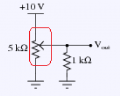
I'm asking about question 16 from https://www.allaboutcircuits.com/worksheets/voltage-divider-circuits/

I don't understand how to arrive at given answers. Let's look at that circuit with potentiometer and try to calculate Vout at 50%:

1742543952606.png

My understanding is that 5k resistor will provide 50% of its resistance. Voltage drop across that 2.5k resistor will be:
\[ E_{\text{1}} = 10 \times \frac{2500}{2500+1000} = 2.86 \text{ V} \]
Measurement from point \(V_{\text{out}}\) relative to the ground(0 V) will be \(10-2.86=7.14 \text{ V}\). 10 V is the source and it is being dropped by 2.5k resistor in a 3.5k serial set-up.

However, the answer is 2.22 V. I guess I'm missing something obvious. Any help much appreciated!
 

Thread Starter

Ldaxar

Joined Feb 27, 2025
14
Hi Eric,

If you're asking about total resistance of 2k5 and 1k it'll be:
\[ R_{\text{total}} = \frac{1}{\frac{1}{2500} + \frac{1}{1000}} = 714 \]
Sorry but I can't spot how that's applicable to the problem. Next hint :D?
 

WBahn

Joined Mar 31, 2012
32,702
It appears that the problem is that you don't understand how potentiometers work and are confusing it with a rheostat.

A rheostat is a two-terminal device whose resistance can be adjusted from some minimum to some maximum.

A potentiometer is a three-terminal device. The total resistance between the two fixed terminals never changes and is the total amount.

The third terminal is a "wiper" that connects to the resistive element at some point between the two fixed terminals, effectively dividing it into two resistors that are connected at the movable wiper.

With that in mind, see how the schematic symbol represents these terminals:

1742547683337.png

So when the wiper is half-way, you have a 2.5 kΩ resistor between the +10 V supply and Vout, and also a 2.5 V supply between Vout and ground.
 

ericgibbs

Joined Jan 29, 2010
21,390
Hi L.
What is the current from a10v source through a series 2k5 and 714R
You can then check the voltage drop across the 714R

It is just another way of seeing the problem.
E
 

LesJones

Joined Jan 8, 2017
4,511
Your equation in post 1 seems to be assuming that the 1K is in series with the bottom end of the 5k pot. (As you are adding 1K to 2.5K.) Try re drawing the circuit with two 2.5K resistors instead of the 5K pot.
Les.
 

Jerry-Hat-Trick

Joined Aug 31, 2022
774
Are you familiar with the formula for two resistors in parallel? Well worth looking it up, prove it to yourself and commit to memory.
Question 12 is similar. Frankly, I think the worksheet could be improved by including explanations in the answers
 

Thread Starter

Ldaxar

Joined Feb 27, 2025
14
Thanks guys! Bob's suggestion was the hint I needed. All previous questions in that worksheet dealt with sequential circuits only, therefore I got tunnel visioned and as a result completely stuck when I got a question with a parallel circuit in it.

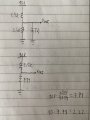
Posting solution for completion:
q16.jpeg
Step 1: Break that 5k resistor into two resistors.
Step 2: Simplify parallel 2.5k and 1k into 714 Ohm resistor(calculation in my previous post).
Step 3: Calculate how much voltage is dropped by 2.5k resistor in that set-up.
Step 4: Calculate the voltage between Vout and ground. Vout is electrically common with all nodes after 2.5k and before 714 resistors so it has the same voltage.

Thanks again for all the help!
- LD
 
Top