Low impedance voltmeter and voltage divider

Thread Starter

Rufinus

Joined Apr 29, 2020
305
Hello. I need to measure a high voltage, and I´ll use a voltage divider 1:1.000 using 16x47MOhm = 752M resistor and 1 low resistance resistor to measure the voltage there. The problem is the voltmeter I´ll use has a low impedance, just 112,5k and it should be at least 753k so the internal resistance of the voltmeter acts at the low resistance resistor. The string of resistors has to be 752M, this value cannot be changed.

So, I think this way should work, but I´m not sure


752M are the string of resistors. To get a measure one volt for every 1,000 volts, I use this configuration. Mi idea is the combination of the resistor of the voltmeter and the 1M and the 2330R resistors make a total of 753k that gets the 1:1000 ratio.

Is my circuit correct? If it isn´t, how could I use that voltemeter in combination with the 752M string to get a ratio of 1:1.000

Thank you

Best regards
 

WBahn

Joined Mar 31, 2012
32,777
Your voltmeter is going to indicate the voltage that it sees across it's terminals.

So if you put a meter with a 112.5 kΩ impedance (seems awfully low these days, but I'll take your word for it) in series with a 1 MΩ resistor, then the meter only sees 10.11% of the voltage across the series combination of the two.

If you put that in parallel with a 2.33 kΩ resistor, you know have 2.325 kΩ resistor in series with your 752 MΩ resistor. So the voltage across the 2.325 kΩ resistance will be 3.09e-9 times the total voltage, and the meter will only see about a tenth of that. So, for every thousand volts, your meter will see about 31 µV across it.

What you are trying to do has a couple of major issues.

How much current must flow through the voltmeter for it to indicate 1 V?

Since it has a resistance of 112.5 kΩ and presumably reads 1 V when 1 V is applied to it, it will have 1 V / 112.5 kΩ = 8.89 µA of current.

How much current would your 752 MΩ resistor have when it has 1000 V across it (assuming the voltmeter has no effect on it)? It would have 1.33 µA flowing through it.

So, how can you route that 1.33 µA in such a way that you somehow end up with 8.89 µA of current flowing in the voltmeter?

Answer -- you can't, not with a passive circuit.

You are starting with 1.33 µA/kV of current available and your circuit can only divert some of that around the meter so that what makes it into the meter results in it reading 1 V/kV. But you need more current than you have available to begin with.

So you need to find a meter that has a resistance of at least 752 kΩ (you might note that 752 kΩ is 1/1000 of the 752 MΩ -- that's not a coincidence).

The alternative is to use an active circuit so that you can get some current gain into your meter. Do you have a DC power source available to power such a circuit?

What is the maximum voltage you are trying to measure?

In addition to this, you need to consider the safety concerns associated with working with these kinds of voltages. If that high-voltage source becomes short-circuited, how much current is it capable of delivering? If it's more than a milliamp or so, you can't ignore the safety considerations without risking serious injury or death to someone at some point.

From a measurement standpoint, you also need to pay attention to how accurate/precise you can make this measurement compared to how accurate/precise you need the measurement to be. You are trying to achieve a 1000:1 measurement ratio. What is the tolerance on those 47 MΩ resistors you are using? What is their temperature coefficient?
 

MisterBill2

Joined Jan 23, 2018
27,362
What is a best gues at the voltage to be measured??? AND, more important indeed is how much current can it deliver??
A simpler and possibly more accurate scheme will be to simply measure the current thru your 752megohm resistor to the other side of the voltage source. In addition, it is not likely that you can safely approach that high a voltage source, if your resources are such that you need to ask us.
 

WBahn

Joined Mar 31, 2012
32,777
Although you can't get 1 V/kV with a passive circuit, you can get 0.1 V/kV.

If 10,000:1 is acceptable, then the nominal design of the circuit is very straight forward.

For each 1000 V your 752 MΩ resistor chain will draw 1.33 µA.

For each 0.1 V of indication, your voltmeter requires 0.89 µA.

That means that you simply need to shunt about 0.44 µA/0.1 V around the meter, which requires a 227 kΩ shunt resistor.

Depending on how accurate you need the measurement and what the tolerance is of all of your components, you may want to add in some trimming ability into this. We can discuss that once you provide that information (and also indicate that this ratio is acceptable for your application).
 

panic mode

Joined Oct 10, 2011
4,947
Increase impedance of voltmeter by adding an amplifier. This was done with tubes, transistors or opamps to increase voltmeter sensitivity...
 

Thread Starter

Rufinus

Joined Apr 29, 2020
305
Thank you for all your help. It´s not for me, but a friend who I am helping. At first I thought it can´t be done, but I tried developing that circuit, but, yes, I was right at first, I can´t create the necesary current.
 

WBahn

Joined Mar 31, 2012
32,777
Thank you for all your help. It´s not for me, but a friend who I am helping. At first I thought it can´t be done, but I tried developing that circuit, but, yes, I was right at first, I can´t create the necesary current.
So go back to your friend as ask them the following questions:

Is an indication of 0.1 V/kV acceptable?

If you really need 1 V/kV, do you have a power source that can be used to power a sensing circuit?

In either case, there are some other basic questions that need to be answered to do a decent design.

What is the maximum value that this high-voltage that you want to measure can possibly be?

What is the degree of accuracy that is required?

There are other questions that will need to be addressed, but these are sufficient to at least get started.
 

panic mode

Joined Oct 10, 2011
4,947
if you need assistance, you need start sharing some details like numbers. ... you even did not say if this is an AC or DC...

so what are the specs of your meter? resistance is one thing but what is the range? typical decent analog multimeter would have 20kOhm/V or higher. in such case 112.5k sounds like 5.5V full scale (odd but whatever). and with 1000:1 divider that would get you up to some 55kV. so 55000V * 20kOhm/V = 1.1GOhm which is higher than you need. in this case you could use parallel resistor with your voltmeter to get things right.

el cheapo analog meter would have far lower sensitivity, something like 2.5kOhm/V. in that case 112.5kOhm would suggest 45V range. still odd but whatever. combining this with 1000:1 divider would get you to 45kV. 45000V*2.5kOhm/V = 112.5MOhm. but this is less than 752MOhm that you plan on using so adding resistor in parallel will not help. using 1/5 or 1/10 of the measuring range is possible but i would consider that a pretty devastating compromise.

analog panel meters found on Amazon etc are not sensitive, seem to be all in 1-2.5kOhm/V range.

so if you want to use full scale of such meter, one possibility is to add some electronics (requires power)
 
Last edited:

Thread Starter

Rufinus

Joined Apr 29, 2020
305
Yes of course.

Is an indication of 0.1 V/kV acceptable? No, he wanted 1 volt per Kv because the voltmeter was in volts, so 1 volt meant 1 Kv

If you really need 1 V/kV, do you have a power source that can be used to power a sensing circuit? He wanted something simple

What is the maximum value that this high-voltage that you want to measure can possibly be? 50Kv

What is the degree of accuracy that is required? well, 5%
 

panic mode

Joined Oct 10, 2011
4,947
so my guestimating was in the ballpark. to get that show you correct voltage in kV with 752M on high side, you need to get your panel meter to 75.2. Since panel meter is 100M, you get there by connecting 300M resistor in parallel with it (or 303.226M).
 

MrAl

Joined Jun 17, 2014
13,686
Hello. I need to measure a high voltage, and I´ll use a voltage divider 1:1.000 using 16x47MOhm = 752M resistor and 1 low resistance resistor to measure the voltage there. The problem is the voltmeter I´ll use has a low impedance, just 112,5k and it should be at least 753k so the internal resistance of the voltmeter acts at the low resistance resistor. The string of resistors has to be 752M, this value cannot be changed.

So, I think this way should work, but I´m not sure


752M are the string of resistors. To get a measure one volt for every 1,000 volts, I use this configuration. Mi idea is the combination of the resistor of the voltmeter and the 1M and the 2330R resistors make a total of 753k that gets the 1:1000 ratio.

Is my circuit correct? If it isn´t, how could I use that voltemeter in combination with the 752M string to get a ratio of 1:1.000

Thank you

Best regards
Hello there,

What types of components are you allowed to use here? Can you use an op amp or a transformer?

I ask because using resistors does not seem possible without changing that 752M series resistor.

Usually when you want to increase the voltage a meter movement will be able to read, you add a series resistor like that 752M resistor. However, you do not start with a given value for the series resistor, you calculate that from the specs of the voltmeter. If you end up with values that draw too much current from the source to be measured, then you have to add amplification of some kind such as an op amp or transformer and use a higher value for the series resistor.
 

panic mode

Joined Oct 10, 2011
4,947
that is what he already did in post 11.
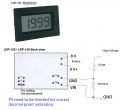
i just checked the specs and that unit requires input to be in 0..+/-200mV (or shunt resistors Ra and Rb need to be added)
so thee solution need to have additional 1000:1 divider (combined ratio 1000000:1).
but the 752M resistors can stay the same... just use 750 Ohm as a low side resistor of the voltage divider and connect panel meter in parallel with that 750 Ohm resistor.

1752248309641.png
 
Last edited:
Top