Various 4017 Things.

Thread Starter

Kim Sleep

Joined Nov 6, 2014
398
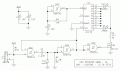
Here is a re-work based of recent posts. As before, U2A and U2B form a 5-second monostable.

U2C is the most simple CMOS oscillator. It can be replaced by some other clock circuit.


The oscillator is not gated by the monostable because this circuit uses the clock enable circuit inside the 4017 to manage when the chip does and does not count.

When the button is pressed, the 4017 stops counting and whatever output is high is illuminated for 5 seconds. Then that LED goes off and the 4017 resumes counting.


As shown, the oscillator frequency is around 800 Hz to assure randomness in the display. Of course, a 4093 can run way faster than that.

ak


View attachment 337943
should the reset of the 4017 be constantly grounded??
 

AnalogKid

Joined Aug 1, 2013
12,130
If you are referring to the schematic in post #80 - Yes. The function of the 4017 is to be a random number generator. As such, there is no reason to reset it between trials. In fact, resetting it removes a small bit of randomness from its outputs.

ak
 

Thread Starter

Kim Sleep

Joined Nov 6, 2014
398
If you are referring to the schematic in post #80 - Yes. The function of the 4017 is to be a random number generator. As such, there is no reason to reset it between trials. In fact, resetting it removes a small bit of randomness from its outputs.

ak
Did you prototype this??
 

AnalogKid

Joined Aug 1, 2013
12,130
What is the IC driving the 4017?
The part number is on the schematic.

The CD4093 is a quad NAND gate. What makes it better than a CD4011 in this application is that the 4093 has Schmitt trigger inputs. The input stage has two transition voltage levels, one for a rising edge and a different one for a falling edge. This feature makes for a very simple oscillator (U1C). It also makes for a much more stable circuit when the timing capacitor voltage is changing very slowly, such as a 5-second monostable.

Here is a link to the original datasheet, re-published by Texas Instruments, who got it from Harris, who got it from RCA:

https://www.ti.com/lit/ds/symlink/cd4093b.pdf?ts=1736789339625&ref_url=https%3A%2F%2Fwww.ti.com%2Fproduct%2FCD4093B%3FkeyMatch%3Dcd4093%26tisearch%3Duniversal_search%26usecase%3Dpartmatches

https://en.wikipedia.org/wiki/Hysteresis#In_engineering

ak
 

Thread Starter

Kim Sleep

Joined Nov 6, 2014
398
The part number is on the schematic.

The CD4093 is a quad NAND gate. What makes it better than a CD4011 in this application is that the 4093 has Schmitt trigger inputs. The input stage has two transition voltage levels, one for a rising edge and a different one for a falling edge. This feature makes for a very simple oscillator (U1C). It also makes for a much more stable circuit when the timing capacitor voltage is changing very slowly, such as a 5-second monostable.

Here is a link to the original datasheet, re-published by Texas Instruments, who got it from Harris, who got it from RCA:

https://www.ti.com/lit/ds/symlink/cd4093b.pdf?ts=1736789339625&ref_url=https%3A%2F%2Fwww.ti.com%2Fproduct%2FCD4093B%3FkeyMatch%3Dcd4093%26tisearch%3Duniversal_search%26usecase%3Dpartmatches

https://en.wikipedia.org/wiki/Hysteresis#In_engineering

ak
Thank you, I am currently building this...God help me!
 

AnalogKid

Joined Aug 1, 2013
12,130
Note C1 and C5. These are power supply decoupling caps, one for each IC. They should be as close as possible to the chip power and GND pins, with short leads.

ak
 

Thread Starter

Kim Sleep

Joined Nov 6, 2014
398
Here's an alternate circuit.

It used two CD4017's, one as a logic state sequencer, and one as an LED sequencer.
This works using LTspice simulation but hasn't been bread boarded.
U2 controls the logic state of the circuit per the spec given by the TS.
The LEDs are limited to ~10mA. Q4 keeps GRN0 LED off when U1 is reset.

If the TS is interested, I will breadboard and test.

Edit: Removed Q4 because its not needed (forgot about Q3). Removed reset U1

View attachment 337948
What is IQ1 and IQ2???
 
Top