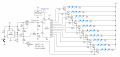
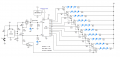
Do you mean the schematic in post #77 ?
What do you mean with transistors driving the outputs?
To complete fully I need your schematic of the 555 driver as well.
Do you mean the schematic in post #77 ?
What do you mean with transistors driving the outputs?
To complete fully I need your schematic of the 555 driver as well.
Its the last Schematic that you sent me that included leds on the output of the 4017. I would like either NPN or PNP transistor switches on the outputs, to drive 3 leds on each output. It can be on a separate sheet that only includes the outputs of the 4017, and all the additional info, it doesnt need to all be on the same sheet.
Thank you.
Kim
Are the LEDs in series and what value current limiting resistor?
What about your 555 driver circuit, want me to add that in as well or leave it as shown before?
Are the LEDs in series and what value current limiting resistor?
What about your 555 driver circuit, want me to add that in as well or leave it as shown before?
They are blue leds so whatever is best for them, and leave the rest of the circuit as it was before. The 3 leds can be series or parallel, whichever is best for a little switching transistor.
Im having a bit of trouble (with the circuit that does NOT include the output transistors).
What is going on:
-the display is blanked
-Switch is pressed
-Led 1 is lit for about 5 seconds
-Thats it!
-every time the button is pressed, only output 1 illuminates
Im using a 555 to pulse the input on pin 14
what the hell am I doing wrong??
C1 is electrolytic. C2 can be either.
If output 1 always illuminates the 4017 is not counting.
Are you sure there is a pulse coming from the 555 driver at pin14?
Check the voltages on pins 13 and 15, they should both be Low when the button is not pressed.
Check connections on R6 and R7.
R6 and R7 are correct
I have an led on the output that is driving the clock input on pin 14 and it happily flashes away
pin 14 oscillates around 5.5-6vdc
13 and 15 are low when button is not pressed
???
Can you possibly supply me with a complete schematic with the changes, as well as the Logic LEDS that indicated the various pulses, such as the reset pulse.
Can you possibly supply me with a complete schematic with the changes, as well as the Logic LEDS that indicated the various pulses, such as the reset pulse.
I would like to thank everyone involved in this discussion.
I would like to thank sghiotofor his help, and drafting his beautiful schematics as well. AS far as Im concerned this can be marked as done``
It used two CD4017's, one as a logic state sequencer, and one as an LED sequencer.
This works using LTspice simulation but hasn't been bread boarded.
U2 controls the logic state of the circuit per the spec given by the TS.
The LEDs are limited to ~10mA. Q4 keeps GRN0 LED off when U1 is reset.
If the TS is interested, I will breadboard and test.
Edit: Removed Q4 because its not needed (forgot about Q3). Removed reset U1
Here is a re-work based of recent posts. As before, U2A and U2B form a 5-second monostable.
U2C is the most simple CMOS oscillator. It can be replaced by some other clock circuit.
The oscillator is not gated by the monostable because this circuit uses the clock enable circuit inside the 4017 to manage when the chip does and does not count.
When the button is pressed, the 4017 stops counting and whatever output is high is illuminated for 5 seconds. Then that LED goes off and the 4017 resumes counting.
As shown, the oscillator frequency is around 800 Hz to assure randomness in the display. Of course, a 4093 can run way faster than that.

 Facebook
 Google
 GitHub
 Linkedin