Reverse Engineering - Understanding function of Various Trimmer Pots

Thread Starter

circus_exam

Joined Sep 17, 2024
8
I'm not sure if this is the correct place on this forum to be posting, so I apologize in advance. I don't want to get too bogged down in the details right away but let me present the problem and maybe from there I can dive deeper into the specifics.

Let's say you have a PCB and no available schematic. The board is responsible for distributing voltages to various solenoids that control the movement of a valve. There is an analog voltage output that is proportional to a linear position of the valve. The board contains 5 trimmer pots, 2 of which are known to adjust the Zero and Span of the voltage reading.

The main question is, is there a way to understand the function of the other trimmer pots without messing up too much of the signal conditioning that's happening on the board? I don't imagine if someone made an adjustment to one and observed the effect and found it undesirable, they could simply set the pot back to the original value before an adjustment and expect the functionality to be restored?

If it helps anymore, the primary goal here is to essentially tune the output reading of this voltage for a controller to control the valve position.
 

dl324

Joined Mar 30, 2015
18,219
Welcome to AAC!
Let's say you have a PCB and no available schematic. The board is responsible for distributing voltages to various solenoids that control the movement of a valve. There is an analog voltage output that is proportional to a linear position of the valve. The board contains 5 trimmer pots, 2 of which are known to adjust the Zero and Span of the voltage reading.
I'd start by tracing the circuit and making a schematic.
 

MaxHeadRoom

Joined Jul 18, 2013
30,558
From your description, when you get into analogue voltages, trimmer pots, and solenoid valves, it could be a proportional valve ?
Servo?
 

Thread Starter

circus_exam

Joined Sep 17, 2024
8
From your description, when you get into analogue voltages, trimmer pots, and solenoid valves, it could be a proportional valve ?
Servo?
No servos, just outputs for electrically controlled pneumatics. This valve actuates up and down to control pressure. The actual controller is a whole other thing.
 

Thread Starter

circus_exam

Joined Sep 17, 2024
8
Gut are they variable-controlled pneumatics/valves?
I believe so yes, they’re referred to internally(among coworkers) as PWMs. So my understanding is that when the valve is operating between fully open or fully closed two solenoids receive a pulse modulated signal to precisely control the air in and out of the valve.
 

MisterBill2

Joined Jan 23, 2018
27,170
There have been some PWM controlled variable controls used for some applications. BUT without more information even a SWAG is not a reasonable response. I suggest, for starters, investigating the circuit. What are the part numbers on the ICs, if there are IC devices.
The TS mentioned SOLENOIDS, more that one. Just what sort of system is it? Some of us have a lot of experience and might be quite familiar wit it. Not all here are beginners, you know.

The start of good advice is understanding the situation!!! AND my mind-reading ability is very poor. Especially at any distance.
 

Sensacell

Joined Jun 19, 2012
3,768
If you want to get somewhere with this stuff you need to take a step back.

Give us the "big picture" context of the situation, take pictures of the system and the boards, post the make and model of the system.
Providing context to your question first saves all of us time, you will get much more useful response this way.
 

Ya’akov

Joined Jan 27, 2019
10,226
Welcome to AAC.

To echo @Sensacell...


I don't want to get too bogged down in the details right away
The irony is that you did exactly that. By extracting what you thought was the cogent cross-section of the problem, you went straight to details that don't allow those trying to help you to understand the actual problem.

If you don't know the solution, when you skeletonize the problem as you have done, you shift the problem from the one you are trying to solve to a new one created by your attempt to "simplify".

You will be much more successful if you explain the problem and not your attempt at a solution, the context (why?), and the specific constraints you are working under.
 

MisterBill2

Joined Jan 23, 2018
27,170
Ya' has provided a much more polite, and totally accurate, explanation as to why providing only part of a picture is less useful. It takes quite a bit to confuse many of the participants here.
 

Thread Starter

circus_exam

Joined Sep 17, 2024
8
Welcome to AAC.

To echo @Sensacell...


The irony is that you did exactly that. By extracting what you thought was the cogent cross-section of the problem, you went straight to details that don't allow those trying to help you to understand the actual problem.

If you don't know the solution, when you skeletonize the problem as you have done, you shift the problem from the one you are trying to solve to a new one created by your attempt to "simplify".

You will be much more successful if you explain the problem and not your attempt at a solution, the context (why?), and the specific constraints you are working under.
Thank you for the response. My apologies for not framing the problem sufficiently, let me try this again...

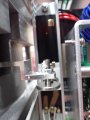
The valve containing the circuit board in question is used for pressure control in a semiconductor process. A vacuum is applied to one side of the valve and sealing bellows is actuated linearly to control pressure of the chamber as gas is into it.

What is happening is the valve is quite noisy compared to what most other are when controlling pressure at low valve angles or at about 2% of the full range of 30mm.

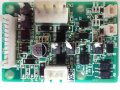
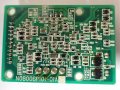
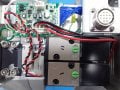
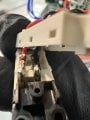
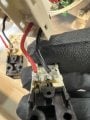
The board has 4 main outputs for the pneumatic controls and 1 connection for a linear potentiometer which should give a resistance value proportional to the valve position. The board top and bottom of the board is shown, along with the 4 pneumatic controls and the linear potentiometer.

Aside from the 5 trimmer pots 2 of which are responsible for the zero and span adjustment of the variable voltage reading taken from the board, I've identified 4 chips on the top of the board as AS324/324A LOW POWER QUAD OPERATIONAL AMPLIFIERS, two TLP185GB Photocoupler IRED & Photo-Transistors, and 3 LM385DR Dual Operational Amplifiers.

The 10 pin connector on the top of the board gets 4 different 24V supplies, one 0-5V analogue input and a 1-5V output.

When the valve is operated anywhere between fully closed or fully open one of the two smaller solenoids (connected to the twisted red and black wires) hum as if they are turning on and off rapidly. And I can only assume that issues with noise only being noticed while these are actively operating that signal noise might be linked to these or the linear potentiometers reading.

I hope this helps.
 

Attachments

MisterBill2

Joined Jan 23, 2018
27,170
OK, and THANK YOU! for the explanation and the photos. What is very clear is that this is not a simple system at all. That is a gas pressure control for part of the gas pressure control in a wafer production machine, where the tolerances are very close,and seriously affect production yield. The valves may operate in the "Huff and Puff" mode where one sources and one vents, to adjust the pressure to hold some set-point. If similar valves in similar systems fo not make the noise, the problem may be wear, or possibly leakage. I think that these are controlling another valve position, either opening or closing. My first guess is that there may be some instability caused by friction that produces a delay in response. There may also be a change in the supply pressure. I have worked with pneumatic and hydraulic servos and the failure might not be an electrical adjustment issue.
 

MisterBill2

Joined Jan 23, 2018
27,170
For mechanical devices, that motion can produce wear. REALLY, PWM is supposed to be fast enough to not cause motion. At least that is the theory.
 

MaxHeadRoom

Joined Jul 18, 2013
30,558
PWM is supposed to be fast enough to not cause motion. At least that is the theory.
I used the PC based Galil Motion cards for many of the servo and CNC DIY systems I made. Galil spec , e.g. "The DMC-40x0 Series, which accepts encoder inputs up to 22 MHz, provides servo update rates as high as 32 kHz, and processes commands " most of these used Transconductance servo amps ,
Result- NO hum. ;)
 

Thread Starter

circus_exam

Joined Sep 17, 2024
8
OK, and THANK YOU! for the explanation and the photos. What is very clear is that this is not a simple system at all. That is a gas pressure control for part of the gas pressure control in a wafer production machine, where the tolerances are very close,and seriously affect production yield. The valves may operate in the "Huff and Puff" mode where one sources and one vents, to adjust the pressure to hold some set-point. If similar valves in similar systems fo not make the noise, the problem may be wear, or possibly leakage. I think that these are controlling another valve position, either opening or closing. My first guess is that there may be some instability caused by friction that produces a delay in response. There may also be a change in the supply pressure. I have worked with pneumatic and hydraulic servos and the failure might not be an electrical adjustment issue.
Thank you for the feedback. You’re spot on about the tight tolerances.

I’m also not entirely convinced it’s an electrical issue, but if I’m to investigate a failure mode, I’m trying to develop and document the best methods for testing various parts of the whole system. However there was some pretty shotty soldering work done on the PWM components (not by the OEM) and that’s what sort of narrowed my focus on those parts. **The neater soldering is an OEM and the other is the Non OEM.

Perhaps instead of getting too much in the weeds I need to take a step back, consider the mechanics of the system.
 

Attachments

MisterBill2

Joined Jan 23, 2018
27,170
What I think that I see is that the coils may have been replaced. OR possibly repaired or substituted. How much history of this pressure controller do you have access to?? At one client of one employer, every adjustment of every thing, including turns of a trimpot, was documented in the log "P3, 2 1/2 turns CCW 10:35 AM,17 May 1985, J.Brown. (Example) So the whole history of adjustments and changes was available for both the next service person and any interested managers.

So the non-oem solder shows that something was done at some time.
POSSIBLY the other three pots could set the PWM frequency and the current for each valve solenoid. AND certainly that PCB would be a challenge to trace out the circuit from. I did not see any adjustment pots in the photos. Are they located on a differnent board?? AND what sort of failure is claimed for the system?? Total, slow, or incorrect response??
 

Thread Starter

circus_exam

Joined Sep 17, 2024
8
What I think that I see is that the coils may have been replaced. OR possibly repaired or substituted. How much history of this pressure controller do you have access to?? At one client of one employer, every adjustment of every thing, including turns of a trimpot, was documented in the log "P3, 2 1/2 turns CCW 10:35 AM,17 May 1985, J.Brown. (Example) So the whole history of adjustments and changes was available for both the next service person and any interested managers.

So the non-oem solder shows that something was done at some time.
POSSIBLY the other three pots could set the PWM frequency and the current for each valve solenoid. AND certainly that PCB would be a challenge to trace out the circuit from. I did not see any adjustment pots in the photos. Are they located on a differnent board?? AND what sort of failure is claimed for the system?? Total, slow, or incorrect response??
I'm pretty much auditing a rebuild procedure while also tracking down a root cause for failure, so as far as the history goes, I can see how many times this part has come through the facility. However, the documentation on what's ever been done (from what I've seen so far) will be lacking.
The failure claimed is that it oscillates around the setpoint too much, so I believe the response is incorrect, since it consistently overcorrects.

Also those trimmer pots are small and most have a small dab of tamperproof glue on the them. The photos taken of just the board are from one that was from the OEM so the tamperproof glue has not been removed.
 
Top