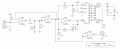
Various 4017 Things.

AnalogKid

Joined Aug 1, 2013
12,128
Misread post #1. Your schematic makes more sense now. oops. I can use the spare gate to disable the LEDs.

Now the start-up, first-half-cycle delay is even more important if the LEDs are off. A 555 oscillator with a timing capacitor bias network would eliminate much of it. Carl (and you - ?) has posted this a few times.

ak
 

AnalogKid

Joined Aug 1, 2013
12,128
Round 2. I moved the first LED back to Y0, since that was discussed with the TS earlier. Click on the schematic for a larger image.

ak

!!LED-Stepper-Game-2-c.gif
 

AnalogKid

Joined Aug 1, 2013
12,128
Are you saying the resistor values must change for different Vcc levels?
Yes.

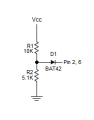
The resistor divider inside the 555 and the one outside to pre-bias the capacitor are two different ratios because of the *constant* voltage difference between them, the diode's Vf.

For example, let's say you want the cap biased to 0.333 x Vcc, exactly the same as the 555 Trigger input threshold voltage. Also, the diode Vf is exactly 0.6 V. If Vcc is 6.0 V, Vth is 2.0 V, and the voltage at the diode anode (Va) is 2.60 V. Thus, the divider needs to be (2.60 / 6.00) = 43.33%

If Vcc is 12 V, then Vth = 4.0 V, Va = 4.6 V, and the divider is (4.60 / 12.0) = 38.33%

In real life you want the cap pre-bias to be just under the Trigger input threshold voltage. The math is the same, just more messy.

ak
 

sghioto

Joined Dec 31, 2017
8,634
In real life you want the cap pre-bias to be just under the Trigger input threshold voltage.
The values of R1 and R2 do that for any level of Vcc minus the diode drop.
The voltage drop across the diode is not that important as its function is to isolate the timing cap and to rapidly charge the cap through R1 and D1 to start that first half cycle closer to 1/3 Vcc.
Normally this pre-bias is only necessary for long duration timers when first powered ON.
 
Last edited:

Thread Starter

Kim Sleep

Joined Nov 6, 2014
398
Round 2. I moved the first LED back to Y0, since that was discussed with the TS earlier. Click on the schematic for a larger image.

ak

View attachment 337623
sorry to bother you Analogue. I would like to thank you for being so helpful in the past, and now with this. I just have the question, does this effect the existing input signal into the 4017?. Is this circuit now "ready to go", for me to prototype??
 

Thread Starter

Kim Sleep

Joined Nov 6, 2014
398
sorry to bother you Analogue. I would like to thank you for being so helpful in the past, and now with this. I just have the question, does this effect the existing input signal into the 4017?. Is this circuit now "ready to go", for me to prototype??
oh, and can q1 be replaced by a standard transistor, as I dont have that mosfet in stock??
 

AnalogKid

Joined Aug 1, 2013
12,128
IRFQ740 or IRF740? The non-Q, IRF740 is massive overkill, but if you've got it, use it.

Alternative: 2N4401, 2N3904, 2N2222 - any of these with a 2.2K to 10K resistor in series with the base.

ak
 

AnalogKid

Joined Aug 1, 2013
12,128
Make sure U1 pin 15 (Reset) is low, and pin 14 is high.

U2C pin 10 is the main oscillator output. After power is applied to the circuit and things have had a few seconds to settle down, U2B pin 4 and U2C pin 8 should be high. Pin 10 should have a square wave, with the frequency adjusted with R4. The Schmitt trigger threshold voltages are not tightly controlled, but the frequency should be around 1 Hz with the trim pot at 50% rotation.

When you press the button, does the LED go out?

ak
 
Last edited:
Top