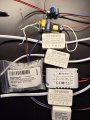
Using regular LEDs with new LED driver - the LEDs flash at 2Hz how to fix?

Thread Starter

Jgreg7

Joined Feb 7, 2026
4
I have a project where I want to power several LEDs with a small LED Driver. These are plain 5mm, 3v, LEDs, the driver is a constant current 250ma driver. I am using three LEDs with a small resistor to reduce the voltage a bit to 2.7v.

The problem is that the LEDs flash at about 2 flashes/second very consistently. I am unable to figure out why.

I have several of these LED drivers with various outputs, and all of them do the same thing (with different resistors).

I have tried adding a capacitor to the circuit at various points (sometimes several) with no apparent effect.

I must be missing something. Any ideas how to make the LEDs steady?
 

eetech00

Joined Jun 8, 2013
4,704
I have a project where I want to power several LEDs with a small LED Driver. These are plain 5mm, 3v, LEDs, the driver is a constant current 250ma driver. I am using three LEDs with a small resistor to reduce the voltage a bit to 2.7v.

The problem is that the LEDs flash at about 2 flashes/second very consistently. I am unable to figure out why.

I have several of these LED drivers with various outputs, and all of them do the same thing (with different resistors).

I have tried adding a capacitor to the circuit at various points (sometimes several) with no apparent effect.

I must be missing something. Any ideas how to make the LEDs steady?
Post a schematic.
 

Alec_t

Joined Sep 17, 2013
15,101
How much current can each LED pass without frying?
Are the LEDs wired in series or parallel?
Do the drivers come from a reputable source and are they genuine, not fakes?
Welcome to AAC!
 

BobTPH

Joined Jun 5, 2013
11,463
Plain 5mm LEDs can handle at most 20 or 30 mA. Three of them cannot handle 250 mA no matter how you wire them.

That type of LED is usually driven by a constant voltage and series resistor. Assuming 20 mA, try 5V and a 100 Ω resistor for each LED.
 

ronsimpson

Joined Oct 7, 2019
4,645
river is a constant current 250ma driver.
Something is very wrong. Please tell us everything about the "LED driver". Pictures, data sheet, link.

I think you have a Constant Current LED driver but you are pulling 20mA or something very small. The driver is upset because it wants to drive 250mA into a BIG LED that has no resistor. It thinks the driver does not see your little LEDs and is shutting down.

There are a number of "LED Drivers" on the market that are not Constant Current but Constant Voltage power supplies. They need LEDs with resistors. They are labeled for LEDs but are not. It still might be the supply needs a minimum amount of current.

Does the "blinking" rate change with load? " 2 flashes/second " Try one LED+ resistor verses two LEDs with resistors.
RonS
----edited----
Probably not but worth thinking about. There is a type of LED designed to blink. They are hard to find and cost more money. They have a built-in blinker inside the LED.
"These are 5mm Diffused (Foggy) lens SLOW BLINKING LEDs. They blink at a 0.5 Hz rate (about 30 times per minute). "
1770476520767.png
 
Last edited:

WBahn

Joined Mar 31, 2012
32,702
I have a project where I want to power several LEDs with a small LED Driver. These are plain 5mm, 3v, LEDs, the driver is a constant current 250ma driver. I am using three LEDs with a small resistor to reduce the voltage a bit to 2.7v.
Putting a series resistor in the path of a constant current source does little for you.

What current are the LEDs rated for?

Unless these are power LEDs, you are way overdriving them.

The problem is that the LEDs flash at about 2 flashes/second very consistently. I am unable to figure out why.

I have several of these LED drivers with various outputs, and all of them do the same thing (with different resistors).
How sure are you that your LEDs are not the kind that automatically blink?

You can do a simple check with a 9 V battery, a single LED, and a series resistor. If the LED is happy with 10 mA and has a nominal forward voltage drop of 3 V, use something in the vicinity of 600 Ω. Anything from about 330 Ω to around 1 kΩ will probably work.

I have tried adding a capacitor to the circuit at various points (sometimes several) with no apparent effect.
This is known as "design by happening". You make random changes and hope that, at some point, something magical occurs and the circuit will just happen to work.

Please post a schematic of how you actually have things wired. Also, posting model numbers or links to your LED driver and your LEDs themselves is very helpful.
 

Thread Starter

Jgreg7

Joined Feb 7, 2026
4
Thank you all for your responses. I have attached a photo of the LED drivers I have been using.
As for circuit diagrams, I have tried too many combinations to document, however the following is a general list:
Single LED to multiple (12) in varying combinations or series, and parallel with various resistors. The arrangements vary in brightness, however, they all exhibit the same flashing issue. I am keeping the voltage at the LEDs between 2.5 and 3.0v.
I have also tried adding capacitors in every combination I can think of with essentially no effect. However, in one instance I added a capacitor across the LED driver output connected to several LEDs and the flashing stopped for about 10 seconds until the capacitor blew up.
I am missing something, but cannot figure out what.

I started using these drivers since the simple LED circuit I made (using resistors, diodes, capacitors, and LEDs) ran quite hot at the resistor. It worked fine, but the hot resistor gave concern over long term use.

My goal is to use 120VAC and run three standard LEDs in a continuous application.
 

Attachments

ElectricSpidey

Joined Dec 2, 2017
3,312
If you want to use a constant current driver for this application, you will need one at the current you need for the LEDs with a voltage output up to 10-volts.

Place the LEDs in series without any resistor.
 

WBahn

Joined Mar 31, 2012
32,702
Thank you all for your responses. I have attached a photo of the LED drivers I have been using.
As for circuit diagrams, I have tried too many combinations to document, however the following is a general list:
Single LED to multiple (12) in varying combinations or series, and parallel with various resistors. The arrangements vary in brightness, however, they all exhibit the same flashing issue. I am keeping the voltage at the LEDs between 2.5 and 3.0v.
I have also tried adding capacitors in every combination I can think of with essentially no effect. However, in one instance I added a capacitor across the LED driver output connected to several LEDs and the flashing stopped for about 10 seconds until the capacitor blew up.
I am missing something, but cannot figure out what.

I started using these drivers since the simple LED circuit I made (using resistors, diodes, capacitors, and LEDs) ran quite hot at the resistor. It worked fine, but the hot resistor gave concern over long term use.

My goal is to use 120VAC and run three standard LEDs in a continuous application.
The LEDs in that package have a part number I can't track down -- looks like the vendor put their own label over the manufacturer's label. Can you peel that label off and determine who the manufacturer is and what their part number is?

Stop trying to control the voltage across the LED -- that's a fool's errand. The LED will establish that an it will be relatively constant in the 3 V range, give or take a bit.

The first thing to do is to determine how much current each LEDs needs. If you don't have the manufacturer's data needed to do this, use a 9 V battery and resistor in series with the LED until you get the brightness you want. Then use Ohm's Law and the voltage drop across the resistor to determine how much current that is.

You can then determine how much total current you need for various combinations of your LEDs. The best is to put them in series and use a constant-current driver that is rated at that current. Not significantly more. A constant current driver is going to do it's best to drive that current out of it's terminals. If you have a 250 mA driver and you put a series resistor that limits the current to 20 mA in your LED, that other 230 mA has to go somewhere. If you put a capacitor across the driver, that excess current will go into pushing charge into that capacitor until something gives, either the driver reaches its maximum output voltage and the current output drops (which may result in it shutting down and resetting after a short time interval, which may explain what you are experiencing), or the capacitor will charge to a voltage well in excess of what it is rated for and explode (which does explain what you experienced).

First things first -- do the test with a battery, some resistors, and a single LED to determine what current you want to drive each LED at.

And you need to stop doing design-by-happening. You were lucky in that the exploding capacitor didn't cause damage or injury. You won't always be so lucky and sooner or later you will try some random thing and start a fire or electrocute yourself.
 

ronsimpson

Joined Oct 7, 2019
4,645
It looks like the LEDs are not "blinkers".
It looks like the Drivers are CC. You have many different versions.
I can see one clearly. Its output is 250mA. It will increase the voltage trying to send 250mA. If you had a 300mA 3.1V white LED it would send 3.0V and 250mA to it. If you put two in series, it will output 6.0V at 240mA. If you put three LED in series, it will output 9.0V at 250mA. At 4 LEDs in series, it will output 12V at 250mA. At 5 LEDs it will flash, saying I can't do 250mA.

This Drier was never designed to drive less than 250mA. It output voltage goes above 12V and then gives up.
 

eetech00

Joined Jun 8, 2013
4,704
Thank you all for your responses. I have attached a photo of the LED drivers I have been using.
As for circuit diagrams, I have tried too many combinations to document, however the following is a general list:
Single LED to multiple (12) in varying combinations or series, and parallel with various resistors. The arrangements vary in brightness, however, they all exhibit the same flashing issue. I am keeping the voltage at the LEDs between 2.5 and 3.0v.
LED CC drivers are designed to drive multiple LEDs connected in series. Don't attempt to connect the LEDs in parallel and don't attempt to control the output voltage. The output voltage is supposed to be variable, that is how it provides constant current. A "programmable" CC driver can be used without a current limiting resistor.
 

BobTPH

Joined Jun 5, 2013
11,463
I started using these drivers since the simple LED circuit I made (using resistors, diodes, capacitors, and LEDs) ran quite hot at the resistor. It worked fine, but the hot resistor gave concern over long term use.
What voltage supply were you using?

The power dissipated in the resistor is proportional to the current through it and the excess voltage it is dropping.

Let’s take a 3V 20mA LED as an example. (That is likely what you have, from the look of them.)

The circuit is a constant voltage supply powering an LED and resistor in series.

For a supply of 5V, the excess voltage is (5 - 3) = 2. The current us 20 mA. The power in the resistor is 40mW.

For a 12V supply, we get 9V at 20mV or 180mW.

For 100V we get 97V at 20mA or 1940mW = 1.9W.

The way to control heat is to use a supply only about 2 or 3V more than the LED forward voltage. 5V is ideal for 3V LEDs. 12V is good for 3 3V LEDs in series.
 

MisterBill2

Joined Jan 23, 2018
27,159
I magnified the image of the drivers and read the label: The output is specified as a CONSTANT CURRENT of 260 mA,, with a no load voltage of 19 volts.
You have a totally wrong driver!!. If you put 13 LEDs IN PARALLEL across the device it might work, IF the voltage can go that low..
Probably 14or 15 LEDs in parallel could work, with each LED getting 20 MA. OF COURSE, all of those LEDs will need to be identical.
 

Thread Starter

Jgreg7

Joined Feb 7, 2026
4
The first thing to do is to determine how much current each LEDs needs. If you don't have the manufacturer's data needed to do this, use a 9 V battery and resistor in series with the LED until you get the brightness you want. Then use Ohm's Law and the voltage drop across the resistor to determine how much current that is.
I used a 9V battery and found that a 500 Ohm resistor provides the correct brightness. This gives me about 20mA for the LED. Given that I have constant current drivers, how do I use the drivers to drive 3 LEDs?
 

ElectricSpidey

Joined Dec 2, 2017
3,312
None of those drivers in that picture that I can make out the specs on will work for you.

You need something more like:

Output voltage: 3 to 12 volts.
Constant Current rating 20mA.
Input as required.

Then place the LEDs in series as I already stated in my other post.

I personally don't see the need for CC driving 20mA LEDs.
 
Top