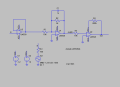
Your middle stage has the indicated gain determined by the resistors at DC where the capacitor in the feedback path has a large impedance. The actual transfer function is more complicated. That circuit is also known as a "lossy integrator".
The choice of VCC+ and VCC- has more to do with your input signals than your output. In so far as it is possible you want your power supply voltages to be larger than your input signals. In the case of a rail-to-rail opamp, which the LM358 is NOT, the inputs can get ever so close to both the positive and the negative rail. When you hav both positive an negative supply voltages you will usually have GND as your reference level. When you have only a single supply, as is common in A/D converter situations you have to modify your circuits to use VCC+/2 as your reference level. The semantic difficulty is that the meaning of "inverter" is not that the sign changes, but that the level goes to the opposite side of the reference level.
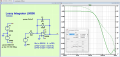
Here is what the plot of your lossy integrator looks like:
The DC gain is ≈ -8dB and at 40 kHz you are at -11 dB which is 3 dB down from the DC level
so should I increase the capacity to reduce this loss?
Also sorry but I didn't understand the VCC+ thing, I also checked the data sheet, but I didn't find any adequate formula to design my circuit
I'm not understanding much of what you asked in the last two posts. The circuit is an inverting circuit, but the gain is negative in dB because the feedback resistor (4.02KΩ) is smaller than the input resistor (10kΩ). If you do the following calculation:
That is the DC gain which matches the plot from the simulation.
Relative to VCC. You make any choice you want, but each and every choice has certain implications. If you choose +10 volts and GND to be your power supply connections, than all of your inputs and all of your outputs need to be INSIDE this range. When you go outside the ranges especially with old designs for opamps that have been around for half a century, bad things happen. Further, if you want single supply operation, ie +10V and GND, the the circuit must be modified to make (+10 V - 0V)/2 = 5V your reference point. When you do this you are restricting the range of gains you can realize. Does that make it clearer?
To take your original signal, which was in the range [-1.5V, -1.0] and transform it into a signal in the range [0.0, 5.0], you need to add 1.5 volts, then apply a gain of 10. This will map -1.5 volts to 0 volts, and -1.0 volts to +5 volts.
To do this easily straightforwardly requires dual power supplies of at least ±10 volts. There may be more optimal ways of doing this but for now, what is simple and understandable is probably better. There is time enough for getting tricky when you are more familiar with opamp circuits.

 Facebook
 Google
 GitHub
 Linkedin