Using an Opamp LM358,

Thread Starter

monika.duccoli

Joined Jan 12, 2024
72
Hi, I'm trying to amplify a sinusoidal signal with a frequency of 100 Hz, amplitude 0.25 V and offset -1.25.
To do this I'm using an Opamp LM358, with inverting input only that by effenduring I get a negative resistance I don't understand where I'm going wrong
 

dl324

Joined Mar 30, 2015
18,275
Hi, I'm trying to amplify a sinusoidal signal with a frequency of 100 Hz, amplitude 0.25 V and offset -1.25.
To do this I'm using an Opamp LM358, with inverting input only that by effenduring I get a negative resistance I don't understand where I'm going wrong
Is this schoolwork?

A schematic would be helpful. If it's homework, post the complete text for the problem.
 

Papabravo

Joined Feb 24, 2006
22,065
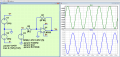
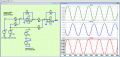
With ±5 V power supplies the opamp, which is NOT a rail-to-rail device, is having trouble reaching within ≈1V of the positive rail.

1706124069344.png

So, let's try for a bit more headroom.
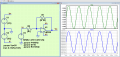
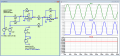
At ±15 Volts the positive peak is being clipped by the opamp, so yet more supply voltage is required.

1706124447548.png

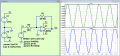
Let's try ±16.5 Volts

1706124543163.png

Ahhhh. The sweet smell of success. Except, I skipped over the second post, and I see what he wants is a bit more complicated. Back to the drawing board
 
Last edited:

Papabravo

Joined Feb 24, 2006
22,065
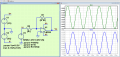
Some may consider this a one opamp problem, but using two opamps allows us to remove the offset and put it back in without having to amplify it by a factor of 10. This also allows the use of the more common supply voltages of ±12 volts.

1706127868256.png
 

Thread Starter

monika.duccoli

Joined Jan 12, 2024
72
I have a sine input signal between minus -1 V and - 1.5 , and I should get an output signal between 0 and 5 V
So I had thought before inserting a buffer, then increasing the signal width and finally using a summer to bring it into the established range
 

Papabravo

Joined Feb 24, 2006
22,065
Finally I should get a frequency response that has a low-pass characteristic with a cut-off frequency equal to 40kHz
OK well, I guess I got you started. Is there any particular requirement on power supplies or how many opamps you can use? Also if possible and it is allowed you should use a modern rail-to-rail opamp. The LM358 is more than half a century old by this time. You should be able to turn the second opamp from an inverter into a low pass filter. I would suggest a Sallen-Key 2nd order with a Butterworth response. check out this website from okawa denshi
Sallen-Key Low-pass Filter Design Tool (okawa-denshi.jp)
 

Thread Starter

monika.duccoli

Joined Jan 12, 2024
72
The opamps I could use are LM358, MCP6292, UA741 and OP07
The most appropriate seems to me LM358, however I have no limitations on the power supply, I can use a source with a maximum of 10 V
 

Papabravo

Joined Feb 24, 2006
22,065
The opamps I could use are LM358, MCP6292, UA741 and OP07
The most appropriate seems to me LM358, however I have no limitations on the power supply, I can use a source with a maximum of 10 V
In order for the opamp to deal with negative voltages you must have a dual supply of +10V and -10V. There is a limitation that most opamps have called the common mode voltage range. I do not think it is possible to do what you want to do on a power supply with a single positive voltage output and ground.

1706133203789.png

A single power supply is an epic FAIL!!
 
Last edited:

Papabravo

Joined Feb 24, 2006
22,065
You can use a single supply voltage if you capacitive couple the inputs and outputs, and bias the op amps to 1/2 the supply voltage.
You still have to add the offset back in when you are done, and I think that will be tough in a single supply environment.
 
Top