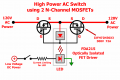
Use MOSFET to control AC power input to transformer

Thread Starter

jackxieeeeee

Joined Nov 27, 2024
17
Hello everyone
I encountered some problems while designing the circuit
I want to use MOSFET to control input of AC power to transformer
The AC power supply uses 4V 400HZ. In the future, the voltage will be increased a lot (50~100 volts) and the frequency will be increased to 1kHZ.
Use ne555 or arduino to output pulse signals to control the switching of MOSFET, so that the sine wave of the AC power supply only passes through one or two waveforms.
The pulse signal uses 9V
The purpose of the experiment is to measure the hysteresis curve of the iron powder core, which is composed by measuring the resistance of the primary side and the capacitance voltage of the secondary side. The transient state is measured by generating an excitation current through a high-voltage input.
The problem currently encountered is that the MOSFET cannot switch normally.
The MOSFET continues to conduct and cannot be turned off, or the simulation cannot operate.

I read some articles and thought that the back electromotive force of the transformer may affect the conduction of the MOSFET (if the transformer circuit is replaced with a resistive load, the switch can operate normally)
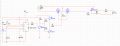
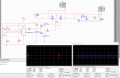
The switch can be a high-side switch or a low-side switch
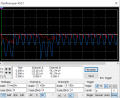
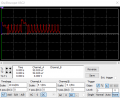
What I am currently trying is a low-side switch. I tried a high-side switch earlier (waveforms will be attached) (XC1 is the Vds of the two MOSFETs) (XC2 is the voltage across the primary side of the transformer)
And use BJT to amplify voltage and current to drive MOSFET

I would like to ask if anyone has any relevant solutions
I can add more or make modifications if needed, thank you.
Sorry my native language is not English, this article may not be easy to read
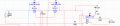
An attempt at high side switch.pngXC1.pngXC2.pngAn attempt at a low-side switch.png
 

Thread Starter

jackxieeeeee

Joined Nov 27, 2024
17
Try R2=100 Ohms and R7=2k2.
It works!(Xc2)
I want to know why this change was made
Can you tell me?
principle or logic
-
And
I'm not sure if the Xc1 waveform is right
I guess it might be the other way around?
The blue color of Xc1 is R3
Red is C3
2024-12-11 220805.png
 

Thread Starter

jackxieeeeee

Joined Nov 27, 2024
17
I have a project that requires using two MOSFETs (IRF540) connected in reverse parallel (source to source) as a switch for an AC power source. My goal is to use this switch to control the input of the AC source. The switch will be controlled by an Arduino, and a 12V battery will provide the voltage for the MOSFETs.

The load is the primary side of a transformer.
I am unsure how to design this switch circuit and where it should be placed(high or low side switch). I’ve been troubled by this for months. I hope someone can provide some suggestions.
 

KeithWalker

Joined Jul 10, 2017
3,603
I hope you have some good thick rubber gloves and boots! The gate supply for the MOS FETS will be floating at AC potential, even if you opto-isolate the controller circuit, so I would suggest that it would be much safer to switch the neutral line.
 

sghioto

Joined Dec 31, 2017
8,633
They make solid state relays for this that can be controlled by the Arduino with complete isolation.
How much current will the transformer or load draw?
 
Last edited:

LowQCab

Joined Nov 6, 2012
5,101
My provided Schematic does not use "Opto-Couplers",
it uses Isolated-Photovoltaic-Gate-Drivers.

So, the answer is no,
You can not use a PC817 Opto-Coupler.

Also, your provided Schematics show a Ground connected between the Switching-FETs,
this is incorrect and will not work, and could be extremely dangerous.

I confess that I did not carefully read what You are trying to accomplish.

What You are trying to accomplish is extremely complex and it is not likely that
anyone who has to ask questions about how to do it in a forum
is going to successfully derive any reliable information about a high-Frequency-Transformer-Core.
My estimation is that this project is way over your head,
it's certainly beyond my pay-grade.

It would appear that You are trying to build your own high-Frequency-Switching-Power-Supply to
convert Mains-Power to some lower Voltage.
This is a very complex task.
My supplied Schematic is too slow to do what You want, it will not work for your purposes.
.
.
.
 

Thread Starter

jackxieeeeee

Joined Nov 27, 2024
17
My provided Schematic does not use "Opto-Couplers",
it uses Isolated-Photovoltaic-Gate-Drivers.

So, the answer is no,
You can not use a PC817 Opto-Coupler.

Also, your provided Schematics show a Ground connected between the Switching-FETs,
this is incorrect and will not work, and could be extremely dangerous.

I confess that I did not carefully read what You are trying to accomplish.

What You are trying to accomplish is extremely complex and it is not likely that
anyone who has to ask questions about how to do it in a forum
is going to successfully derive any reliable information about a high-Frequency-Transformer-Core.
My estimation is that this project is way over your head,
it's certainly beyond my pay-grade.

It would appear that You are trying to build your own high-Frequency-Switching-Power-Supply to
convert Mains-Power to some lower Voltage.
This is a very complex task.
My supplied Schematic is too slow to do what You want, it will not work for your purposes.
.
.
.
If I modify my requirements to have an adjustable AC source frequency, with voltage adjustable according to experimental needs, starting with a frequency of 400Hz , and switching frequencies via a switch, would this be easier to achieve? Are there methods to accomplish this?
 

Thread Starter

jackxieeeeee

Joined Nov 27, 2024
17
I hope you have some good thick rubber gloves and boots! The gate supply for the MOS FETS will be floating at AC potential, even if you opto-isolate the controller circuit, so I would suggest that it would be much safer to switch the neutral line.
I'm sorry, I don't quite understand what you mean. Could you please elaborate further? I would like this switch to disconnect after outputting two to three waveforms and resume outputting two to three waveforms when needed.
 

Thread Starter

jackxieeeeee

Joined Nov 27, 2024
17
They make solid state relays for this that can be controlled by the Arduino with complete isolation.
How much current will the transformer or load draw?
They make solid state relays for this that can be controlled by the Arduino with complete isolation.
How much current will the transformer or load draw?
Are you referring to a solid-state relay module?
The IRF540 requires a higher gate voltage for proper operation.
I'm not sure how to use this module.
I previously tried using a BJT to introduce a higher voltage to replace the 5V, but encountered some difficulties.

Yes, it's the same one, but I've clarified my requirements.

The requirement is to create a switch that allows a small amount of AC source waveform to be input to the load to observe complex changes, repeating this process.
Since the experiment requires adjusting the AC source for comparison, I think I can't determine the current consumption now.
 

Thread Starter

jackxieeeeee

Joined Nov 27, 2024
17
Any reason you can't use a triac?
IRF540 is only rated at 100V, that means your AC source must be less than 70V rms.

I believe I cannot use a TRIAC because once it is turned on, it cannot be turned off.
I want to control it with an external power source, allowing the switch to conduct for a brief period when needed.
 

ronsimpson

Joined Oct 7, 2019
4,647
I don't quite understand why. Can you explain more?
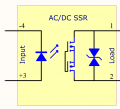
An AC/DC solid state relay has two MOSFETs and an opt isolator. Just what you want.
I believe I cannot use a TRIAC because once it is turned on, it cannot be turned off.
No. It can turn off every time the AC crosses zero.
There are several types. The older ones can be turned on at any time in the cycle. There are some that have a circuit added inside that only lets them turn on at a zero crossing.
The all can be turned off at zero. (you say turn off and then they will delay to the next zero time)
 
Check out Figure 2 in this document. Notice where the load is placed. The gates for the MOSFETs are tied to the microcontroller GPIO pin and the sources are tied to GND. Take some time to study why this is. Keep in mind that a MOSFET turns on when the Gate to Source threshold is reached. Then consider what would happen if the load is in the middle.

https://www.ti.com/document-viewer/lit/html/SSZTB27
 

Thread Starter

jackxieeeeee

Joined Nov 27, 2024
17
An AC/DC solid state relay has two MOSFETs and an opt isolator. Just what you want.

No. It can turn off every time the AC crosses zero.
There are several types. The older ones can be turned on at any time in the cycle. There are some that have a circuit added inside that only lets them turn on at a zero crossing.
The all can be turned off at zero. (you say turn off and then they will delay to the next zero time)
Sorry, I just checked a lot of information. I can probably understand what you mean.

Because the professor told me earlier that using triac would prevent the circuit from starting at zero voltage. I think he may be wrong.

I have a component here, but it's in Chinese. Can I use this module to directly link the bit I want to control without connecting Mosfets?

https://www.taiwansensor.com.tw/pro...c3J3vdmyKG7o2vqdRJypbdcZiRcbb0UpXnLshv0po1ATp
 
Top