Synchronous buck converter problem

Thread Starter

alberredon

Joined May 21, 2025
6
I have developed a synchronous buck converter, but there is something I don't understand. I am measuring the voltage drop across the low-side MOSFET. In my simulations, the voltage drop during conduction of the low-side MOSFET is negative (around -10 to -20 mV). However, real measurements show a higher and positive voltage drop.

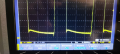
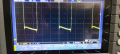
I’ve attached an oscilloscope screenshot where you can see that this voltage drop also depends on the duty cycle. The same voltage drop has been observed both with and without load. It seems like there is a DC offset superimposed, as the voltage drop across the MOSFET increases with the duty cycle.

I have also attached the schematic of the buck converter.


Voltage drop (Low side MOSFET) (Duty cycle 31%)
1747840753511.png

Voltage drop (Low side MOSFET) (Duty cycle 62%)
1747840834890.png

Voltage drop (Low side MOSFET) (Duty cycle 78%)

1747840891183.png
 

Attachments

Thread Starter

alberredon

Joined May 21, 2025
6
I have the oscilloscope ground connected to the source of the low-side MOSFET. I'm also using a ground isolator with the oscilloscope to avoid ground loops or short circuits.
 

ronsimpson

Joined Oct 7, 2019
4,645
The scope shows a picture of the Rds on of the MOSFET. I think the on resistance is 1.5m to 2m ohms.
There is probably voltage drop in the PCB.
 

Thread Starter

alberredon

Joined May 21, 2025
6
Yes, the ON resistance should be around 2 mΩ. I am measuring directly at the MOSFET pins to avoid including the PCB resistance in the measurement. However, I don't understand why the voltage drop is positive. During low-side MOSFET conduction, the voltage drop should be negative, since the current flows from GND (Source) to the switching node (Drain).
 

ronsimpson

Joined Oct 7, 2019
4,645
Many scopes see distortion when the waveform is beyond the top/bottom of the screen. Some types of scopes have a big problem with this.
It looks like you are trying to see a 10mV out of 20Volts. Many scopes cannot do that. I can explain how the front end of a scope works if you want.
 

Thread Starter

alberredon

Joined May 21, 2025
6
So you mean that I am taking an inaccurate measurement? I would be really grateful if you could explain more about the scope.
 

ronsimpson

Joined Oct 7, 2019
4,645
explain more about the scope.
The front end of a scope has an amplifier. Years ago, the HP and the Teltronics engineers had very different ideas on how to build the amp. Each method had different problem.

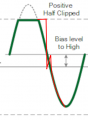
Take an op-amp with a gain of 100. Drive it with a 1V signal. (power supply is +/-10V) The output should be 100V but can't. The signal cannot go beyond the supply. Many amps cannot drive within 2V of the supply. When the output hits the limit the amplifier sets "sticky". It takes a long time for the output to pull back off the supply.
Why?
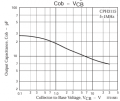
A transistor has capacitance; who's value depends on how much voltage is across the part. Here I picked a transistor at random.
The capacitance inside the part is 7pF with a voltage of 30V B-C. If the voltage is very low like 0.1V the C=28pF. An amplifier gets really slow when the output voltage approaches the supply voltage.
1747848871025.png
The problem can happen anywhere inside the amp. The input stage also has this problem.

I could not find a good example of overdriving an amp. I drew the red line from memory.
1747849441981.png
Edited------------------------
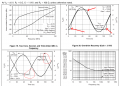
Fount it. This is what happens when you over drive any amplifier. Some are better and some worse. From the data sheet of OPA659.
1747849903143.png
 
Last edited:

Ian0

Joined Aug 7, 2020
13,097
I could not find a good example of overdriving an amp. I drew the red line from memory.
View attachment 349667
That's due to saturation of the output transistor, not capacitance. The drive circuit can't get the carriers out of the base emitter region fast enough.

The other thing going on in the TS's circuit is the charging of the MOSFET gate capacitance. That causes current to flow in the source as the capacitance charges.

A final thought - in a normal buck regulator, when the lower FET is on, the output current is decreasing, so that the voltage across the MOSFET should be getting less negative but it seems to be getting more negative. Perhaps the converter is working in reverse?
 

ronsimpson

Joined Oct 7, 2019
4,645
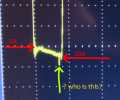
Where is zero volts in the picture?
Do you have a current probe?
Just by looking at the ramp. It looks like the current is ramping up.
I want to see the current in M2 but if we could see the current in L4 we could guess what the current is in M2 and M1. Safe and easy to lift one leg of L4 and add a probe.
I think this should start at 10A and ramp down to 5A. (wild guess)
Is the yellow arrow pointing when the Gate is driven off.
1747869813390.png
 

Thread Starter

alberredon

Joined May 21, 2025
6
Zero voltage level is indicated in the screenshot (label with number 1):
1747924121425.png


Unfortunately, I don't have a current probe. However, please note that these screenshots correspond to the buck converter operating without a load, so no current is expected through the MOSFETs. Interestingly, the same waveform is observed when I connect a load to the output. Therefore, my interpretation is that I may be taking an inaccurate measurement here.

As far as I know, the voltage drop across the low-side MOSFET during conduction should be negative, since current flows from source to drain. Could you confirm whether this is correct? In fact, I’ve measured efficiencies higher than 85% in the buck converter.
 

ronsimpson

Joined Oct 7, 2019
4,645
the voltage drop across the low-side MOSFET during conduction should be negative, since current flows from source to drain.
If you replace the MOSFETs with diodes, the voltage will be -1 diode drop. (depends on what type of diode) About -0.6V.
The MOSFET should have a negative voltage.
 

Ian0

Joined Aug 7, 2020
13,097
If you replace the MOSFETs with diodes, the voltage will be -1 diode drop. (depends on what type of diode) About -0.6V.
The MOSFET should have a negative voltage.
Just for testing, you could short the lower MOSFET gates to their sources, so they just work as body diodes.
 

Orson_Cart

Joined Jan 1, 2020
110
over-driving a scope input causes all sorts of issues for all but the finest quality scopes - hence the true 0v point shifts as you vary the V/div in overdrive.
assuming the current is vertically up in the lower mosfet - the volt drop will be small and negative.
 

Plamen

Joined Mar 29, 2015
111
Where do you have your scope earth connected?
During Off Time , the Buck inductor fly-wheels through the lower MOSFET body diode and creates a negative voltage drop of around 0.5V. This is normal as the inductor current is inertial and cannot change rapidly i.e. continues to flow clockwise from the output through the load, trough the lower MOSFET (and its body diode). In discontinuous conduction mode (light load), when the magnetic energy in the inductor is exhausted before the end of the off state, the negative voltage spike also ends prematurely.
 

Ian0

Joined Aug 7, 2020
13,097
During Off Time , the Buck inductor fly-wheels through the lower MOSFET body diode and creates a negative voltage drop of around 0.5V. This is normal as the inductor current is inertial and cannot change rapidly i.e. continues to flow clockwise from the output through the load, trough the lower MOSFET (and its body diode). In discontinuous conduction mode (light load), when the magnetic energy in the inductor is exhausted before the end of the off state, the negative voltage spike also ends prematurely.
But it's a SYNCHRONOUS buck converter, so the fly-wheel current is through the lower MOSFET, but it is switched ON, so it doesn't go through the body diode. In synchronous operation, there is no discontinuous conduction mode: at light load current flows back from load to source after the current reaches zero.
 

Plamen

Joined Mar 29, 2015
111
But it's a SYNCHRONOUS buck converter, so the fly-wheel current is through the lower MOSFET, but it is switched ON, so it doesn't go through the body diode. In synchronous operation, there is no discontinuous conduction mode: at light load current flows back from load to source after the current reaches zero.
At beginning of off time, the lower switch takes time to turn on, so the inductor current flows first upward through the body diode. Thereafter the switch takes over and lowers the voltage drop, still keeping the switching node negative.
My main goal was to explain where the negative voltage at the switching node comes from.
Discontinuous conduction mode means the inductor magnetic energy is exhausted prior to the off time end.
Accordingly as the current declines and stops, so does the negative spike.
 

Ian0

Joined Aug 7, 2020
13,097
At beginning of off time, the lower switch takes time to turn on,
That phase only lasts for the dead-time of the controller, maybe 100ns to 500ns.
Discontinuous conduction mode means the inductor magnetic energy is exhausted prior to the off time end.
Accordingly as the current declines and stops, so does the negative spike.
No, it does not. If the lower FET is still conducting, why would the current stop? There is still voltage across the inductor, and dI/dt=V/L still applies.
 

Plamen

Joined Mar 29, 2015
111
That phase only lasts for the dead-time of the controller, maybe 100ns to 500ns.

No, it does not. If the lower FET is still conducting, why would the current stop? There is still voltage across the inductor, and dI/dt=V/L still applies.
If the inductor current is exhausted, the switching node will no longer be negative and will track the output voltage (via the inductor. However, if the lower switch is still on, it will start discharging the output capacitor through the inductor.
The current in off state can only be sourced by stored magnetic energy in the inductor. Once exhausted, the load gets fed by the output capacitor. To summarize- the Buck input current is discontinuous. During on time if feed the load via the inductor (while storing there energy), during off time it stops (the load is fed by the inductor and output cap. The Buck output current is continuous (either from the input or from the inductor and cap). The Boost topology has it other way around - continuous input current, choppy output current. This makes the Buck an input power quality liability - the choppy input current creates choppy voltage drops in the input loop-affecting the input power source.
 
Top