Understanding a circuit

Thread Starter

anishkgt

Joined Mar 21, 2017
549
Hello all,
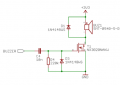
I trying to understand why there is a capacitor (C4) in series to the gate of the mosftet and is R4 meant to pull down the gate to ground to avoid false triggering ?bzr.png
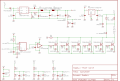
What does R11 do here ? is it to pull down the Drain to ground ? or load-share the current on that pin ?
spotwelder-sch2.png
 
Last edited by a moderator:

Deleted member 115935

Joined Dec 31, 1969
0
The way to answer these sort of questions is ask, what happens without these parts ?
 

AnalogKid

Joined Aug 1, 2013
12,126
Your question is lacking many details, so all answers will be flailing guesswork.

In the first sch, C4 turns an incoming level change, for example from 0 V to 5 V, into a pulse at the FET gate. When the input level changes, the buzzer will chirp. With the values shown, for about 2 milliseconds. That's not much, and many buzzers will not respond to that at all. Something's off there.

If the input signal is a squarewave at the desired output freq, and what is labeled a buzzer is actually a speaker, then C4 combines with D3 to form a voltage doubler for a higher gate voltage, turning on the FET "harder". For example, a 3.3 V peak input square wave will appear as approx. 6.0 V peak at the gate.

In the second schematic, R11 prevents the drains from floating when they are off. This makes them less susceptible to ESD damage. It also might create a minimum current through the load, depending on what that is.

ak
 
Last edited:

Thread Starter

anishkgt

Joined Mar 21, 2017
549
This was something i got over the internet. i was just curios of what some components does in the circuit.

Seeing capacitor C4 in series to a signal is something new. Always thought capacitors blocked DC. Then there is a R11 in the second where i understand its to be pulled down or here may load sharing. Thought somebody could help.
 

Thread Starter

anishkgt

Joined Mar 21, 2017
549
In the second schematic, R11 prevents the gates from floating when they are off. This makes them less susceptible to ESD damage. It also might create a minimum current through the load, depending on what that is.
Thanks man. That was something new.
If it was to prevent the gates from floating then shouldn't R11 be at the gate of the MOSFET than at the Drain ? or it something to do with the Gate-to-Drain concept ?
 

kubeek

Joined Sep 20, 2005
5,796
If the speaker is a piezo, then you don´t really need that capacitor. However if the speaker is a normal voice coil design, then if the input somehow gets stuck and stays high, then the transistor will stay on and the speaker will get fried quite quickly.
The pulldown after the capacitor is just to establish a way for the gate to end up at source potential without being driven, but with a microcontroller you want to keep it there as well, because when a microcontroller reboots the pins that will become outputs are high impedance inputs for a while, and the pulldown resistor keeps the correct voltage on the gate until the micro boots up and switches the pin to an output.
 

Thread Starter

anishkgt

Joined Mar 21, 2017
549
I am familiar with bypass capacitors in supplies in series to GND. There are a couple of designs that use them in series to a component such as piezo buzzer or maybe to input pins of an arduino.

What is the advantage of having a ceramic or similar capacitor in series to an I/O pin ?
 

Audioguru again

Joined Oct 21, 2019
6,826
A bypass capacitor is always in parallel, never in series. A series capacitor passes AC but blocks DC.
A parallel bypass capacitor passes AC noise to ground, smoothing the DC.
 
Top