Types of Class B Amplifers and Current Use

Thread Starter

Sir Kit

Joined Feb 29, 2012
213
As I understand, there are two types of class B push-pull amplifiers. The single supply type requires a phase splitting input transformer and results in a reversal of current during each half cycle. By contrast, the complementary symmetry type uses a dual supply and the current flows in the same direction during both half cycles.

If that is correct so far, do all class B or AB consumer audio devices, including PC sound cards, now use the second type? If not, what would be the exceptions?
 

Papabravo

Joined Feb 24, 2006
22,084
As I understand, there are two types of class B push-pull amplifiers. The single supply type requires a phase splitting input transformer and results in a reversal of current during each half cycle. By contrast, the complementary symmetry type uses a dual supply and the current flows in the same direction during both half cycles.

If that is correct so far, do all class B or AB consumer audio devices, including PC sound cards, now use the second type? If not, what would be the exceptions?
I do not think that is 100% accurate. I think you can have a class B amplifier, with a single supply, biased at Vcc/2, and AC coupled on the input and output. Long ago with tube amplifiers it was common to use transformer coupling between the stages. I haven't seen that since about 1960.
 

Audioguru again

Joined Oct 21, 2019
6,826
Audio amplifiers are never class-B which produces crossover distortion.
Amplifiers used transformers many years ago, complementary symmetry amplifiers can use a single supply voltage and input and output capacitors or use a dual supply voltage.

Many modern audio amplifiers use class-D switching at a very high frequency for efficiency.

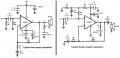
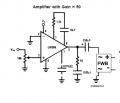
Here is a fairly old class-AB audio amplifier IC using a dual supply voltage and using a single supply voltage:
 

Attachments

BobTPH

Joined Jun 5, 2013
11,567
I don’t know what you mean about the current flow. The current to the speakers reverses for both configurations.

Bob
 

Audioguru again

Joined Oct 21, 2019
6,826
The two output transistors are usually complementary emitter-followers and are idling at half the supply voltage for a single supply and at 0V for a dual supply. The NPN pushes the output voltage positively and the PNP pulls the output voltage negatively. They are called push-pull because the signal is AC (Alternating Current). The output voltage and current go positive, negative, positive, negative with the AC signal, which maybe you say is reversing.
 

Thread Starter

Sir Kit

Joined Feb 29, 2012
213
So then, my premise was wrong. All class A/B audio amps apply alternating current.

If I have a stock hi-fi amp is there any way externally to force the current to be monopolar and not alternate between positive and negative? For example by adding a split winding output transformer and/or offset from a separate DC supply?
 

MrChips

Joined Oct 2, 2009
34,930
So then, my premise was wrong. All class A/B audio amps apply alternating current.

If I have a stock hi-fi amp is there any way externally to force the current to be monopolar and not alternate between positive and negative? For example by adding a split winding output transformer and/or offset from a separate DC supply?
Why would one ever want to do that?
 

Audioguru again

Joined Oct 21, 2019
6,826
ALL audio amplifiers produce an AC output. DC in a speaker causes its coil to permanently move and bash into the magnet structure. DC also heats the coil.

With a single supply, an output coupling capacitor feeds AC to the speaker but blocks the DC.
 

BobTPH

Joined Jun 5, 2013
11,567
You could indeed add a DC offset to an AC output from an amp, making an output that was always positive. But what would you do with it then?

Bob
 

Thread Starter

Sir Kit

Joined Feb 29, 2012
213
You could indeed add a DC offset to an AC output from an amp, making an output that was always positive. But what would you do with it then?

Bob
There is no speaker involved. I am using the hi-fi amp to experimentally drive an electromagnet and do not want the field polarity to reverse under AC. In doing so, the intention would be to not apply any continuous DC. IOW the drive signal should swing between 0 and Vpp out.

I have bench power supplies. How would you recommend adding the positive offset voltage? Is a transformer required?

Can the same be done with a negative offset voltage, using a dual supply, to enable the coil polarity to be switched via the applied signal?

To avoid mishaps, I would appreciate a few sound ideas to try.
 

Ya’akov

Joined Jan 27, 2019
10,262
Where does the input to the amplifier come from? I realize you said this is "experimental" but it would be exceedingly useful to know just what the experiment and its goals are in order to render useful help and not just make guesses based on changing information.
 

MrChips

Joined Oct 2, 2009
34,930
Hi-fi amps are designed to amplify music or audio signals. They generally do not have frequency response down to 0Hz. What you need is a power op-amp. For example, Kepco makes power supplies that do this.
 

Thread Starter

Sir Kit

Joined Feb 29, 2012
213
The amp input is line level audio frequencies from a function generator. The objective is to create a unipolar magnetic field at various frequencies for seed germination exps. There is no DC, as in 0Hz, required.

To the greatest extent possible, I would prefer to use a "standard" home amplifier so other people without construction skills can replicate. As previously mentioned, the question is how to simply (if possible) convert its AC output to unidirectional current.

Thank you for the advice so far.
 

ericgibbs

Joined Jan 29, 2010
21,470
hi SK,
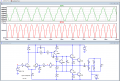
If I read your requirement correctly, you could use a full wave bridge rectifier, to give an unidirectional current.?
E
Added: A demo circuit.
EG 997.png
 

Attachments

Last edited:

BobTPH

Joined Jun 5, 2013
11,567
Eric: If you don’t mind changing the waveform and doubling the frequency.

You could simply put the audio out in series with an isolated DC supply.

Bob
 

ericgibbs

Joined Jan 29, 2010
21,470
hi Bob,
As you say, there are a number of options, I have posted the basic idea to give the TS food for thought.

Let's see which way he wants to go.:)

E
 

BobTPH

Joined Jun 5, 2013
11,567
hi Bob,
As you say, there are a number of options, I have posted the basic idea to give the TS food for thought.

Let's see which way he wants to go.:)

E
Agree. I think my comment sounded like a criticism of your idea, it was not, I just intended to point out that you get a different output the two methods.

Bob
 
Top