Diode types for receiver

DickCappels

Joined Aug 21, 2008
10,661
Most times a germanium diode is used for such receiver.
1N34A and 1N60 are types that are often used.
Just a note: Using authorized distribution I can get plenty of 1N60's but most of them are Schottky. It is not easy to tell the difference between the Schottky and Germanium versions with a DMM because at room temperature the two are quite similar for diodes of about the same current rating. The difference jumps out at you when you compare forward voltage as a function of temperature for suspect devices.

From the web:
The forward voltage of a Si diode will drop by about 2.1 mV/°C (negative temperature coefficient, NTC). For a Ge diode this NTC is a bit higher at 2.5 mV/°C.
The effect is almost perfectly linear, so if you want you can make the diode a temperature sensor by supplying it with a constant current.


This is consistent with my observations. A DMM and a soldering iron is all you need to easily tell the difference.
 

KeithWalker

Joined Jul 10, 2017
3,603
Mazragors, don't let the experts confuse you with their extensive knowledge. Both germanium and Schottky 1n60 diodes will work well in a crystal set circuit.
 

Ramussons

Joined May 3, 2013
1,567
Hello,

The circuit you show is a so called "crystal receiver".
Most times a germanium diode is used for such receiver.
1N34A and 1N60 are types that are often used.

Bertus
A crystal receiver uses a Point Contact Diode. Can that be generalised as a Germanium Diode?
 

crutschow

Joined Mar 14, 2008
38,316
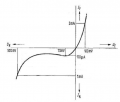
The most sensitive diode detectors are back diodes, which are basically tunnel (Esaki) diodes operated in reverse.
The high sensitivity results from their conduction current-voltage curve going through zero with a very low forward drop (example below):
Of course the trade-off is that their maximum blocking voltage in the reverse direction is only a few tens of mV, so can only be used with very low signal levels (which would likely be typical of a crystal radio receiver).
And they are typically only used for high microwave frequencies mounted in a microwave module, and are expensive (although there are some old, inexpensive tunnel diodes on ebay, which might work okay for hobby use).

1758821397437.png
 
Last edited:

crutschow

Joined Mar 14, 2008
38,316
A crystal receiver uses a Point Contact Diode. Can that be generalised as a Germanium Diode?
Not really.
A point contact diode with a (typically) galena crystal is basically a metal-semiconductor Schottky diode, so the closest diode to that for use in a crystal set would likely be a low-current Schottky type such as a BAT54.
 
Last edited:

sparky 1

Joined Nov 3, 2018
1,218
Both sensitivity and selectivity can be affected by capacitance, not just Vf, the point contact having lower capacitance
Because crystal radio relies on what comes from the antenna, putting a load on the tank has limitations.
Capacitance a closer look, the 1N5819 Schottky power diode compared to a small signal low barrier Schottky like the HSMS 5820
whose manufacturing process improved "junction area control" for lower capacitance and very repeatable
characteristics. Looking back to a low capacitance Galena Cat Wisker design where receiver resonant Q is less affected.
Using a microscope and various techniques not widely published reducing capacitance from 16pF down into the femto
is only part, the rest of the receiver and antenna Q that all components have to match that performance or the receiver.

A diode that has been successfully employed and whose 1 pF capacitance acceptable in MW for practical high performance.
Some continue to search for the holy grail diode did not appreciate testing all the receiver components and becoming familiar
with the terminology of the better RF Small Signal diodes found in specific datasheets that work good in radio demodulation and
also having the documentation regarding spice parameters that are key in having a working simulation to make improvements.
 

Attachments

Last edited:

graybeard

Joined Apr 10, 2012
118
The early crystal receivers used a galena crystal. Galena is a crystalline form of lead sulfide.
You brought back a memory.

The first radio I made as a Cub Scout in the 60s. It used a cat-whisker wire and I had to find the right spot on the galena crystal to get it to work. :)
 
Top