TVS diode working principle

Thread Starter

andrew74

Joined Jul 25, 2022
204
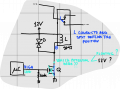
Let's consider this circuit (I drew it myself as an example).

In the light blue case, what potential is there at the lower terminal of the electromechanical relay's coil L if the uC output is low and therefore the MOSFET doesn't turn on?
SmartSelect_20260111_110904_Samsung Notes.png

I understand that TVS diode conducts when the voltage across it exceeds a certain breakdown value, but assuming that in the light blue case it did not exceed it... I don't understand if it is a simple short that lets the 12V pass.

We can assume that the TVS is this to give an example
 

Rf300

Joined Apr 18, 2025
72
The voltage at the lower pin of the coil (and therefore at the drain of the FET) will be 12 V. You can consider it as a simple voltage divider between the coil resistance, maybe about 100 Ohm, depending on your coil, and the off-resistance of your FET which will usually be > 10 MOhm. Do the math by yourself.

BUT: I would not recommend a bidirectional TVS-diode in parallel to your coil! This diode is used to clamp the voltage at the drain of the FET due to back EMF when switching the FET off. The voltage at the drain will be the supply voltage plus the forward voltage of the clamping diode. Since you linked to a 26 V TVS diode, the clamping voltage will be about 30 V (from my experience, I didn't read the data sheet). So the drain voltage will be about 42 V! Just use a simple fast switching diode or schottky diode, cathode to + 12V, anode to drain. This will reduce the drain voltage to less than 13 V.
 

ronsimpson

Joined Oct 7, 2019
4,645
The 26V TVS is probably too high a voltage. You need a part that does not even think of turning on at 12V when the MOSFET is on. I think 16V might be better.

We normally use a simple diode there.

Why? A diode keeps the "flyback" voltage down to 1V above the 12V supply. (one diode drop) This causes some delay when opening up the relay. (mS) Using a TVS where the flyback voltage is 16V (or 26V) will reset the relay faster. Most applications don't care about a small amount of delay.
 

crutschow

Joined Mar 14, 2008
38,316
As noted, a simple diode is usually used to clamp the flyback voltage.

If you need to minimize the relay turn-off delay this causes, you can add a small resistor in series with the diode.
That will increase the peak flyback voltage by the value of that resistance times the nominal coil current.

If that resistance is made equal to the relay coil resistance, for example, then the relay coil flyback voltage would be essentially equal to the supply voltage, and the peak voltage seen by the MOSFET would be twice the supply voltage.
That value would essentially half the decay time of the relay coil current.
 
Last edited:

Thread Starter

andrew74

Joined Jul 25, 2022
204
The 26V TVS is probably too high a voltage. You need a part that does not even think of turning on at 12V when the MOSFET is on. I think 16V might be better.

We normally use a simple diode there.

Why? A diode keeps the "flyback" voltage down to 1V above the 12V supply. (one diode drop) This causes some delay when opening up the relay. (mS) Using a TVS where the flyback voltage is 16V (or 26V) will reset the relay faster. Most applications don't care about a small amount of delay.
Thank you for the explanation.

I would appreciate it if you could explain in more detail why the TVS diode resets the relay faster.
As I see it, the TVS has a higher voltage (and therefore more energy), accelerating the discharge and thus the opening of the relay.
Am I wrong?
 

crutschow

Joined Mar 14, 2008
38,316
I would appreciate it if you could explain in more detail why the TVS diode resets the relay faster.
The diode absorbs the inductive energy stored in the relay coil inductance from the coil current, so the higher the clamping voltage, the fast the energy is dissipated, and the faster the magnetic field holding the contacts closed, collapses.
But there is a effective limit on how much this can speed up the relay turn-off, since it can't reduce the time it takes for the contacts to move from closed to open as determined by the return spring and the mechanical inertia.

You can estimate the magnetic field collapse time from the inductive current change-rate formula, di/dt = V/L. where L is the coil inductance and V is the clamp voltage.
When that collapse time to zero current is significantly lower than the spec'd relay spec'd release time, than further increasing the clamp voltage will have little effect on the release time.
 

ronsimpson

Joined Oct 7, 2019
4,645
I want to answer, but backwards.
The relay coil is an inductor.
When the MOSFET first turns on, the current is zero. The current ramps up over time. The slope of the current ramp is related to 12V/L. (simplified) The relay cannot pull in until the current reaches the pull-in level.
When the MOSFET opens up the inductor wants to "fly up" above the 12V supply. To get the current to ramp back down you need voltage across the inductor. If a 0.65V diode is used the slope will be 0.65V/L. The current needs to ramp down to the dropout current.
A slope of 12 is short while a slope of 0.65 is slow. (in most cases we do not care)
 

crutschow

Joined Mar 14, 2008
38,316
A slope of 12 is short while a slope of 0.65 is slow. (in most cases we do not care)
Interestingly, you can't ignore the coil resistance.
For a typical small relay the turn-on and turn-off time-constants are dominated by the L/R value of the coil, so the two times are relatively close to the same with a diode clamp.
 

Thread Starter

andrew74

Joined Jul 25, 2022
204
Yes, I did not want to get into more math. So, I gave a simplified version.
OK.
But effect of the resistance basically negates your statement about the difference in the relay coil current charge and discharge time for a diode clamp.
If it's not too complicated, could you include the coil resistance in the calculations?
Just so I can understand the whole picture.

Thank you
 

crutschow

Joined Mar 14, 2008
38,316
Edit: Refined simulation--
Shows longer difference between operate and release time than originally stated.


Basically the charge and discharge time-constants are determined by the L/R value of the relay coil.

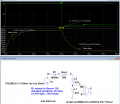
I'm not much into doing the math, but below is a simplified simulation of a relay coil charge and discharge times.
The values are for a typical 2A, 12V relay from Omron
Note that the relay open-state inductance is significantly less then for the relay closed-state, due to the contact armature adding a lower magnetic reluctance when closed.

S1 opens to simulate the change from the low inductance to the high inductance state at 31mA current, where the contacts are specified to close (here occurring at about 2.3ms).
D1 simulates the diode clamp across the coil when the input voltage goes to zero.

V(1) (green trace) is the relay coil voltage.
Note the -0.7V clamp voltage from the diode drop when the relay is turning off.

I(L2) (yellow trace) is the coil current.
(The sudden reduction in coil current at 2.3ms is due to simulation limitations, which does not allow an inductance change during the simulation time. It would not occur in the real circuit.)

As you can see, the release point of the relay is about 3.6ms longer than the operate point, for those conditions.
(Note that the operate time is longer in the data sheet, likely due to the intrinsic inertia delay for the contacts to close after the must operate current is reached).

1768501539472.png
 
Last edited:
Top