10A10 diode - Schottky?

Thread Starter

B-JoJo-S

Joined Jan 3, 2026
210
I was looking at a Datasheet for what Amazon is telling me is a Schottky diode. The data sheet for the 10A10 specifies 1.2V forward. That's not what I want. What I'm looking for is a 10 amp diode with a 0.6 (or real close) Vf.

Why? you ask? Because I've figured out how to trick my alternator into putting out 14.4V as opposed to the standard 13.8V. Adding a diode into the sense line (at the fuse box) will make the alternator sense a lower voltage and try to push it up to what it thinks is 13.8V when in reality it will be pumping out 14.4V.

Why a 10A diode? Because the fuse that is going to protect the circuit is a 7.5A fuse. I don't expect to find a 7.5A diode. Besides at 7.5 the diode is not protected.

Any questions? Comments? Concerns? Recommendations?
 

Thread Starter

B-JoJo-S

Joined Jan 3, 2026
210
YIKES! $6.99 shipping. Doesn't make sense to order a single diode or even 5.

Will take that under advisement. But a sincere thank you.
 

dl324

Joined Mar 30, 2015
18,216
Because I've figured out how to trick my alternator into putting out 14.4V as opposed to the standard 13.8V. Adding a diode into the sense line (at the fuse box) will make the alternator sense a lower voltage and try to push it up to what it thinks is 13.8V when in reality it will be pumping out 14.4V.
The 13.8V number is probably when the engine is idling. At higher revs, it will be closer to 14.4V. Increasing it another 0.6V would likely be too much for the battery (long term).
 

sghioto

Joined Dec 31, 2017
8,633
YIKES! $6.99 shipping. Doesn't make sense to order a single diode or even 5.

Will take that under advisement. But a sincere thank you.
The minimum shipping is $4.99 using USPS Ground.
Order some other components you might need later.
They are available through Amazon but not Prime, order at your own risk.
Sometimes you have to write it up to the "Cost of Doing Business"
 

Thread Starter

B-JoJo-S

Joined Jan 3, 2026
210
Datasheet claims a 0.55 to 0.57Vf at 125˚C (257˚F). Not sure how warm it will get in the summertime under the hood. I doubt it will have to conduct 7.5A. Don't know how many amps the sense circuit of my alternator will draw; it's just protected at 7.5A. Would have to assume 5A is not big enough, that's probably why they went with 7.5A, to give them a margin of protection above and beyond what is expected.
The 13.8V number is probably when the engine is idling. At higher revs, it will be closer to 14.4V. Increasing it another 0.6V would likely be too much for the battery (long term).
Shortly after starting the engine a high idle for several seconds to a minute (closer to 10 seconds) the dash board panel volt meter shows 13.8V. Once idle calms down voltage can drop to 13.6V. At highway speeds the meter never shows more than 13.8 to 13.9; depending on the age of the battery.
The minimum shipping is $4.99 using USPS Ground.
Order sheet shows $6.99 shipping. Will have to investigate if there's another shipping option. But like you said - cost of doing business. So I won't have that morning coffee one day this week.
 

dl324

Joined Mar 30, 2015
18,216

Thread Starter

B-JoJo-S

Joined Jan 3, 2026
210
Actually looking at a similar device:
STPS1045D
Seems to have the same characteristics but with a slightly more favorable Vf. (my opinion)
 

Thread Starter

B-JoJo-S

Joined Jan 3, 2026
210
As I may have mentioned in another post, I've put AGM's in both my wife's car and in my Rav4. The video below is how I am looking to change the voltage on my Rav4. The 2017 Rav4 has the same electrical charging system as the 2017 Tacoma. As for my wife's Venza, that car has an ALT-S fuse (Alternator Sense Voltage regulator fuse [7.5A] ). This is where I plan on putting the diode. Not in my car, in my wife's car.
https://www.youtube.com/embed/qUQTOd54G7w
 

Thread Starter

B-JoJo-S

Joined Jan 3, 2026
210
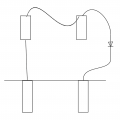
Don't know how well this drawing can be understood; but I'm pulling the 7.5A fuse (wife's car) and connecting one lead to a diode then putting the remaining leads back into the fuse box. The two lower rectangles represent the socket where the fuse normally goes. The upper two rectangles represent the leads of the fuse. Using a fuse extender (I know that's not what it's called) I'm going to introduce the questioned diode and connect it back to the fuse box. It will drop the sensed voltage by 0.6V which will make the alternator compensate for the dropped - sensed voltage. The result will be the battery getting 14.4V instead of 13.8V. I know these voltages because I have a panel meter in the car to tell me the voltage at all times when the engine is running.
Screenshot 2026-01-14 at 12.23.39 PM.png
Again, I have never had any issues with voltages in the car. Nor with amperage pulling the voltage down because of a weak connection. Perhaps this thread should be merged in with the other thread, the one about the battery voltage (cold resting voltage) being 11.78 volts (or something like that).

This thread - all I was asking for was a Schottky diode. The 10A10 isn't a Schottky and has a forward voltage drop of 1.2 volts. Use of that diode would have boosted battery voltage up to 15 volts. I don't want 15 volts. 14.4 is what I want for charging the battery properly. And yes, I'm referring to the other thread now. Sorry for the confusion.
 

MisterBill2

Joined Jan 23, 2018
27,159
None of the cars I have owned in the past 60 years has had the regulator mounted or even attached to the alternator. That seems to me to be a very poor choice, especially since the alternators are now out of the airflow from the fan. Much simpler to service or check when mounted someplace else. AND, no reason to replace the alternator if the regulator fails!! And a rebuilt alternator costs well over $100 while a NEW regulator is probably up to $25 by now. The one I bought was $18, back in 1974.
 

Thread Starter

B-JoJo-S

Joined Jan 3, 2026
210
I remember my father's car. He pulled a faulty regulator off. The contacts kept sticking and over-volting the system. I remember the wire wound resistors and maybe a ceramic resistor or two. I also remember the ballast resistor for the 12 volt ignition coil. There was a reason why it was called "Hot-wiring a car". You literally bypassed the ballast resistor with a wire from the battery. And the coil got hot. I remember playing with all that stuff.
 
Top