Thank you, it helps. Then coil should be recalculated for 10kHz upper frequency.
And one more question: What is desirable value of magnetic field strength amplitude inside coil?
For example, strength of Earth's magnetic field is 0.00005 Tesla.
PA speaker transformers are 70.7V RMS in North America which is 200Vp-p.
70.7V at 25W is a 200 ohms impedance that your magnetic coil must produce at your frequency (10Hz?).
The coil is the load, where and why add a 400 ohms resistor?
Many PA transformers do not pass frequencies below 100Hz.
I may not want to wind 400 (or 200) ohms worth of magnet wire. Hence the added resistor. But my question is really about the DC shift for unidirectional current. The rest I can probably sort out under test.
Maybe I should have explained better. The DC offset would be applied in series with the secondary and magnet. I would limit the transformer output to 24V so I can offset with a 12V wall wart or similar. I like this approach because it can be set up by persons with minimal electronics knowhow.
The full output of the hi-fi amplifier would be available as drive current. If necessary, I would crank back the volume knob to reduce field intensity. I am not trying to replicate natural background levels as such.
The impedance of a transformer is not its DC resistance. Impedance is AC and the resistance must be very low for high efficiency so that 65W input produces 60W (not 6W) of output.
Adding DC to a transformer might saturate its core producing extreme extra power needed from the amplifier and lots of distortion.
Thank you, it helps. Then coil should be recalculated for 10kHz upper frequency.
And one more question: What is desirable value of magnetic field strength amplitude inside coil?
For example, strength of Earth's magnetic field is 0.00005 Tesla.
The full output of the hi-fi amplifier would be available as drive current. If necessary, I would crank back the volume knob to reduce field intensity. I am not trying to replicate natural background levels as such.
Coil, recalculated for 0-10kHz frequencies:
Inner diameter 110mm
Outer diameter 121mm
Height 30mm
Magnet wire diameter 1mm
Number of turns 145
Inductance 2 mH
Resistance 0.923Ω
Magnetic field strength 0.026T (@ current 4.3A)
==============================
Coil, directly feeding from amplifier, requires 275Vp for current 4.3A, so power of amplifier should be about 1 kW.
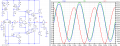
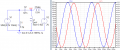
However using circuit below, power, provided by amplifier, may be decreased to few watts:
The amp input is line level audio frequencies from a function generator. The objective is to create a unipolar magnetic field at various frequencies for seed germination exps. There is no DC, as in 0Hz, required.
To the greatest extent possible, I would prefer to use a "standard" home amplifier so other people without construction skills can replicate. As previously mentioned, the question is how to simply (if possible) convert its AC output to unidirectional current.
The solution will not be to use an amplifier at all. The device that will supply a strictly unipolar voltage at some power level is a programmable power supply. Those are available in ranges from a few watts to quite a few Kilowatts, and the external programming frequency response range is varied. Usually these are "laboratory" devices intended for that exact application so your design efforts will be much simpler.

 Facebook
 Google
 GitHub
 Linkedin