Trouble with Falling Edge Monostable Trigger, 555

Thread Starter

Mark&Phoebe

Joined Aug 15, 2024
19
R1 = 22k
C1 = 10uF

I also changed C2 = 100nF, and here I DID see V go right down at #2 when beam was interrupted. However, the problems are not resolved yet; #3 doesn't go high when it's supposed to.

What does seem to happen is random; sometimes the relay activates when beam is broken, mostly not. I have not even been able to get it to work with scope probes on #2 and #3 simultaneously.
 

Thread Starter

Mark&Phoebe

Joined Aug 15, 2024
19
No improvement, I'm afraid. I get a few random relay activations when I first power on, then it becomes unresponsive.

I'm afraid I have to stop now, I will be back early tomorrow morning.

Thank you again.
 

panic mode

Joined Oct 10, 2011
4,995
did you ever get the relay to turn on - at all? low voltage relays need more current. your power source may be a problem. or may want to put fat cap across 5V and GND...

the other issue is that your schematics shows that supply is just 5V but relay coil is wired from 555 output to GND. this is not favourable as 555 output drop voltage considerably (up to 2V). a better alternative is to use external transistor. then voltage drop will be tiny.

next, is there any load connected to the relay contacts? it may cause contacts to stick (weld).

finally, did you try to test your circuit without relay? just add LED and 220 Ohm resistor. this would allow you test the circuit logic without load and issues related to load, once this works, all that is needed is drive the relay.
 

Thread Starter

Mark&Phoebe

Joined Aug 15, 2024
19
did you ever get the relay to turn on - at all? low voltage relays need more current. your power source may be a problem. or may want to put fat cap across 5V and GND...
Let me give you a short history: when the device is wired as simply as possible, as shown in the first schematic, it works like a charm. 40 relays, each independent, activate 40 solenoids when needed. It has worked without issue for the last 6 years.

I am using exactly the same power sources now when I prototype, so I feel those should be OK.

the other issue is that your schematics shows that supply is just 5V but relay coil is wired from 555 output to GND. this is not favourable as 555 output drop voltage considerably (up to 2V). a better alternative is to use external transistor. then voltage drop will be tiny.
From what I have seen, the trigger outputs very close to 5V to the relay, so I think I'm OK there.

next, is there any load connected to the relay contacts? it may cause contacts to stick (weld).


finally, did you try to test your circuit without relay? just add LED and 220 Ohm resistor. this would allow you test the circuit logic without load and issues related to load, once this works, all that is needed is drive the relay.

Yes, I've tested everything both with and without relay, and relay with and without load. I'm beginning to think the photo-transistor may not be as straightforward as it appears. It's the only thing I can think of that's throwing sand in the gears . . . after all, it works absolutely like it's supposed to when the collector is connected to 5V, Pin #2 simply has the emitter from the p-t connected to it, and a 22k resistor from it to Ground. I just wanted it to give me a nice pulse on a negative edge . . .
 

Thread Starter

Mark&Phoebe

Joined Aug 15, 2024
19
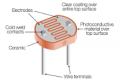
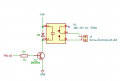
I got reliable operation adding Q2 to the mix in this configuration using a photocell for Q1.
May need to adjust R1 depending on the impedance of Q1 when the laser beam is on.
View attachment 330144

I'm delighted to tell you this circuit WORKS! Break the beam and the relay kicks on for .8 seconds, then turns off. If the beam is permanently interrupted, same thing. THANK YOU!!!

Now, I do have 2 questions:

1) When put Pin #3 on the scope, I got a little over 3V as the relay ticked (same when I tested voltage across the relay). I see from the datasheet this relay has a pick-up voltage of 3.8V, so I would have thought that there wasn't enough voltage to set off the relay, but so far it has kicked off every single time. Maybe I'm not understanding this correctly?

2) Would it be possible to decrease the on-time for the relay? I ask because I first tried reducing the timing resistor from 33k to 22k, but while the relay would activate, it would not turn off if the beam stayed interrupted. Ideally, we would like to have the relay activation time be around 0.25s.

Thank you all again so much!
 

sghioto

Joined Dec 31, 2017
8,634
I ask because I first tried reducing the timing resistor from 33k to 22k, but while the relay would activate, it would not turn off if the beam stayed interrupted. Ideally, we would like to have the relay activation time be around 0.25s.
I'm not seeing that problem on my test circuit with R4 at 22K and C2 at 10uf, appx 240ms relay ON time.
I using the same relay listed on the schematic.
Is the 5 volt supply stable?
Is the diode installed across the relay coil?
 
Last edited:

Thread Starter

Mark&Phoebe

Joined Aug 15, 2024
19
I'm not seeing that problem on my test circuit with R4 at 22K and C2 at 10uf, appx 240ms relay ON time.
I using the same relay listed on the schematic.
Is the 5 volt supply stable?
Is the diode installed across the relay coil?
Regarding the first part, the values across the timing portion (Pins #6 & 7, etc) the resistor listed in the schematic (post 29) I followed is 33K and C2 at 22uF, hence the 0.7986s signal duration.

The 5V is from a really good power supply, a Kikusui, and the diode (1n4001) is across the coil.
 
Top