Trouble soldering copper cable to pcb pads/tracks

Thread Starter

gray-b

Joined Aug 4, 2025
87
The copper cable I am using is very fine, a bit like a USB cable.

But I just cannot get solder to stick to tracks or pads. All of the SMD components have had solder paste used, and I cannot get the solder to mix.

I am using flux-cored leaded solder, and I have also tried PCB flux.

But it does not spread or flow. It just leaves a blob. The temperature is at 330 deg C

I have never had this problem before, and I put it down to maybe the wire is not 100% copper.

Any advice or guidance?
 

ericgibbs

Joined Jan 29, 2010
21,413
hi gray,
Lots of wires these days are just steel wires which have been copper plated or 'flashed'
It's cheaper to produce.
I have had some success with solder designed for aluminium soldering.

E
 

dl324

Joined Mar 30, 2015
18,260
cannot get solder to stick to tracks or pads. All of the SMD components have had solder paste used, and I cannot get the solder to mix.

I am using flux-cored leaded solder, and I have also tried PCB flux.
What do you mean by "mix"? To bond?

Is the flux liquid or paste?
I put it down to maybe the wire is not 100% copper.
Is the wire copper plated or tinned? I've soldered copper coated steel wires from some AliExpress jumpers and didn't have to use extra flux to solder them.

Have you tried tinning the pads first?
 

vandveuser16776

Joined Feb 21, 2026
141
Prepare the board and the wire tips before soldering anything. I recommend two types of solder paste. One is slightly acidic (the one in a can) and does an excellent job of fluxing the surfaces; the other is better suited for final soldering.
This is how I do it: First, polish the board with fine sandpaper—grit 800 or higher—if the copper is not perfectly shiny. Then apply a small amount of the acidic flux to the mounting pads and dip the wire tips into it. Next, fine-tune the soldering iron temperature. The heat should be just enough to melt the solder wire quickly and easily upon contact with the tip.
Then tin the wire ends and the pads on the board. After that, clean all flux residues from the board and wire tips using a paper towel. For soldering SMD components, use the paste from the tube.
PS. Make sure your wires are real copper. Remove the coating and cut several 1mm sections and put them on a paper. get a strong magnet and test to see if it picks the small shavings. If so, your wires are bad. And how for long have you been using this soldering Iron?
 

Attachments

vandveuser16776

Joined Feb 21, 2026
141
Really? man, when did that start?
The world has been facing a copper shortage. For at least the past 20 years, aluminum magnet wire has increasingly replaced copper in AC motors and transformers.
Refrigerators used to have copper suction lines from the evaporator and copper capillary tubes. First, the suction line was replaced with aluminum; now even the thin capillary tube is often made of aluminum. This has made repairs and refrigerant refilling more difficult.
 

Reloadron

Joined Jan 15, 2015
7,868
Your temperature is more than adequate. I would clean the pads on the board using 0000 steel wool and after that wash things down using isopropanol alcohol and an acid brush with bristles cut short at an angle. Scrub things down real well. What solder are you using? I like the old classic 60/40 Kester. Make sure your tip is clean, wiped down. When soldering always remember, the bigger the blob, the better the job.

Ron
 

Thread Starter

gray-b

Joined Aug 4, 2025
87
I think I found the problem, but I am not sure why.

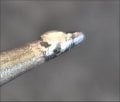
I noticed solder bubbling on the solder iron, but not on the very tip. No way could I get the solder all over the tip. Flux on the tip did not make any difference or using the copper mesh pad used for cleaning tips.

solder-tip-20260421_174834.jpg

I then used a new tip, and that was the same.

So my initial problem may have been due to not enough heat transfer from the very tip.

It's as though there is some contamination of the copper tip.

Now having filed the tip to thoroughly clean it up, it does not seem to be copper, but a silvery finish. So not sure what material it is ??

But as soon as cleaned the tip, it went black in that same area under the heat. But still the solder would not cover the tip.

Any clues ?? or ideas

Might have to get some new ones.
 

dl324

Joined Mar 30, 2015
18,260
So my initial problem may have been due to not enough heat transfer from the very tip.
The tip looks oxidized. Strange that a new tip would have the same problem unless it was also oxidized. While this behavior is not desirable, it shouldn't affect solder bonding on wires/pads if the solder is melting.
It's as though there is some contamination of the copper tip.
You don't mention the tip brand, but my Weller tips have an iron coating on a copper tip. The non-working area is then coated with aluminum to prevent oxidation of the iron.

1776796324730.png
Now having filed the tip to thoroughly clean it up, it does not seem to be copper, but a silvery finish. So not sure what material it is ??
Unless you know what you're doing, and are very careful, you should never file a tip.

I've used (gently) the edge of an X-acto blade to scrape off stubborn oxidation that couldn't be removed with solder and flux, but I'd never use a file or sandpaper. That's just too abrasive and will remove the iron cladding and then the tip is toast.
 
Last edited:

Thread Starter

gray-b

Joined Aug 4, 2025
87
The brand used is a non-descript Aliexpress type.

Just put in a different new one from another Aliexpress supplier, this seems to work.

I have 3 different sorts: Pure Copper, Copper Iron Alloy, and Electroplated Iron.

I can disregard Pure Copper. I am not sure which of the other 2 it can be. I assume it might be Electroplated Iron, and the plating might be so thin it just wears away so quickly (especially when you file it off).

Again, I assume the other tip just put in is the Copper Iron Alloy.
 

MisterBill2

Joined Jan 23, 2018
27,271
The copper cable I am using is very fine, a bit like a USB cable.

But I just cannot get solder to stick to tracks or pads. All of the SMD components have had solder paste used, and I cannot get the solder to mix.

I am using flux-cored leaded solder, and I have also tried PCB flux.

But it does not spread or flow. It just leaves a blob. The temperature is at 330 deg C

I have never had this problem before, and I put it down to maybe the wire is not 100% copper.

Any advice or guidance?
It sounds like possibly two separate problems: The not being able to even tin the PCB traces MIGHT be due to an invisible coating. BUT not being able to solder wires to the PCB is also probably due to just plain insufficient heat energy at a high enough temperature to make the flux work. THAT is when you need one of the cheap 30 watt solder pens that used to sell for less than $10. The temperature AND the heat capacity (two completely differet things) must be adequate to activate the flux and also heat the wiire hot enough for the solder to wet it. The temperatur controlled iron is probably perfect for surface mount components but not to heat the wire hot enough.
 

panic mode

Joined Oct 10, 2011
4,915
When tip is oxidized, tip cleaner is a great help.
Make sure the metal surfaces you tey to solder are tinned before connecting them to something else. If wire is enameled, strip the coating. Also your soldering tip is not helping. Conical tips are notorious for pulling solder away from tip. Try chisel shape tip..
 

dl324

Joined Mar 30, 2015
18,260
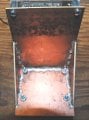
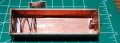
I use a 1/32" conical tip almost exclusively. Including when making copper clad boxes that take a lot of heat and solder.
copperCladBox.jpg18650-18500Box.jpg
 
Last edited:

Thread Starter

gray-b

Joined Aug 4, 2025
87
I am beginning to wonder if it's the soldering iron. So I have ordered a new Silverflo 917GC Soldering Iron for 8586D-II solder station.

Also found out that the actual heater is mains voltage (in my case 220v). This seems to be very unusual nowadays, as most are 24V.

It is very hard to get info from Aliexpress, even to find out the exact wattage. But I believe it is 220v and 60w.

So I have also bought 2 different heating elements with the same rating. One of them is described as 907 60W 220V Ceramic Heater, as it seems 907 / 907A / 907C 60W 220V are compatible with 917GC. The other is just described as being suitable for a 8586D-II solder station.

So I will hopefully see where my problem lies.
 

dl324

Joined Mar 30, 2015
18,260
I am beginning to wonder if it's the soldering iron.
I doubt that it's the iron. The solder looks melted.
It is very hard to get info from Aliexpress, even to find out the exact wattage. But I believe it is 220v and 60w.
Personally, I wouldn't buy a soldering iron from AliExpress. I bought my last two Weller soldering stations (W-TCP-L and TC202) used on eBay for $30-45. The iron I'm currently using is a W-TCP modified to be a -L that I've had since the 1970's. In that time, I've replaced the heater and one tip. I also picked up a TC202 with a spare heating element at a swap meet for about $30 in parts.
 

MisterBill2

Joined Jan 23, 2018
27,271
I use a 1/32" conical tip almost exclusively. Including when making copper clad boxes that take a lot of heat and solder.
View attachment 366360View attachment 366362
I recall that at leastone brand of soldering stations made their tips out of some material that had a heavy copper plating. Or maybe it was iron plating that was then copper plated. When the plating wore thru after a whuile, the material beneath was inpossible to tin. I think that the inner material was mostly graphite that was somehow copper plated. So the heat was produced right at the tip. But once the plating failed there was no possile repair. In that era I could buy a new cheap 25 watt soldering iron for aboutthe price of the replacement tip.
 
Top