Facebook
 Google
 GitHub
 Linkedin
Hello Everyone,
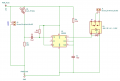
We have a rather peculiar issue we're trying to explore. We are using a red laser pointer to illuminate a photo-transistor, which then feeds into the #2 pin of a 555. When the beam is broken, #2 goes low and the #3 pin activates a relay which powers up a 24V solenoid. We use ping-pong balls to break the beam. We currently use this version below, which works every time the beam is broken:
The problem is, as long as the beam remains broken the relay continues to feed 24V to the solenoid (which also has a diode across the terminals).
Right now, there are 50 solenoids, each fed with its own PCB. I know the solenoids can handle the current, but to stress them as little as possible I just want the relays to activate ONCE when the beam is first broken, and then turn off even if a ball happens to still be blocking the beam.
If a ball bounces in, breaks the beam, and then bounces out, great. Relay is still off. If by chance a ball breaks a beam, bounces out, then bounces back, again no big deal - the relay will only activate twice in total. We can live with that. We just don't want to chance 50 solenoids all on for perhaps 10 minutes at a time.
We did some research and prototyping, and came up with the following:
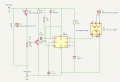
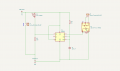
This one has a PNP transistor, etc added to the original circuit, which is supposed to trigger on a falling edge. It seems to work, but it's doing peculiar things, too, which we'd really like to understand. These are:
1. For about the first 15-20 seconds after power-up, nothing responds to a beam break. However, this doesn't always happen.
2. After a beam is broken and the relay activates, one of 2 things can happen: (a) again, the circuit becomes unresponsive for about 15-20 seconds when the beam is interrupted a second time, or (b) the circuit seems to work just fine and the next time the beam is broken the circuit activates the relay as expected. (I do realize there is a deliberate non-responsive time built in by the RC circuit, but that should only be about (100uF x 2.2k x 1.1) = 0.24 seconds, not 15-20.) Again, I don't seem to get consistent results.
It could be there is a poor connection somewhere, but I'm wondering if possibly there is a flaw in the design? This was a bit ad-hoc, since we couldn't find anything out there that dealt specifically with using a photo-transistor.
Any insights gratefully received!
Thank you in advance.
We have a rather peculiar issue we're trying to explore. We are using a red laser pointer to illuminate a photo-transistor, which then feeds into the #2 pin of a 555. When the beam is broken, #2 goes low and the #3 pin activates a relay which powers up a 24V solenoid. We use ping-pong balls to break the beam. We currently use this version below, which works every time the beam is broken:
The problem is, as long as the beam remains broken the relay continues to feed 24V to the solenoid (which also has a diode across the terminals).
Right now, there are 50 solenoids, each fed with its own PCB. I know the solenoids can handle the current, but to stress them as little as possible I just want the relays to activate ONCE when the beam is first broken, and then turn off even if a ball happens to still be blocking the beam.
If a ball bounces in, breaks the beam, and then bounces out, great. Relay is still off. If by chance a ball breaks a beam, bounces out, then bounces back, again no big deal - the relay will only activate twice in total. We can live with that. We just don't want to chance 50 solenoids all on for perhaps 10 minutes at a time.
We did some research and prototyping, and came up with the following:
This one has a PNP transistor, etc added to the original circuit, which is supposed to trigger on a falling edge. It seems to work, but it's doing peculiar things, too, which we'd really like to understand. These are:
1. For about the first 15-20 seconds after power-up, nothing responds to a beam break. However, this doesn't always happen.
2. After a beam is broken and the relay activates, one of 2 things can happen: (a) again, the circuit becomes unresponsive for about 15-20 seconds when the beam is interrupted a second time, or (b) the circuit seems to work just fine and the next time the beam is broken the circuit activates the relay as expected. (I do realize there is a deliberate non-responsive time built in by the RC circuit, but that should only be about (100uF x 2.2k x 1.1) = 0.24 seconds, not 15-20.) Again, I don't seem to get consistent results.
It could be there is a poor connection somewhere, but I'm wondering if possibly there is a flaw in the design? This was a bit ad-hoc, since we couldn't find anything out there that dealt specifically with using a photo-transistor.
Any insights gratefully received!
Thank you in advance.