Facebook
 Google
 GitHub
 Linkedin
Hello,
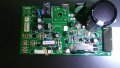
My treadmill stopped working (i.e. belt no longer moves) with a loud popping sound. When I inspected the motor-controller board I found a damaged 22 ohms resistor that I replaced. Then, I decided to see if the board works fine, so I put the board back and I used my DMM to measure the live voltage across the output ports where the motor wires usually go, and it measured 320V. The DC motor is labeled as 180V with horse power 1.1. Does this mean that the board is still faulty? I could not bring myself to connect the motor to avoid further damage -- in case it hasn't been damaged already.
What I noticed is that the controller board's output voltage is 0 when the machine is off; and when I turn it on and start raising the speed, the output jumps to 320V i.e. it does not reach that value gradually and seems oblivious to dashboard speed controls (except powering on, and raising speed from 0.0 km/h to 0.2 km/h).
I could not test the motor itself as I don't have lying around any DC power supply that I know can be used to test if the motor is fine. The brushes have comfortable length.
So to recap, from this description:
(1) Is my motor-controller board faulty? What should I inspect further? diodes? transistors?
(2) Will the 180V-rated motor be damaged if I connect it to the 320V output?
(3) How can I test the motor in isolation?
(4) Any further advice?
Many thanks.
My treadmill stopped working (i.e. belt no longer moves) with a loud popping sound. When I inspected the motor-controller board I found a damaged 22 ohms resistor that I replaced. Then, I decided to see if the board works fine, so I put the board back and I used my DMM to measure the live voltage across the output ports where the motor wires usually go, and it measured 320V. The DC motor is labeled as 180V with horse power 1.1. Does this mean that the board is still faulty? I could not bring myself to connect the motor to avoid further damage -- in case it hasn't been damaged already.
What I noticed is that the controller board's output voltage is 0 when the machine is off; and when I turn it on and start raising the speed, the output jumps to 320V i.e. it does not reach that value gradually and seems oblivious to dashboard speed controls (except powering on, and raising speed from 0.0 km/h to 0.2 km/h).
I could not test the motor itself as I don't have lying around any DC power supply that I know can be used to test if the motor is fine. The brushes have comfortable length.
So to recap, from this description:
(1) Is my motor-controller board faulty? What should I inspect further? diodes? transistors?
(2) Will the 180V-rated motor be damaged if I connect it to the 320V output?
(3) How can I test the motor in isolation?
(4) Any further advice?
Many thanks.