Well did the toner transfer but had issues transferring the toner. Im doing top & bottom via lamanator and got 1 side to work good but the top was bad. going to redo later today
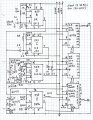
Some corrections made, added pin nos. to Q7. I have not used TTL since early 1970s , but ' believe you can leave unused input pins open & will= a 1 or high input.View attachment 104906
Hi Bernard, so just a couple of questions. Could I add the power on monostable that Wendy described in post #149?
Also at the top of your circuit, does the lines D,C,B,A GND AND V+ goes to another set of 74154? if so do I connect pin #19 (G2) to existing Q5 (N74154) pin #3?
Re post # 203. Yes, Stream #2, R2, 1 meg pot.
Re post #204. Stream # 11 A is not intended for your final project as it operates on 5 V & uses useable but antiquated chips which you already have. The buss lines extend to as many as 16 74154's with each G2 pin going to one of the 16 outputs of Q 5. If Q7 is next then Q5-3 goes to Q7-19. Q3 can only drive 10 inputs without additional buffers.
As this is a stand alone ckt. there is no need for power-up reset, but it can be used. As there is no reset on 74154 on power-up there may be some LEDs on which will be washed away on first pass.
The video is circuit Stream #2. Stream # 9 would look the same, but would start with all LEDs off & start filling in from the top, rippling as they traveled to the bottom. As shown, would take about 7 sec for 250 LEDs to complete lighting & then all would continue blinking for the remainder of 20 sec. & then would clear or if desired clear & repeat the sequence. Do you want to continue with this proposal or wate for Wendy's proposal ?
The video is circuit Stream #2. Stream # 9 would look the same, but would start with all LEDs off & start filling in from the top, rippling as they traveled to the bottom. As shown, would take about 7 sec for 250 LEDs to complete lighting & then all would continue blinking for the remainder of 20 sec. & then would clear or if desired clear & repeat the sequence. Do you want to continue with this proposal or wate for Wendy's proposal ?
I would like both proposals. I am starting to breadboard your circuit and I want to add additional components for about 150 led's. I made Wendy's circuit from post#141 and it doesn't currently work so I have been doing tracing to see what I did wrong. She has an LED near the 555 chip that barely lights up and flickers. I am running about 12.6V. Not sure whats going on so I am troubleshooting mode.
Post # 141,LED D1 monitors the clock, C MOS version of 555 with very little high side drive hence large
10k R giving less than 1 mA. Rotate the pot & notice change in flicker. Clock is working.
Stream #12 is the construction schematic based on Stream #9.
Decided that we did not need to blank out the LED's while loading with 0's, so tied pins 15 high eliminating one buss line.
R2 & R8 eliminate the possibility of connecting 555 pins 7 directly to + 12V if pot is at 0 ohms.
Clock 555-D is enabled if either OS B or OS C outputs are high via diode OR gate D1, D2, R12, & double inversion of F2 & F3.
Two speed clock D is achieved by paralleling R 9, 1 M pot & R 8, 10k, with R 10, 2k2 when PNP is turned on
when C is on.
LED resistors will be figured when LEDs are identified.
As you have 4011's, you can tie inputs together & use as inverters, replacing the 4049's
Attempting another thought, as Lock Out circuit already has a 20 second timer, we could drop 555-B.
Clear the SR's on power-up for first 1/2 sec., load one at a time with blinking, about 7 sec, then continue all blinking until Lock Out kicks in. Any thoughts??
Post # 141,LED D1 monitors the clock, C MOS version of 555 with very little high side drive hence large
10k R giving less than 1 mA. Rotate the pot & notice change in flicker. Clock is working.
As you have 4011's, you can tie inputs together & use as inverters, replacing the 4049's
Attempting another thought, as Lock Out circuit already has a 20 second timer, we could drop 555-B.
Clear the SR's on power-up for first 1/2 sec., load one at a time with blinking, about 7 sec, then continue all blinking until Lock Out kicks in. Any thoughts??
Basically I'm trying to construct a circuit for 3 channels. By pushing the red button, all the red led's (300) either light up in a continuous sequence for 30 seconds then off. When the green is pressed, the same thing happens but about 150 led's. Maybe a different pattern of dance. The blue channel will be like the green but a different pattern.
Basically I'm trying to construct a circuit for 3 channels. By pushing the red button, all the red led's (300) either light up in a continuous sequence for 30 seconds then off. When the green is pressed, the same thing happens but about 150 led's. Maybe a different pattern of dance. The blue channel will be like the green but a different pattern.
ok i did bread boarded Wendy's circuit and only 1 led is lit. it looks like no counting. I have rebuilt this circuit twice with the same results I am unsure of the problem. im gonna replace the 555 and hope it works
You said LED D1 was blinking, so the clock is working-555 is OK. 555 is fine in this circuit. You can change R3 to 1 k for brighter LED. Check inputs to U2, p 16 = + 12V ?, p 8 ground ?, p 9 hi or low ? If hi U2 counting is disabled &U3 should be counting. With both U2 & U3 one output pin will always be hi.
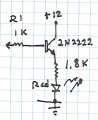
Maybe a LED test probe would help.
The video is from Stream #2, & looks the same for all of the shift register circuits. Stream 11 , using decoders is a single LED chaser, same result as Wendy's matrix.
On Stream #2, I substituted aquablue LED's for frosted blue - the frosted blue, as in video, looks better.
Actually the etched pcb led was dim flickering. The breadborad circuit has led bright and on but no output from to the led matrix. I am checking all connections. I'll let you know in a bit
You said LED D1 was blinking, so the clock is working-555 is OK. 555 is fine in this circuit. You can change R3 to 1 k for brighter LED. Check inputs to U2, p 16 = + 12V ?, p 8 ground ?, p 9 hi or low ? If hi U2 counting is disabled &U3 should be counting. With both U2 & U3 one output pin will always be hi.
Maybe a LED test probe would help.View attachment 105951
im using an old micronta test probe. 55 timer pin 3 output is high and the led indicator is steady on. all vcc & gnd pins check ok. u2 pin 14 is H and all pin 9's are L

 Facebook
 Google
 GitHub
 Linkedin