hi M,
With respect, your very short replies, without any posted calculations, are not helping me to help you.
Lets see some written work in your replies.
You still have to solve the original question.
E
hi M,
With respect, your very short replies, without any posted calculations, are not helping me to help you.
Lets see some written work in your replies.
You still have to solve the original question.
E
hi M,
With respect, your very short replies, without any posted calculations, are not helping me to help you.
Lets see some written work in your replies.
You still have to solve the original question.
E
As you have no other d/s values for 10V supply operation, have you considered assuming that the Zo will be the same for the OPA with a 2K load.
Zo =1764R.
From that Zo and 2K load with a 10v supply you should be able to calculate the typical Vout voltage.
As you have no other d/s values for 10V supply operation, have you considered assuming that the Zo will be the same for the OPA with a 2K load.
Zo =1764R.
From that Zo and 2K load with a 10v supply you should be able to calculate the typical Vout voltage.
Do you have an image of the full original question that you could post.?
With only one Vout value at 10V [high mode] operation stated in the d /s, it is difficult to calculate a Vout for another load value with a high degree of confidence.
Do you have an image of the full original question that you could post.?
With only one Vout value at 10V [high mode] operation stated in the d /s, it is difficult to calculate a Vout for another load value with a high degree of confidence.
I make it the same value.
Pity we don't have more than one known point, with two or more known points we would have a higher confidence in the calculated value.
If you have a tlc271 on the test bench you could [should] check your findings.
I make it the same value.
Pity we don't have more than one known point, with two or more known points we would have a higher confidence in the calculated value.
If you have a tlc271 on the test bench you could [should] check your findings.
I used a different approach.
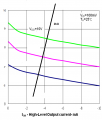
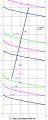
I take the plot from the fig. 6 (page 14) and do small interpolation and additional I plot the 2kΩ resistance also. http://www.ti.com/lit/ds/slos090d/slos090d.pdf
As we can read from the plot the output voltage should be around 8.5V.
From this plot, it is also possible to read ro = ΔVo/ΔIo ≈ 150Ω and the output voltage without load resistance Vo_max ≈ 9.3V
I used a different approach.
I take the plot from the fig. 6 (page 14) and do small interpolation and additional I plot the 2kΩ resistance also. http://www.ti.com/lit/ds/slos090d/slos090d.pdf
As we can read from the plot the output voltage should be around 8.5V.
From this plot, it is also possible to read ro = ΔVo/ΔIo ≈ 150Ω and the output voltage without load resistance Vo_max ≈ 9.3V
hi M,
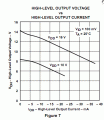
Also if you check fig #7, it suggests for a 10V supply with a 2K load, ie: 2mA, the Vout will be 8.0v.
E EDIT:
That image also shows the 8.5Vout for a 10k load.
hi M,
Also if you check fig #7, it suggests for a 10V supply with a 2K load, ie: 2mA, the Vout will be 8.0v.
E EDIT:
That image also shows the 8.5Vout for a 10k load.
hi M,
I have assumed that as the Vdd = 10v and the load is 2k, so ideally that would give Io=10v/2k = 5mA.
Then looking at the Xaxis on that graph, the 5mA high level output, crosses the Yaxis high level output at thr 8v point, do you agree.??
You can see that
That image also shows for Vdd= 10v, the 8.5Vout for a 10k load. ie: 1mA
hi M,
I have assumed that as the Vdd = 10v and the load is 2k, so ideally that would give Io=10v/2k = 5mA.
Then looking at the Xaxis on that graph, the 5mA high level output, crosses the Yaxis high level output at thr 8v point, do you agree.??
You can see that
That image also shows for Vdd= 10v, the 8.5Vout for a 10k load. ie: 1mA
Hi,
Did your tutor suggest a method for solving this type of problem.?
A point to note, as you may have noticed already in the d/s specification, there is spread in the value of certain parameters, so a typical figure is stated.
Hi,
Did your tutor suggest a method for solving this type of problem.?
A point to note, as you may have noticed already in the d/s specification, there is spread in the value of certain parameters, so a typical figure is stated.
He told me today that because TLC271 can output 30mA max and with 2k resistor it's not going to drain so much current so it would be around 8.5v and and that we could put as voltage output 8.5v

 Facebook
 Google
 GitHub
 Linkedin