Facebook
 Google
 GitHub
 Linkedin
Hi,
First, thank you for helping me. I am using the TH4541 FDA as an ADC input to the ADC3662 ADC IC. I am having trouble understanding how to verify that a gain won't saturate the output voltages of each single ended output of a full differential amplifier. I thought I had an idea and simulated my design and it seems to be working but the output voltages and input voltages to the FDA aren't what I calculated. At this point I think I just got it correct by chance. below is the process and the calculations I made.
ADC Specs:
Full Scale ADC = 3.2Vpp
Vicm = 0.95V
Input analog signal:
1.8Vpp AC coupled
FDA Voltage Rails:
Vs(+) = 3.3V
Vs(-) = 0V (ground)
FDA Limitations:
Input Voltage Low (Common Mode input low) = Vs(-) - 0.2 = 0-0.2 = -0.2V
Input Voltage High (Common Mode input high) = Vs(+) - 1.2 = 3.3-1.2 = 2.1V
Output Voltage Low = Vs(-) + 0.2 = 0+0.2 = 0.2V
Input Voltage High = Vs(+) - 0.2 = 3.3-0.2 = 3.1V
Vocm = 0.95V
As I understand the datasheet section 7.3 (which I am sure is where I fail to understand), I want the output voltage to swing around 0.95V. The lower output limit will dictate the swing, hence, the output voltage swing will be between 0.2V and 1.7V (+/- 0.75 + 0.95). That is about a 1.5Vpp single ended signal for each FDA output.
Using the fact that the full scale ADC is 3.2V, I figured the gain would be, Av = 3.2/1.8=1.78. Using the same logic as above, that meant:
0.95+0.89=1.84V and 0.95-0.89 = 0.06V. The upper limit is within range of the FDA output but the lower limit is not. The next step was to use 1.5v/v gain. Therefore, 0.95+0.75=1.7V, 0.95-0.75=0.2V. Great this gain will do (I guess).
with this in mind, scrolling down to 8.4.1.3 in the THS4541 datasheet,
Using the quadratic formula (eq 7) to calculate Rt and with Rf = 402, Rs = 75, I calculated Rt = 93.68. Using the proceeding equation, Rg1 = 256.11 and Rg2 (direct method) = 297.7 and Za = 366.24.
I use these values to simulate the circuit below with a 1MHz 1.8Vpp signal:
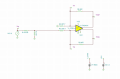
running a transient simulation. everything looks good. except that the output voltages are not what I calculated. At first I thought maybe it was the "voltage divider" created from the Rs and Rt that may have thrown me off but couldn't find a connection to relate to the output.
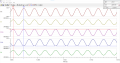
One thing I did notice is that voltage peak to peak of Vout(+/-) ~ 1.9 which is twice the Vocm of 0.95.
i also used section 2.2 of te slyt394 to determine the outputs of the single ended signals and I can't seem to figure out how to determine the output voltages of the single ended signals from the FDA. I also found an FDA calculator from TI that gave me simliar results in terms of the resistors gains.
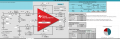
its almost 3AM so I am sure i forgot to mention something but i would greatly appreciate your advise and knowledge on this.
Thank you!
First, thank you for helping me. I am using the TH4541 FDA as an ADC input to the ADC3662 ADC IC. I am having trouble understanding how to verify that a gain won't saturate the output voltages of each single ended output of a full differential amplifier. I thought I had an idea and simulated my design and it seems to be working but the output voltages and input voltages to the FDA aren't what I calculated. At this point I think I just got it correct by chance. below is the process and the calculations I made.
ADC Specs:
Full Scale ADC = 3.2Vpp
Vicm = 0.95V
Input analog signal:
1.8Vpp AC coupled
FDA Voltage Rails:
Vs(+) = 3.3V
Vs(-) = 0V (ground)
FDA Limitations:
Input Voltage Low (Common Mode input low) = Vs(-) - 0.2 = 0-0.2 = -0.2V
Input Voltage High (Common Mode input high) = Vs(+) - 1.2 = 3.3-1.2 = 2.1V
Output Voltage Low = Vs(-) + 0.2 = 0+0.2 = 0.2V
Input Voltage High = Vs(+) - 0.2 = 3.3-0.2 = 3.1V
Vocm = 0.95V
As I understand the datasheet section 7.3 (which I am sure is where I fail to understand), I want the output voltage to swing around 0.95V. The lower output limit will dictate the swing, hence, the output voltage swing will be between 0.2V and 1.7V (+/- 0.75 + 0.95). That is about a 1.5Vpp single ended signal for each FDA output.
Using the fact that the full scale ADC is 3.2V, I figured the gain would be, Av = 3.2/1.8=1.78. Using the same logic as above, that meant:
0.95+0.89=1.84V and 0.95-0.89 = 0.06V. The upper limit is within range of the FDA output but the lower limit is not. The next step was to use 1.5v/v gain. Therefore, 0.95+0.75=1.7V, 0.95-0.75=0.2V. Great this gain will do (I guess).
with this in mind, scrolling down to 8.4.1.3 in the THS4541 datasheet,
Using the quadratic formula (eq 7) to calculate Rt and with Rf = 402, Rs = 75, I calculated Rt = 93.68. Using the proceeding equation, Rg1 = 256.11 and Rg2 (direct method) = 297.7 and Za = 366.24.
I use these values to simulate the circuit below with a 1MHz 1.8Vpp signal:
running a transient simulation. everything looks good. except that the output voltages are not what I calculated. At first I thought maybe it was the "voltage divider" created from the Rs and Rt that may have thrown me off but couldn't find a connection to relate to the output.
One thing I did notice is that voltage peak to peak of Vout(+/-) ~ 1.9 which is twice the Vocm of 0.95.
i also used section 2.2 of te slyt394 to determine the outputs of the single ended signals and I can't seem to figure out how to determine the output voltages of the single ended signals from the FDA. I also found an FDA calculator from TI that gave me simliar results in terms of the resistors gains.
its almost 3AM so I am sure i forgot to mention something but i would greatly appreciate your advise and knowledge on this.
Thank you!
Attachments
-
2.7 MB Views: 1