Newbie - how to use a TLC271

Status
Not open for further replies.

Thread Starter

matgube

Joined Nov 16, 2023
30
Hi all,
I have a TLC271 and I want to boost a 5V signal to 12V. I have a 12V source (stretched but it will do), but I'm struggling to understand how to connect the IC. The datasheet is to tech for me...
I imagine the TLC271 may not be the best choice, but it will have to do for now.
Can you help me understand how to connect the pins?
Currently I have:
  • IN- to GND
  • GND to GND
  • IN+ is my 5V signal
  • VDD to 12V
But I don't know about Bias, Offset 1 and Offset 2...
Thanks!
 

MrChips

Joined Oct 2, 2009
34,845
I presume you already have TLC271 chips on hand. I am curious as to why you chose this IC.
There is nothing wrong with this IC and there are many other op amps like it.

The first thing you need is the manufacturer's datasheet. You need to know the pinout of this IC. More importantly, you need to become accustomed to reading device specifications, as complicated as it may seem. Very often, the datasheet will show device test circuits and even application examples.

Now, an op amp is a generic "black box" component. You need to look up some electronic sites to learn different ways one can configure an op amp. Here are two examples:

https://www.allaboutcircuits.com/textbook/semiconductors/chpt-8/introduction-operational-amplifiers/

https://www.electronics-tutorials.ws/opamp/opamp_8.html

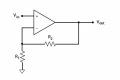
To cut to the chase, you need a non-inverting op amp circuit configuration.

1724926169993.png

The voltage gain of this circuit is R2 / R1.
 

Thread Starter

matgube

Joined Nov 16, 2023
30
I presume you already have TLC271 chips on hand. I am curious as to why you chose this IC.
There is nothing wrong with this IC and there are many other op amps like it.

The first thing you need is the manufacturer's datasheet. You need to know the pinout of this IC. More importantly, you need to become accustomed to reading device specifications, as complicated as it may seem. Very often, the datasheet will show device test circuits and even application examples.

Now, an op amp is a generic "black box" component. You need to look up some electronic sites to learn different ways one can configure an op amp. Here are two examples:

https://www.allaboutcircuits.com/textbook/semiconductors/chpt-8/introduction-operational-amplifiers/

https://www.electronics-tutorials.ws/opamp/opamp_8.html

To cut to the chase, you need a non-inverting op amp circuit configuration.

View attachment 330418

The voltage gain of this circuit is R2 / R1.
Thanks, this helps, getting there.
This is the schematic and I can't really figure out what to do with the 2 offsets and bias...


I picked this IC because I found it in an example somewhere.
I also need to be able to read what the right "direction" of the chip is as I smoked a couple of them cause they were rotated...
1724928917235.png
Finally, could you suggest something more appropriate?
I have 5V DC outputs and I need to power 12V led strips. No dimming, just on/off.
Thanks!
 

ElectricSpidey

Joined Dec 2, 2017
3,335
You might be on the wrong track here...an Op-Amp cannot boost voltage.

If you are using the 5-volts as a signal and a proper 12-volt supply to power the LEDs then you just need a transistor.
 

Thread Starter

matgube

Joined Nov 16, 2023
30
If you have a 12V source as you stated, then you just need a transistor as a switch to control that voltage to the LEDs.
Can I control a transistor with a 5V though? If the output is 12V? I was told the gate control must be at least the output voltage, can't be smaller
 

MrChips

Joined Oct 2, 2009
34,845
You can control a BJT transistor on and off with just 1 V signal, even if the supply voltage is 5 V or 12 V.
If the transistor is MOSFET, then the control voltage must be at least 3 V.
 

MrChips

Joined Oct 2, 2009
34,845
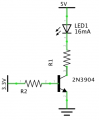
This is your basic LED controller using an NPN BJT such as 2N3904.

1724944513748.png

If your LED forward voltage is 2 V and draws 16 mA, then the series resistor R1 is calculated from

R = (Vs - Vf)/ Id

Where,
Vs = supply voltage
Vf = LED forward voltage
Id = LED current

R1 = (5V - 2V)/ 16mA = 188 Ω

Any value from 220 Ω to 1 kΩ will work, with dimmer output at higher resistance values.

R2 can be anything from 100 Ω to 5 kΩ.
 

Thread Starter

matgube

Joined Nov 16, 2023
30
This is your basic LED controller using an NPN BJT such as 2N3904.

View attachment 330439

If your LED forward voltage is 2 V and draws 16 mA, then the series resistor R1 is calculated from

R = (Vs - Vf)/ Id

Where,
Vs = supply voltage
Vf = LED forward voltage
Id = LED current

R1 = (5V - 2V)/ 16mA = 188 Ω

Any value from 220 Ω to 1 kΩ will work, with dimmer output at higher resistance values.

R2 can be anything from 100 Ω to 5 kΩ.
How can I rearrange this circuit if the LEDs are already all wired as Common Cathode?
 

DickCappels

Joined Aug 21, 2008
10,661
It is late in the game to be introducing new information.

Do you want to switch the LEDs on and off individually?

Are all of your LEDs already connected in a common cathode configuration?

What is the source and voltage range of the control signal?
 

MrChips

Joined Oct 2, 2009
34,845
Here is a word of advice when posting questions on AAC.

You began by requesting information on how to use an op amp to convert 5 V to 12 V.
Now we can see that the final goal has nothing to do with the problem stated. In order to avoid playing the game of 101 Q & A, it is better for everyone if you start off with the actual problem and not what you envision is your problem.

We see this too often here on AAC forums and strive to make the AAC experience more efficient and enjoyable for everyone concerned.
 
Status
Not open for further replies.
Top