Could you guys give some feedback to a newbie on his ZVS driver?

Thread Starter

ARealHippo

Joined Jun 7, 2025
3
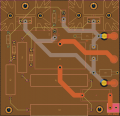
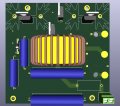
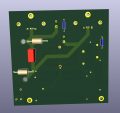
I am building this ZVS driver (in KiCad 9.0) to drive a custom flyback transformer and I was hoping to get some criticism and feedback. This is a circuit that has power input (red, 4mm) on top, gate traces (green, 0.3mm), a ground plane, and LC traces (blue, 3.5mm) all in that order. The input power is 24-90V from a current limited boost converter which will supply more than my max current draw of ~5A. The blue and parts of the red traces should experience peaks of 300V and 14A at absolute max. The board is around 100x100mm to achieve the special deal on JLCPCB. This is a personal project; however, I did try my best to follow basic trace spacing requirements for consumer electronics that I knew of and researched (not many). The parts all play nice in LTspice and are size accordingly. The exact specs are: R1, R2 = 1.2k ohm resistor 10W, SQP10AJB-1K2, (way more wattage than needed, it was just cheaper); R3, R4 = 5 ohm resistor 7W, PNP7WVJT-91-5R, (wayyyyyyyyyyyyyyyy more wattage than needed, it was just cheaper, and I added this just because it solved a large ringing problem I had in sim); R5, R6 = 5.1k ohm pulldown resistor 1/4W, MFR-25FTE52-5K1; D1, D2 = 15V zeners, 1N5929BRLG; D3, D4 = schottkys, TSCDT06065G1; D5, D6 = TVS diodes for shutdown and some extra protection, 1.5KE300A; L1 = 250uH inductor, ATCA-08-251M-V; C1 (connecting the two blue traces) = 27nF film capacitor, B32641H6273J000; finally the MOSFETs are 650V 11A, STF16N65M2, (I spread out the slots for its pins to allow for better spacing between the 300V and ground terminals, I will just bend the pins irl). The TVS diodes, MOSFETs, standoffs, and terminal are all connected to the ground plane through solid connections while everything else are connected through thermal reliefs. I would appreciate any and all feedback and criticism :)Screenshot 2025-07-13 214523.pngScreenshot 2025-07-13 214554.pngScreenshot 2025-07-13 214614.pngScreenshot 2025-07-13 214634.png
 

Ian0

Joined Aug 7, 2020
13,097
I would have expected one power input to go to a source and the other to a drain, but without a circuit diagram it's hard to tell.
 

Thread Starter

ARealHippo

Joined Jun 7, 2025
3
Sorry, I'm a little confused, if you mean how does the source get back to the terminal and how does the terminal reach the drain? because if so the source is connected via a ground plane (the orange thing in image 2) and the middle pad would connect to the other two via the primary of the flyback (it is a center tapped design, sorry, should've mentioned that)
 

Ian0

Joined Aug 7, 2020
13,097
Sorry, I'm a little confused, if you mean how does the source get back to the terminal and how does the terminal reach the drain? because if so the source is connected via a ground plane (the orange thing in image 2) and the middle pad would connect to the other two via the primary of the flyback (it is a center tapped design, sorry, should've mentioned that)
Well that proves my point: impossible to say anything useful without a circuit diagram.
 

Thread Starter

ARealHippo

Joined Jun 7, 2025
3
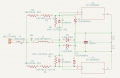
Fair enough, I hope this helps :) (a lot of these are downloaded models, so that's why the mosfets look weird. Also L2 and L3 are just there to represent the flyback primary)Screenshot 2025-07-14 094221.png
 

MisterBill2

Joined Jan 23, 2018
27,159
I am not clear on the feedback path, assuming that this circuit is intended to be an oscillator.

With the arrangement of the drawing the signal paths are not as clear as would be handy.
What does this statement mean?? " The parts all play nice in LTspice and are size accordingly. " Does it actually oscillate?? What is not at all clear to me is just what is the question and what is any problem. I admit that I am not able to read minds at all.
One real shortcoming oof most simulators is that parts seldom fail due to ecesss power,current, or voltage breakdown.
 
Top