I want to build a drum snare piece of ekit with reactive rgb lighting can you guys help me?

Thread Starter

psychlo0015

Joined May 26, 2015
18
So I have this buddy from highschool that drums but hes so fugged he could never build something like this. I am a music producer and could actually use it while I build it but I dont even know where to start. In the end i plan to give it to my friend. Anyways here is the vision.

An rgb snare drum. I want the spectrum of light to represent the sound of the drum so in fl studios the high end is blue and the low end is orange by default. So for example a rim shot (when you hit the rim not the drum) would be more blue where as a center hit would be more orange. Id like to be able to modify the color spectrum and stuff.

I cant even solder i mean ive maybe soldered like 3 things max out of like 20 attempts my whole life. Most of the time i just twist wires and etape it.
 
Last edited by a moderator:

MrChips

Joined Oct 2, 2009
34,626
“Colour organ” circuits appeared way back, maybe as early as in the ’60s.
Today, they are common features in bluetooth and powered speakers.
 

AnalogKid

Joined Aug 1, 2013
12,042
What is an "fl studio"?

Conceptually this is a color organ, but with much more stringent requirements for the band-separating filters.

In drum synthesizers, the core of the snare drum sound is a white noise generator. That's because real snares sound like modified white noise. Thus, the differences between the lower center hit tone and the higher rim tone will be partly masked by the relatively wide band noise of the snares. To differentiate between the two will take two bandpass filters(or at least one highpass and one lowpass) and level detectors that are adaptive to the short-term average volume.

If I were designing a commercial product, I would start with an audio spectrum analyzer. I could literally "see" the frequency differences between the two sounds and start the filter design from there. A digital scope with an FFT (Fast Fourier Transform) function can do this. Windows MediaPlayer has a version of this for one of its displays. Record a few drum hits in a .wav file, play it in MP, and see if you can see a repeatable difference.

Not picking on you at all, but this is no way a beginner's design project.

ak
 

MisterBill2

Joined Jan 23, 2018
27,159
AK is certainly correct in that what was described is far from a beginners project. In fact, it would be a chore even for an engineer.
There is a different scheme that is totally a different concept, much simpler, but much less efficient: Use serious AUDIO POWER AMPLIFIER and a set of series resonant tuned circuits, , directly driving incandescent light bulbs. Certainly the coils in the tuned circuits will need to be low resistance, This would be close to the very original "color organ, but with more channels. And the amplifier would need either that 70.7 volts output or the higher voltage one yet, I think it is 154 volts, but I am not sure .
 

boostbuck

Joined Oct 5, 2017
1,032
It will be very complicated to build from basic components, but who does that these days?

Buy a bluetooth speaker that has the 'sound-to-color' built-in, as they often do these days, and this will give you most of the technically complicated stuff pre-made. If you can get one with a microphone input then you're done, otherwise hook a microphone preamp into the sound path.
 

MisterBill2

Joined Jan 23, 2018
27,159
Still, the simple direct scheme will be a set of series resonant tuned circuits in series with the LEDs or light bulbs. Of course, the tuned circuits must be able to handle the required power level, and have a low impedance.
 

Thread Starter

psychlo0015

Joined May 26, 2015
18
I may ask chat gpt then come back hear now that i know the lingo I should be able to get it in the right dirrection thank you guys so much for the replys... I reaally appreciate it i think I will figure this out some how with chat gpt and build a whole kit one drum at a time starting with the snares. i gotta have a snare and an off snare and i gotta be able to program it with multiple drum hits and be able to swap out drum kit sounds easily i wanna go fully custom and im willing to invest the time to research learn and test. So i appreciate you guys getting me going now on this sorry for late reply. if u guys wanna here something from me ima post it in a zip its just an mp3. something i did today in fl. if u guys want to learn music production in fl let me know in dm i love teaching music production and i like to help people get better quicker so they can release their creative energy instead of their tedious grind energy (I got workflows for like 90% less clicking than most producers). i included a script i just finished today with gpt brroooo this alone will drive you to be more creative because you can focus on midi alright ima shut up but
What is an "fl studio"?

Conceptually this is a color organ, but with much more stringent requirements for the band-separating filters.
 

Attachments

Thread Starter

psychlo0015

Joined May 26, 2015
18
Still, the simple direct scheme will be a set of series resonant tuned circuits in series with the LEDs or light bulbs. Of course, the tuned circuits must be able to handle the required power level, and have a low impedance.
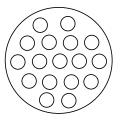
thius actually gave me an idea i think they are called pizo pickups? but i know how to make and tune drums from plastic bottles and i was thinking maybe a pickup to capture a punchy non resonant drum could then trigger the leds based on volume of the pick ups i could do it like this... 1772073526207.pngeach little circle could be a pizzo pick up and i could distribute and make a very strange drum like this if i could linkeach pick up to a different sound and hook it up to my monitors... like if the drum sounds were just modified versions of the same one....

im wondering if doing a drum like this could be done on something bouncier than a real drum...
 

MrChips

Joined Oct 2, 2009
34,626
That's too complicated.
All you need is a microphone to pick up the signal and three filters, low, mid and high frequencies.
Your LEDs will blend depending where in the audio spectrum the sound is the loudest.
 

MisterBill2

Joined Jan 23, 2018
27,159
Drum Heads,especially on the snare drums of some REALLY TALENTED drummers, produce different sounds, apparently from different areas, although I have not investigated that part.
A package with a bunch of piezo pickups could use just a two transistor amp directly feeding an LED, all attached to a drum head. A piezo pickup with an output adequate to drive an MPSA13 darlington transistor may be adequate.
 

MisterBill2

Joined Jan 23, 2018
27,159
Most snare drums do not change the pitch very much, but rather the intensity of the sound. So a loudness controlled RGB display makes more sense. BUT dont attach a sensor to the drum head because that will change the drum's sound. But a cheap crystal microphone should provide an adequate voltage if it is INSIDEthe drum. Then a quad comparator can sense four different levels of sound, and a few CMOSgates can control the light intensity.
OR you can drive the transistors directly from the comparator outputs.
 
Top