Theory of Everything

Thread Starter

Jennifer Solomon

Joined Mar 20, 2017
112
Lol, not quite. First, the elements of ℝ are not sets, and ℕ is a set. Therefore, ℕ ∉ ℝ.
They're not sets themselves? If you "pull out" any interval, and you have 100% of ℝ do you not have a set of sets? What kind of set retains 100% of a section of itself once you delineate a portion??

What's true is that ℕ ⊂ ℝ, i.e., N is a subset of R. But that fact says nothing about the properties of either. For example, let A be the set of birds, i.e., A is comprised of winged animals. Let B be the set of all animals. Clearly, A ⊂ B, but that does not in any way imply that every animal has wings.
No diff though in the end. We know ℝ is continuous and infinite. We know ℕ is discrete and infinite. If ℕ ⊂ ℝ, R contains the properties of both itself and ℕ!
 

Thread Starter

Jennifer Solomon

Joined Mar 20, 2017
112
The light doesn't make the dog appear 3D, your brain does. You don't have to trust me on this, there is a plethora of well-documented research on the subject.
So the object does not exist to you, yet you insist it does, independent of information ("where is the dog in the light"), because you do not make a distinction between spatial and non-spatial things!

Your brain knows precisely what relationship each bit is in relation to another to form a discrete unique 2D image, storing each in relationship to each other? Yet you ask the question "where is this thing" in space, *independent of the 1D information*! You grok the bits I'm slingin?? Where does the 3D meta-information come from? This is done in a computer by a human parser with great programmatic intention so as to sequentially file each bit to reconstruct what the light sent about the actuality, the REAL thing. And where is this meta-information stored??
 
Last edited:

bogosort

Joined Sep 24, 2011
696
Numbers — "mathematical objects" ? What are they in relation to the physical substrate's representation limitations (the brain you are using)?
Numbers, like all mathematical objects, are concepts.

Side-note: t is proven that the brain can interface with binary computers (we can move limbs and cursors with brain-based controllers) — more evidence for our propositional logic desires to have a T/F value.
Technical note: it is not "proven", it is demonstrated. Proofs happen in formal systems, not research labs. Anyway, not sure why you brought this up. We can make analog brain-limb interfaces, too. Digital is just more convenient.

Geometry — So you're saying there's no "real" difference between 1D and spatial 3D in the end? Essentially there's no such thing as true spatial geometry, am I reading that right?
1D space and 3D space are indeed different. For instance, the vectors in \( \mathbb{R} \)-space are scalars; the vectors in \( \mathbb{R}^2 \)-space have two components.

I don't know what you mean by "true spatial geometry", but it feels like a category error. If you're asking what geometry most accurately models our experience of the universe, the current answer is the pseudo-Riemannian manifolds induced by the metric tensor of GR.
 

Thread Starter

Jennifer Solomon

Joined Mar 20, 2017
112
For the record, a multiplicity of puppies die when you use "concept" by drawing circles around discrete light switches on walls and labeling them as special because they possess unique logic states. Your use of CONCEPT to me is as repugnant as my use of REALITY to you, just sayin'. ;)

We have finally boiled down to a very solid central starting question:

Does real, spatial 3D exist independent of geometric notions thereof?
 

Thread Starter

Jennifer Solomon

Joined Mar 20, 2017
112
If something exists independent of the information used to describe it

and

If you're using information to distinguish between that which is geometric and truly spatial, this implies "spatial" is a separate concept from information(!) that must exist or it would be an incongruous comparison.

This implies there is an element of knowing something exists without the information about it, if it exists independent of it! PERHAPS, just perhaps, mystery-token "FEELING" is found here, and it's why a person will insist they "know something by feeling" vs. by rote information.
 

bogosort

Joined Sep 24, 2011
696
But you somehow trust external data from it to form hard mathematical relationships?
Is it possible that all mathematical theorems are invalid? Not within mathematics itself; that's the beauty of formal systems! Once you agree to the rules of the system, the results are indisputable.

Could it be, however, that mathematics itself is invalid? It's difficult for me to imagine how an axiomatic system without contradiction can be invalid. I suppose I can suspend my disbelief and imagine that the universe is a simulation in which humanity has been specifically programmed to think that formal conclusions are valid, even though they somehow aren't outside of the simulation.

But even then, as long as the conclusions are valid in our universe, I'm fine with it.

"Appear 3D." And you know the difference between appear and actual how? Are you making a distinction between appearance and REAL in that statement potentially? ;--)
Lol, again, no one has any idea what "REAL" is really like. But the information available to me (and anyone else who cares to look) strongly suggests that our eyes present 2D images to our brains. Of course, this 2Dness is also a concept of brains and in no way declares what the geometry of space might actually be like. But, using our well-worn models of experience, we can best describe the whole visual thing as occurring in two-dimensional space.
 

bogosort

Joined Sep 24, 2011
696
They're not sets themselves? If you "pull out" any interval, and you have 100% of ℝ do you not have a set of sets?
An interval is a set. Pull out a single element from ℝ -- say, 42. It is neither continuous nor a set.

What kind of set retains 100% of a section of itself once you delineate a portion??
A dense set. Note that this has nothing to do with countability, as ℚ is both countable and dense.

No diff though in the end. We know ℝ is continuous and infinite. We know ℕ is discrete and infinite. If ℕ ⊂ ℝ, R contains the properties of both itself and ℕ!
So all animals have wings? Your conclusion is invalid.

We've been loose with our terminology calling ℝ "continuous". Technically speaking, continuous is a property of functions, not sets. We often speak of the continuum of ℝ, which is just a poetic way to say that it's an uncountable ordered field. But ℝ is not continuous. If we're talking about sets, we should restrict ourselves to the domain of sets, which has basically no mathematical structure: just elements and a binary relation ∈.
 

Thread Starter

Jennifer Solomon

Joined Mar 20, 2017
112
An interval is a set. Pull out a single element from ℝ -- say, 42. It is neither continuous nor a set.
You can't access the intervals, remember? You can't terminate the intervals with a delimiter. ;--) If the intervals can't be delineated, we have a stream of numbers we're creating intervals and sets out of.

A dense set. Note that this has nothing to do with countability, as ℚ is both countable and dense.
What's also dense is the partiality between these things, when the only thing that exists is ℕ and ℝ. LOL.


We've been loose with our terminology calling ℝ "continuous". Technically speaking, continuous is a property of functions, not sets. We often speak of the continuum of ℝ, which is just a poetic way to say that it's an uncountable ordered field. But ℝ is not continuous. If we're talking about sets, we should restrict ourselves to the domain of sets, which has basically no mathematical structure: just elements and a binary relation ∈.
"Technically speaking, continuous is a property of functions, not sets" ... this is great, because we're getting to some core elemental presumptions here. So you don't believe there is any such thing as a stand-alone continuous element in existence?

Then tell me, what precisely is going on when a function is creating continuity out of discrete elements?

Does this not imply that the function itself is ContinuityMaker v1.∞?
 

Thread Starter

Jennifer Solomon

Joined Mar 20, 2017
112
Technically speaking, continuous is a property of functions, not sets.
Then ℚ is not a set of numbers, either, since it contains numbers that have non-terminating representations, e.g., 1/3, 1/9, etc.

So, you are Kronecker after all. The only set of numbers is ℕ.
Pleased to meet you. This inter-morgue email system has been giving me problems for a while, but I hope we can finally put this Cantor sanitarium to rest, since I keep getting back a bounced SMTP error from Cantor's server.

Ok, herr Doktor, if we only have counting numbers, then what are we to make of magnitudes? We can compare magnitudes using the same relations we use on ℕ, e.g., "less than", "equals to", and so forth. We can do arithmetic on magnitudes just as we can on numbers in ℕ. Isn't there a saying that goes something like, If it walks like a number, and smells like a number?
Again, why I am heavenbent on rendering numbers as their most base of logic states so it can be seen that "positionality" and symbology is an abstract construct! How does a computer's comparator chip do it?

How does the binary computer see EVERY number and render every computation with it? By reducing it to BINARY GRUNTS. The GRUNTS are dimensionless, separate from higher order amalgamated symbols ("CONCEPTS"). CONCEPTS do NOT exist unless there is some kind of ContinuityMaker™ running somewhere.

We represent the numbers 7 and 4 at 5GL levels by reducing them to the Zero-and-One-Foot-Pedals level with strings of 0 and 1 truth states (high and low voltage), and the chip pumps out a true or false.

{1, 2, 3, 4, 5}

is really

{T, TF, FTT, TFF, FTFT}

Logic states are the assembly code beneath the higher level numeric abstract... T and F are symbols here, but they are standing for dimensionless LOGIC STATES in the ontological hardware. There's no ordinality, nor cardinality or magnitude unless user-defined.

At the very core we have LOGIC STATES (discrete "counting numbers" — I refuse to use the term "countable" when it goes on forever) and CONTINUITY as underlying principals. The LOGIC STATES (bits) are portions of the continuity, in the same way a sine wave has infinite values, and we can work with portions of it without compromising it. It's like ℝ is as fire. You can put a match to it and get more ℝ on a new match, but it doesn't effect the existing fire's definition.
 
Last edited:

bogosort

Joined Sep 24, 2011
696
So the object does not exist to you, yet you insist it does, independent of information ("where is the dog in the light"), because you do not make a distinction between spatial and non-spatial things!
I said: "The light doesn't make the dog appear 3D, your brain does." How did you conclude from that "the object does not exist to you"? Seriously, wtf?

Your brain knows precisely what relationship each bit is in relation to another to form a discrete unique 2D image, storing each in relationship to each other? Yet you ask the question "where is this thing" in space, *independent of the 1D information*! You grok the bits I'm slingin?? Where does the 3D meta-information come from? This is done in a computer by a human parser with great programmatic intention so as to sequentially file each bit to reconstruct what the light sent about the actuality, the REAL thing. And where is this meta-information stored??
The "meta-information" that the brain uses to form 3D perception comes from the brain integrating the changes in light that occur over time. In other words, each visual "scene" is a 2D display, but there is extra information in how the scenes change over time. Even if you sit perfectly still, your brain forces your eyes to move slightly about. Each movement presents a different angle on the scene, and these changes in visual information provide "meta-information".

A good example is parallax. Keep your eyes fixed on some point, move your head a tiny bit, and you'll notice the relative position of objects changes. This relative movement is much more pronounced for objects that we'd describe as being close than for objects we'd describe as being far away. The brain uses this information, along with its memory of how big things should look, to calibrate its perception of distance.

Now, because we've spent our entirely lives seeing the parallax effect, we're very tempted to say that parallax is a demonstration of the z-axis. But, and this is important, it is just as valid to say that the z-axis is how we interpret the phenomenon of parallax. We assume there is a distance between things because that's how it looks to us. It feels like we're walking up to the door, reaching for the door knob, and opening it. But that's the story our brains tell us. What we think of as "movement" might be perceived in an entirely different way to a race of electromagnetic creatures.

I'm not saying that 2D or 3D or 10D is true. I'm saying that we have no idea what the "REAL" geometry, or even if geometry is applicable to whatever is out there. I'm saying that, just because our brains do a convincing job of presenting a 3D perspective, doesn't mean that the universe is 3D. In fact, physics is pretty adamant that it isn't.
 

bogosort

Joined Sep 24, 2011
696
For the record, a multiplicity of puppies die when you use "concept" by drawing circles around discrete light switches on walls and labeling them as special because they possess unique logic states. Your use of CONCEPT to me is as repugnant as my use of REALITY to you, just sayin'. ;)
Fine, though I'd point out that some other set of light switches is drawing the circles around those light switches, which means that the other set of light switches has just deemed those switches special as a group.

[
Does real, spatial 3D exist independent of geometric notions thereof?
Whatever the "REAL" universe is like, it is almost certainly independent of the human notions of geometry. Geometry is the abstraction humans made to try to reason about space. Space was here first.
 

bogosort

Joined Sep 24, 2011
696
If something exists independent of the information used to describe it

and

If you're using information to distinguish between that which is geometric and truly spatial, this implies "spatial" is a separate concept from information(!) that must exist or it would be an incongruous comparison.

This implies there is an element of knowing something exists without the information about it, if it exists independent of it!
Not without the information. Without the information of a thing in the first place, we have no perception or conception of the thing. Nonetheless, once we have the information, we are free to wonder about the nature of the thing independently of the information of the thing. Great, never disputed.

PERHAPS, just perhaps, mystery-token "FEELING" is found here, and it's why a person will insist they "know something by feeling" vs. by rote information.
Huh? Feeling comes from information. We can't know anything without information about that thing.
 

bogosort

Joined Sep 24, 2011
696
You can't access the intervals, remember? You can't terminate the intervals with a delimiter. ;--) If the intervals can't be delineated, we have a stream of numbers we're creating intervals and sets out of.
What are you talking about? Here's a a closed interval of ℝ for you: [6, 42.4]. Here's an open interval for you: (1.2, Pi).

What's also dense is the partiality between these things, when the only thing that exists is ℕ and ℝ. LOL.
"The only thing that exists is ℕ and ℝ"?!? Did you stop taking your meds?

"Technically speaking, continuous is a property of functions, not sets" ... this is great, because we're getting to some core elemental presumptions here. So you don't believe there is any such thing as a stand-alone continuous element in existence?
"Continuous" is a property of functions. Functions are elements in a function space, so we could call them "continuous elements" in that context. But I doubt that's what you mean.

Then tell me, what precisely is going on when a function is creating continuity out of discrete elements?
Not sure what you mean. A function \( f:\mathbb{N} \to \mathbb{R} \), such that f is continuos, might be said to be creating "continuity out of discrete elements".

There are many (uncountable) such functions. Here's one: \( x \mapsto \sqrt{x} \). How precisely does it work? It maps 0 to 0, 1 to 1, 2 to root-2, 3 to root-3, and so on.

Does this not imply that the function itself is ContinuityMaker v1.∞?
Lol, nah. Functions don't make things, they map things.
 

bogosort

Joined Sep 24, 2011
696
Again, why I am heavenbent on rendering numbers as their most base of logic states so it can be seen that "positionality" and symbology is an abstract construct! How does a computer's comparator chip do it?
I agree that positionality and symbology are abstractions. But when we write a glyph down to represent something, we are concretizing the abstraction. The glyph is concrete -- we can move them around, cut them up, paste them back together. Manipulating glyphs (symbols) is how we do computation. However, numbers are not logic states -- category error!

Like all machines, a comparator works by the laws of physics. It is a difference amplifier -- we design it such that if the difference between the voltages at its two inputs is positive, the output goes to the positive rail; if the difference is negative, the output goes to its negative rail. Comparators amplify differences in voltages.

How does the binary computer see EVERY number and render every computation with it? By reducing it to BINARY GRUNTS.
A computer does not see any numbers, just voltages. We use these voltages as symbols (concrete glyphs) to represent numbers. But not all numbers can be so represented; in fact, most of them can't.


{1, 2, 3, 4, 5}

is really

{T, TF, FTT, TFF, FTFT}
No! The computer hardware doesn't know what true or false is; it only knows how to respond to voltages.

Logic states are the assembly code beneath the higher level numeric abstract... T and F are symbols here, but they are standing for dimensionless LOGIC STATES in the ontological hardware.
We invented logic states. Logic states are useless without a formal system to provide the rules. That's ok, we invented those, too. But logic systems are not about numbers, they are about logic-valued statements of formal languages. You're making a category error.
 

Thread Starter

Jennifer Solomon

Joined Mar 20, 2017
112
I said: "The light doesn't make the dog appear 3D, your brain does." How did you conclude from that "the object does not exist to you"? Seriously, wtf?
If the object exists independent of information, how do you know information even maps to it if you can't know anything about it directly? "Where is the dog in the light?" If you will not say the dog exists as something in space that has some spatial dimension, then you believe light is essentially fibbing when it comes to sending you information about its empirically verifiable spatiality. To deny your own measurable spatiality of minimum x, y, z is to deny your own existence in space, because you think it's all a brain-processing "magic trick."

Do you fundamentally believe the concept of your car in your head is different from the non-concept one?

The "meta-information" that the brain uses to form 3D perception comes from the brain integrating the changes in light that occur over time. In other words, each visual "scene" is a 2D display, but there is extra information in how the scenes change over time. Even if you sit perfectly still, your brain forces your eyes to move slightly about. Each movement presents a different angle on the scene, and these changes in visual information provide "meta-information".
Talk about category error. There is no 3D spatial cube in the brain, and you have absolutely no idea what your neuronal flip flops are representing. That's my whole issue here.

I'm not saying that 2D or 3D or 10D is true. I'm saying that we have no idea what the "REAL" geometry, or even if geometry is applicable to whatever is out there. I'm saying that, just because our brains do a convincing job of presenting a 3D perspective, doesn't mean that the universe is 3D. In fact, physics is pretty adamant that it isn't.
I'm talking about minimality for discussability. You also don't need to know the nth nano-harmonics of a C major chord to know it exists minimally as C-E-G in some octave.

You think the dog as 3 discrete x, y, z is not something independent of the information processing in your mind?
 
Last edited:

Thread Starter

Jennifer Solomon

Joined Mar 20, 2017
112
I agree that positionality and symbology are abstractions. But when we write a glyph down to represent something, we are concretizing the abstraction. The glyph is concrete -- we can move them around, cut them up, paste them back together. Manipulating glyphs (symbols) is how we do computation. However, numbers are not logic states -- category error!
Numbers are MADE of logic states, and this is axiomatically, positively correct at the ontological level for a digital system. The computer is working with voltage that is on (1 or T or "minimal presence"). At the end, the voltage is using "multiple instances of itself" to manifest a number (unary), or one can interpret a contrasting state of it (higher or lower voltage) to represent them, and "If you're a computer, you are doing this exact thing" saith Jon Von Neumann and myself! So you will say a number is a CONCEPT, but there's that heinous word again — "the amalgamater" that says @@@@@@@@ switches on the wall "represent" 56.

Like all machines, a comparator works by the laws of physics. It is a difference amplifier -- we design it such that if the difference between the voltages at its two inputs is positive, the output goes to the positive rail; if the difference is negative, the output goes to its negative rail. Comparators amplify differences in voltages.
A computer does not see any numbers, just voltages. We use these voltages as symbols (concrete glyphs) to represent numbers. But not all numbers can be so represented; in fact, most of them can't.
Um. Machine says what? Machine == Computer == Human to you. Again, this is the issue I'm having with your assumptions. The "glyphs" == CONCEPTS -> a nun just became a sex worker.

It's just voltages in the computer, and just also voltages in you, a self-proclaimed computer. For those times when you insist discrete things are somehow not truly discrete and truly unrelated, doctors recommend Discreticil® by Kronecker Pharmaceutics. Discreticil® was found to keep reasoning consistent so that "so-goes-a-computer, so-goes-a-human" unless metaphysical properties are ascribed. Discreticil® was found to reduce the need to insist switches and voltages give a unary sh*t about any other switches and voltages to create "glyphs, symbols, concepts and other elements" that don't really exist without invoking Tarot cards. And for insisting machines don't know what numbers are, but calling yourself a machine that DOES for some reason, because your voltages are special magic fairy dust, Magicwandicor® was also found to work well to reduce these symptoms by up to 74.3% in tandem with Discreticil® in double-blind studies.

No! The computer hardware doesn't know what true or false is; it only knows how to respond to voltages.
Yes, News at 11! Remember the whole TDS/TAS thing? That was one of the closest times we started to agree and make some sense. And then you insisted, well, "it's UNARY" out of spite because you thought I was married to binary. Well, I'm fine with the unary, as I said! UNARY or BINARY. At its core, light is giving us 1 BIT of information per photon to arrive at anything. Count the u-its as @@@@ or each position can have 2 states of high or low.

We invented logic states. Logic states are useless without a formal system to provide the rules. That's ok, we invented those, too. But logic systems are not about numbers, they are about logic-valued statements of formal languages. You're making a category error.
Category error, for you, again—a machine—is another way for you to get away with saying CONCEPT. So let's put that, too, behind the semantic police-line-do-not cross yellow tape.

What are we working with with a computer? And therefore YOU, again? Voltages and states of that voltage, where at the end, we have essentially HIGH and LOW for the voltage. The range doesn't matter, unless it's contrasting. This gives us the baseline of reasoning, that all propositional logic is based on, and why Boole's Laws of Thought essentially let us know the same thing.

Let 1 (voltage) = a UNIVERSE. What's the universe? More voltage in different areas?

Let 1 = DOG in space. (you can use let J3gjLF = DOG in space. In the end, those glyphs need to boil down to tons of unary voltages, or voltages that are contrasting for greater space efficiency).

Do you see what I'm getting at here yet? I'm looking at the voltage states as what's going on, not any further abstractions.

They know nothing about numbers, as you said! So you are no different if you're a machine!
 
Last edited:

Thread Starter

Jennifer Solomon

Joined Mar 20, 2017
112
What are you talking about? Here's a a closed interval of ℝ for you: [6, 42.4]. Here's an open interval for you: (1.2, Pi).
Um. We can't pretend that any number, if it does not terminate, can have a terminating element, and thus, set it off from any other element. Under what intellectual justification are you saying those points, and intervals, are elements of this "set" without invoking Harry Potter? E.g., what "cells" in the C array are those again? You don't know where 42 is in there.. it's in between 41.9197917012910... and 42.4189027501827510... and infinite other numbers. ℝ is no more countable than it is addressable in "reality". Intervals are addressing actual, discretely addressable elements in a set that are delimited by commas (or some other delimiter) so you can address them. My point is, the very concept of R as having all its infinite numbers as being rationally "addressable as part of it" is madness. It's either 1 continuous line, or it doesn't exist. It is not a number "set," like "ℕ," it is a stand-alone phenomenon.

"The only thing that exists is ℕ and ℝ"?!? Did you stop taking your meds?
Because ℕ is a discrete, delimited number set, and ℝ is something else entirely. It is improper to call it a set in the same way. ℕ is like an array in C, where each element has a cell. ℝ is like, well, not an array in C. Lol. "So I got an idea! Let's compare their 'cardinalities'!" Yeah, no, you Cantor. One is an array, and one is some kind of:

Screen shot 2020-05-27 at 9.47.19 PM.png

You can't do a cardinality comparison on ℕ and ℝ like you can't do one with that thing above and a Care Bear. You also can’t say ℕ is a subset of ℝ, I’m realizing, because that again is incongruous for the same reason.

You’re gonna love this one: Every discrete element of ℕ is actually a name for a unique packetized manifestation of ℝ, ordinalized into a comma delimited set. The other sets don’t exist as “sets” because they, too, are attempting to manifest ℝ, but fail because you can’t terminate elements with commas. The “all animals vs. ones with wings” comparison thing doesn’t work here, because of the above.


"Continuous" is a property of functions. Functions are elements in a function space, so we could call them "continuous elements" in that context. But I doubt that's what you mean.
What are they in the brain hardware, is what I mean. An infinite-value sine wave doesn't "exist" to you in the brain, but you seem to have a function to create one from an infinite continuum in your brain??? WTF all day long.


Not sure what you mean. A function \( f:\mathbb{N} \to \mathbb{R} \), such that f is continuos, might be said to be creating "continuity out of discrete elements".

There are many (uncountable) such functions. Here's one: \( x \mapsto \sqrt{x} \). How precisely does it work? It maps 0 to 0, 1 to 1, 2 to root-2, 3 to root-3, and so on.

Functions don't make things, they map things.
Mapping what? How exactly is the notion of continuity existing in a discrete system???
 
Last edited:

Thread Starter

Jennifer Solomon

Joined Mar 20, 2017
112
This is great right here:

Screen shot 2020-05-27 at 7.35.36 PM.png


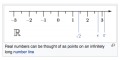
ℝ is literally ALL the numbers and their interrelations in one long line. This is not a delimit-able, elemental set in the mathematical sense, because we CANNOT terminate each element. This is a transcendent phenomenon.

If we reduce that line to points, or U-ITS, we can create "intervalic" concepts out of this thing that's infinite at every point, everywhere. So it's "uncountable" until we make a manifestation of it "countable." Nod to Euclid's wonderful metaphysical definitions of "point with no part," and "line comprising infinite points."

If ℕ, too is reduced to infinite foundational U-ITS, then ℕ is essentially referencing subsections of ℝ, and each subsection is more ℝ. ℕ is our way of dealing with this unknowable phenomenon.

So where is that "REAL" line in your discrete material brain substrate, or the "REAL" sine-wave along with it?
 
Last edited:

Thread Starter

Jennifer Solomon

Joined Mar 20, 2017
112
Thought experiment based on the above:

Envision that REAL line, now extend it into a REAL plane. Now extend it up to create "walls". Now top it off with another REAL plane. What do you have? A CUBE made out of "The REAL stuff."

Incidentally, this cube was NOT seen in physical space. It was manufactured internally out of definitions that COULD NOT HAVE COME FROM PHYSICAL SPACE (So important)! You can now address elements of it!

"WHERE is that thing located in your physical discrete-state brain, if it's not a function, but an addressable spatial thing you can "walk around in the space of your mind?"

The real numbers can’t themselves be a function in the brain. They must exist in the mind as a continuum that is being placed through a function mapper to create the cube. It’s not possible to store the reals in the brain. And it’s not possible for the discrete brain to have innate definitions for ℝ, being just a discrete bit dirt processor. Remember, there are just discrete voltages in the brain, and no “environment” to map an ℝ object to.
 
Last edited:

bogosort

Joined Sep 24, 2011
696
If the object exists independent of information, how do you know information even maps to it if you can't know anything about it directly? "Where is the dog in the light?"
I feel like I've repeated this twenty times in the past couple of pages. I believe the dog exists independently of me, but the only information I have about the dog is the information conveyed by my senses. I can't know how accurately that information maps to the dog. But, since I've experienced many dogs in my life, I can be pretty sure that -- whatever they actually are, which I'll never know -- I have a reasonably consistent representation of them.

Please note the following key points, so I don't have to repeat them anymore:

Objects are out there, independent of us.

We know the objects only through the information we get from the objects.
This introduces uncertainty; big deal, we live with it.

There is no dog in the light. There is information about the dog in the light.

If you will not say the dog exists as something in space that has some spatial dimension, then you believe light is essentially fibbing when it comes to sending you information about its empirically verifiable spatiality.
Ugh. Here's my direct quote: "I'm not saying that 2D or 3D or 10D is true. I'm saying that we have no idea what the "REAL" geometry, or even if geometry is applicable to whatever is out there."

My statement is a claim of ignorance, not a claim of knowledge that "dogs don't exist spatially" or whatever. You're the one who claims to know what space is "really like"; I have no such pretension.

The light isn't fibbing to us -- each photon conveys a single bit of information, such as it is. The light is honest: it tells a camera the same thing it tells a brain. The brain is the fibber; it uses information from the light and other sources to fabricate a story.

To deny your own measurable spatiality of minimum x, y, z is to deny your own existence in space, because you think it's all a brain-processing "magic trick."
I don't deny that I can measure spatiality. We do it all the time! What I deny is the claim that such measurements tell us how space "really is".

Assume for a second that I'm right, that the brain fabricates a perception of 3D space. With such a perception, of course humans are going to devise tools (rulers and such) that correspond to that perception's modality. We think of rulers as measuring length/distance because that's precisely how we frame experience. When I grab a ruler and put it next to my foot, I interpret all of that as occurring in three spatial dimensions. But an alien being with a different perception mechanism might see my actions and have a totally different, non 3D experience of what happened.

Can you acknowledge that possibility? If so, then the simple fact that it is possible makes it necessary to take it seriously. A ToE has to account for any such possibility.

On a personal note, I strongly believe that such possibilities should make us very skeptical about what we take at "face value".

Do you fundamentally believe the concept of your car in your head is different from the non-concept one?
There is no non-concept car in my brain, so I interpret your question as this: Do I believe that the concept of car is different from the object that I associate with the concept? Yes, of course. Entirely different things.

Talk about category error. There is no 3D spatial cube in the brain, and you have absolutely no idea what your neuronal flip flops are representing. That's my whole issue here.
What category error? I'm wondering if you know what I mean by that phrase. The domain of information processors is states and information, and so includes associations between states (information about the relationships between states). From these we get concepts. "Spatial dimensions" is a concept. There's no category error.

"There is no 3D spatial cube in the brain" -- why would you say this? It's almost as if you believe that the brain needs to be 3D in order to interpret experience as 3D. But that's like saying that a brain needs to be red in order to interpret the experience of red. You yourself have acknowledged that the computer in a drone can be programmed to intepret "1D data" as "3D space". If a computer can do it, why can't a human?

I'm talking about minimality for discussability. You also don't need to know the nth nano-harmonics of a C major chord to know it exists minimally as C-E-G in some octave.
Discussability? We're not chatting about the weather; we're trying to get at a fundamental theory of everything. C-E-G is fine for a conversation between musicians, but nth nano-harmonics are appropriate for scientists trying to understand the nature of sound.

You think the dog as 3 discrete x, y, z is not something independent of the information processing in your mind?
Whatever the dog is, it's independent of me.
 
Top