Theory of Everything

bogosort

Joined Sep 24, 2011
696
You insist on using frameworks to reason, so let us create our own. No prior knowledge other than basic logic, arithmetic and inference.
Knowledge of logic and arithmetic encapsulates a lot of knowledge, with no clear boundary between basic and non-basic. What's the line?

Even if we manage to agree to some arbitrary distinction between basic/non-basic, I don't understand why you think we'll end up creating something new. When humans sit down and think hard about logic and arithmetic, they end up with formal systems. In fact, they end up with the very systems that you're trying to get us not to use.

AXIOM: A number is a grunt
Absolutely not. Grunts are (non-unqiue) ways of expressing certain classes of numbers. In particular, every number in N and Q can be expressed by grunts. The same is not true of numbers in R or C.
 

bogosort

Joined Sep 24, 2011
696
The difference between defining a number as a stand-alone (a “1”) element vs. only seeing it as a member of a set is to make the concept of God, which is “1“ and “infinity“ combined, to be dependent upon external classification, or an effect of some other concept other than God defining what God is. Cantor was clear to state he still believed in the former, but believed this other relationship was also true. I would call this the basis of “fantasy truth,” where a transfinite number is a bizarre-concept that lies in between numbers and infinity.
It's very strange to me that you bring god into a discussion about numbers. I don't care if Cantor wrote "and so sayeth Yahweh" after each line of his proofs, the math stands or falls independent of any personal spiritual beliefs.

What does god have to do with the subsethood of N in Q?

If we start from the premise that a number is a stand-alone label and not part of a set, how does this affect your reasoning?
Lol, what makes you think I can't categorize labels as sets? The set of mailing labels is a subset of the set of addressing labels.
 

Thread Starter

Jennifer Solomon

Joined Mar 20, 2017
112
Here's your argument with "government" replacing "infinity":

Information is a measurable quantity.
Government is not a measurable quantity; therefore, government is not information.

Thereom: GOVERNMENT is not a measurable quantity, and therefore not information. But if information can be used to describe the very existence of government, information must be derivative of government in some way,

Are you willing to accept that information must be derived from government? If not, then your logic for infinity doesn't work.
Problem with the original definition then. Information is a measurable quantity. Does that mean quantity is not information? Of course it's information. In essence are you not defining one in terms of the other: I.e. "information is quantity and quantity is information?" (which is strange AF)

If your goal is to show that geometry -- i.e., the mathematical abstraction of spatiality -- is somehow more fundamental than a vector space -- i.e., the mathematical abstraction of linearity -- then you're doomed to fail.

Note that the linearity of vector spaces has nothing to do with the lines of geometry.
I'm doomed to fail ONLY if I don't see physical space and information's relation to it is its own "rulebook," which I'm insisting on proving here — that "feeling" is its own "knowing and proof system." (and which post #1472 is based on).
 

Thread Starter

Jennifer Solomon

Joined Mar 20, 2017
112
Well, in this sense it's all illusory -- there is no ℕ, either.

giphy.gif

Kronecker was reincarnated briefly above as a feline.

Seriously, this post ALONE is proof God exists! 1.6 million words between us here and it is possible — possible! — we may, may have reached critical mass of something that may appear to be agreement!

The phrase, "God created the integers, all else is the work of man" is another way of saying:

"ALL IS INVENTION, EVEN ℕ!" (God created N, man created everything else!)

Three very interesting things here in this statement, if you catch me here:

1) Notice the phraseology of Kronecker's quote: "God CREATED" the integers" meaning, they TOO are a construct, rendering "numbers themselves" non-existent outside of VALUE ASSIGNED to them. That's right, "meaning" is what allows you to say 6 > 3. Meaning is an experiential value assigned. No assigned value, then this is possible: 3 > 6.

2) "In this sense all is illusory" — consider a moment the magnitude of the semantics being used here. If "illusory" is a term that means essentially, "fake," then what MAY — MAY be termed an opposite term? Just possibly here... could it be a 4-letter word of ....

REAL?​

Just a thought. :--)

3) Something else hella interesting here: If ℕ and everything else is an illusion, that means we have a problem. In order to make the statement

"All is illusory, even ℕ"​

TWO things are happening INDEPENDENT of any "sets" in that statement— a tacit declaration of an elementary ontological phenomenon of existence, that I've been trying to drill down to here:

A) "ALL" is functioning as a quantity (as in "everything" or "all things") and

B) It is a TRUE or FALSE statement to you

How do you know it's true? Experiential FEELING (the basis of MEANING!)

BADABING!
 
Last edited:

Thread Starter

Jennifer Solomon

Joined Mar 20, 2017
112
This why I want to invent an ONTOLOGICAL set of numbers called O — {0, 1}. It is the master set of "GOOD/BAD feeling" as the basis of knowing or experiencing foundational existential phenomena, even to know mathematical theorems are legit!! It's both a number and a sense of logic. It is an existential phenomena which overlaps quantity with truth state independent of information to prove it! "A mathematical theorem is both ONE ELEMENT and TRUE at the same time!".

This is the first-order definition of truth. Using your quote (the most important phrase of this entire discourse IMHO!):

"Well, in this sense it's all illusory -- there is no ℕ, either."​

Could be read as:

Well, in this FEEL (sensibility, capacity to KNOW something), it's all NOT REAL — "there are" (as in "existing as ONE definable thing") no "NUMBER SETS", either, implying we exist independent of numbers and sets to say this statement.

No matter how much one ardently can't stand absolutes, one absolute he insists on: that is the phrase
"there are no absolutes" is an absolute!!

Existence is an absolute, or we don't exist to say it. Therefore, things such as number sets and mathematics are tools of EXISTENCE.
 
Last edited:

MrAl

Joined Jun 17, 2014
13,722
Curious your thoughts on post 1472 as the basis of a proof that numbers are logic states by bypassing framework knowledge.
I am not sure if maybe i did not state something correctly.

We can describe the state of an electrical system for example as the node voltages:, let's say:
1.23v, 4.38v, 8.25904v (v=volts)
therefore the numbers can be thought of as the states.
The logical connectives here may be implied though because those three numbers dont tell us anything unless we associated them with a given variable or location.

But it sounds like you may be getting into the old argument of does the brain decide everything or does nature (excluding the brain). The brain processes everything so everything in nature is filtered. One example of how these views change everything is Descartes' "Evil Genius" theory. There is an evil demon that intercepts everything that everyone experiences in nature and changes it to what it wants us to see. Thus does everything start with nature or with the brain. How do we know we are not all floating in a tank somewhere with imagines being projected into our minds by some powerful entity.
That's a sarcastic view but i dont think there is an agreement yet or else maybe there is and i just havent seen it yet.
 

Thread Starter

Jennifer Solomon

Joined Mar 20, 2017
112
I am not sure if maybe i did not state something correctly.

We can describe the state of an electrical system for example as the node voltages:, let's say:
1.23v, 4.38v, 8.25904v (v=volts)
therefore the numbers can be thought of as the states.
The logical connectives here may be implied though because those three numbers dont tell us anything unless we associated them with a given variable or location.

But it sounds like you may be getting into the old argument of does the brain decide everything or does nature (excluding the brain). The brain processes everything so everything in nature is filtered. One example of how these views change everything is Descartes' "Evil Genius" theory. There is an evil demon that intercepts everything that everyone experiences in nature and changes it to what it wants us to see. Thus does everything start with nature or with the brain. How do we know we are not all floating in a tank somewhere with imagines being projected into our minds by some powerful entity.
That's a sarcastic view but i dont think there is an agreement yet or else maybe there is and i just havent seen it yet.
Yes, I understand... I was curious what you felt about applying that sense of “numbers as the states” with an overlap of “truth states” ontologically (as hardware states), as a proof means, as seen in that post.

And the “evil genius” element is definitely a legit notion.

The only thing we know for sure is that there is or isn’t an evil genius. :—) And that is the basis of knowledge.
 
Last edited:

Thread Starter

Jennifer Solomon

Joined Mar 20, 2017
112
It's very strange to me that you bring god into a discussion about numbers. I don't care if Cantor wrote "and so sayeth Yahweh" after each line of his proofs, the math stands or falls independent of any personal spiritual beliefs.
I say "God" simply as shorthand for the mechanism of innate "meaning determinator" that allows us to declare "X is potentially illusory or not".

So by that definition, you said, "In that sense, all is illusory, including ℕ [thus saith God]."

Because we can use this very mechanism to say, "Perhaps all mathematical theorems are illusory" — the very mechanism to do so lies outside of the theorems to determine any one of them "make sense."

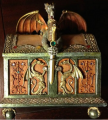
Here we are discussing "Grokk, The A$$hole Dragon" — the guardian of the holy elements of existence. A rarely seen 3D sculpture of him is here:

Screen shot 2020-06-08 at 8.44.09 PM.png

The elements of ORDER (how things interrelate and the amount of meaning each thing has) are in that box, and include all mathematical theorems and their gradations of feeling toward them that enables us to say they "sit right" or don't. The Grokk is present in every single human being. No Grokk, no meaning, no meaning, no math, no logic, no mind.

The Grokk is very reticent and reveals himself through the mechanism of experience only. I invoked him when I used the "inverse-proof" approach to saying "the reason you thought the axioms I made were a mess" was because you had a mechanism to do so that was transcendent to the math itself, which was a proof that the axioms were real. This is the first definition of "proof": The ability to identify a proof by the Grokk's permission. That which is real is that which the Grokk informs us is real by letting us feel the value of the information and its countless relationships, including moral, in relation to information referring to itself or information referring to physical space—something a conscious being does, but an inert non-living mechanical device does not (insofar as we can observe—generally those in caskets and on gurneys don't appear to be doing such).

That first little "story" I wrote that was considered "humorous" by you and me, who share "parity of feeling toward information" was the Grokk revealing himself — because the whole thing was based on playing "REAL" against "NON-REAL" as the kernel determinator of what is generally considered sane universally. Someone who is in their own world (in that "fake" story, your wife) that has "their own concepts" that are not shared with others in accordance with the Grokk, are deemed as humorous by the Grokk, and he makes us laugh. The only absolute he expects we adhere to is that there are no absolutes other than the fact that we know there are none. That is the basis of sanity, and the basis of calling anything ultimately "true" or not. Not via a function, an equal sign, or a vector space: these are Grokk-approved tools. But they have no meaning without the Grokk.
 

Attachments

Last edited:

Thread Starter

Jennifer Solomon

Joined Mar 20, 2017
112
Also a note on the Grokk and art:

The mathematical theorems that the Grokk has gradations of feeling and meaning for are born in symmetry and equality.

The arts can be described in terms of sets of things that belong and don't belong together. So while we might hate absolutes of any kind, there are groups of shared ones across humanity.

The chief one that is shared is words. There is a very shared concept the Grokk has granted for our ability to "know what the hell someone else is saying" on a very basic level. If there wasn't a baseline, no communication could be had whatsoever.

In film, there is a reason, for example, that most everyone who sees the movie The Shawshank Redemption considers it one of the best movies they've ever seen. This isn't random. It's because the film's construction is abiding by mathematically describable stylistic laws that the Grokk likes and has deemed it very universal.

Almost anyone universally who watches the film, if at various parts a random all-male Klezmer band in blonde curly wigs dressed in all hot pink with kazoos started blowing the tune to Happy Birthday in back of the warden, or a deep emotional conversation between Andy and Red, most anyone with eyes and ears would say that "doesn't fit there." It's because the Grokk has set the experiential value for that "sense" or "context" to be a certain mood and feel, and you'd bastardize his rules if you did such a thing. But then the Grokk insists on challenging that as well. "Someone just said, WHAT, you don't like men dressed in pink with all blonde wigs blowing kazoos???" You're a RACIST!" And then someone else says, "Cool it, he's just being glib and funny." And then someone else "laughs at the distinction." The Grokk ascribes controversial meaning on purpose to give us variety so that the only absolute is to know there is none.

In music, most who pick up the guitar will learn the several second-fret campfire chords that the Grokk has given meaning to. With these, one can learn "chord progressions" that most people respond to. The Grokk has set all sorts of contexts to those progressions so that different feelings are evoked for each person. But what isn't argued generally is whether or not chords are being played. Because the core of the music is mathematically describable theory, which allows us to take a course in music and learn the ABC's and 123's of music theory. And someone who gets "really good", who has mastered the Grokk's theories that most agree on, can become like the band Toto, who are so good, they can play their own music, and then play the backing tracks of a multi-platinum seller like Michael Jackson.

Even if one hates Michael Jackson, the same person would generally only say "THAT'S NOT MUSIC" in the sense of preference, but not in the sense of mathematically describable chord and rhythm theory. The Grokk will insist there's an element of universalism and also subjectivity to keep things ...REAL. REAL is what the Grokk deems is real for each and every one of us. For some, "real" means there's no God. For others, the concept is a part of their life. In either case, no one chooses their preferences set by the Grokk, they just think they do, and the Grokk gives us the illusion of "100% automonous free will" by playing different conscious and subsconsious feelings against each other that we DO NOT control, but that we use to make decisions with! (which is another analysis entirely) — and it's why the Grokk might make one particular decision feel good based on "all the information" and then some time later, looking back at it, it's deemed idiotic in retrospect. It's because the Grokk has set new experiential parameters for that data set.

One might call the most universal preference based on mathematically describable symmetry the "pop preference."
 
Last edited:

Thread Starter

Jennifer Solomon

Joined Mar 20, 2017
112
Great, so you agree that the computer distinguishes between groups of switches.
The distinguishment isn't something it knows.

Now, explain to me why my brain cannot distinguish between groups of states?
It can, it doesn't know or experience it. That's the issue. The Grokk is only present in a being with LIFE. LIFE is that capacity, not the brain. The brain that is dead no longer does any things of the kind (that we can observe).

We said before that the "dog in the light" problem is about being able to address the dog and its capacities directly. If we can't do that about the dog, how are we to do it about the brain that's supposedly "asking about the dog?"

There is no connection between the brain and the dog.

Therefore we must invoke the Grokk's direct-connection mechanism and say "The dog exists," "the brain exists", etc. They are both things in reality. The Grokk's feeling mechanism is what is making the difference between different states and their substates, and what it means to KNOW.

Now my sense concerning the feeling mechanism is that this is where the concept of true spatiality exists within the being, that's able to directly interface with the objects in physical space and "feel" they exist "as 1 thing". To "feel" is to "sense" and is to "know" these things exist as "1" indivisible thing which is CONCEPT. It is this mechanism that is causing the capacity to know the difference between non-dimensional information and dimensional things in both the mind and space and ascribe weight to things.

I think there are perhaps 3 principal "infinite-bit" shapes within the mind — circle, square, triangle — all 3D, and these things are resonating a value of meaning and quantity.
 
Last edited:

Thread Starter

Jennifer Solomon

Joined Mar 20, 2017
112
Knowledge of logic and arithmetic encapsulates a lot of knowledge, with no clear boundary between basic and non-basic. What's the line?

Even if we manage to agree to some arbitrary distinction between basic/non-basic, I don't understand why you think we'll end up creating something new. When humans sit down and think hard about logic and arithmetic, they end up with formal systems. In fact, they end up with the very systems that you're trying to get us not to use.
It’s not that I’m trying to get us not to use them, I’m trying to identify the most rudimentary foundational building blocks that drive them all for a ToE. It has to do with “meaning,” feeling and the capacity to grok.


Absolutely not. Grunts are (non-unqiue) ways of expressing certain classes of numbers. In particular, every number in N and Q can be expressed by grunts. The same is not true of numbers in R or C.
Are you willing to think about numbers without the set theory? (Serious question). How is it Pythagoras came up with his theories having no concept of them? Or Newton or Leibniz or anyone else? Exactly what do they afford us with respect to their application in physical space that not knowing about them didn’t?

For example, if we distinguish between grunts and grunt-processes, we can perhaps see numbers in a different, elementary, and unifying light?
 
Last edited:

Thread Starter

Jennifer Solomon

Joined Mar 20, 2017
112
"Separate" implies a spatiality that doesn't make sense at this level. My brain is a set of states that store (and convey) information.


The second sentence is incoherent. "With information I can't insist that my brain exists." I have no idea what you're trying to say.
Sorry... that was, “WITHOUT information you can’t insist your brain exists.”

“My brain is a set of states that store (and convey) information” <— No machine can declare such, because there is no “Grokk“ to make the definitional distinction between the physical, their states and information itself. At what complexity level of physicality would such a delineation exist? More switches and wires and their more complex interrelation does no such thing.
 

bogosort

Joined Sep 24, 2011
696
Problem with the original definition then. Information is a measurable quantity. Does that mean quantity is not information? Of course it's information. In essence are you not defining one in terms of the other: I.e. "information is quantity and quantity is information?" (which is strange AF)
No, the problem is with your logic. A quantity is not the thing it quantifies. Mass is a measurable quantity, yet quantity is not a mass.

Quantity is not information. A quantity is a magnitude or count; it belongs to the abstraction level of numbers. When related to other quantities, a quantity can convey information.

I'm doomed to fail ONLY if I don't see physical space and information's relation to it is its own "rulebook," which I'm insisting on proving here — that "feeling" is its own "knowing and proof system." (and which post #1472 is based on).
Whatever that "rulebook" might be, you are going to try to describe it using geometric notions such as length. And as soon as you invoke geometric notions, you have automatically invoked all the machinery of linearity, i.e., vector spaces. The only way around this is to not use geometry to describe the "rulebook".
 

bogosort

Joined Sep 24, 2011
696
Seriously, this post ALONE is proof God exists! 1.6 million words between us here and it is possible — possible! — we may, may have reached critical mass of something that may appear to be agreement!
Sadly, no. I was responding to your claim that N being a subset of Q is an illusion. My response -- "then it's all illusion" -- was meant to be rhetorical. I was pointing out the slipper slope of your argument. I don't believe that "it's all illusion".

As for the content of this post. you suggest that numbers are an invention, which carries with it the implication that mathematics could have been invented otherwise, i.e., that the rules of math as we know them were the inventor's choice. But this is not the case! The rules of math and numbers could not have been otherwise. God herself could not have said, "Let '2 + 3 = 4' be a theorem in the ring of integers."

Humans invented the symbols and language that we use to describe mathematics. But we did not invent the rules, nor the consequences of those rules.
 

bogosort

Joined Sep 24, 2011
696
This why I want to invent an ONTOLOGICAL set of numbers called O — {0, 1}. It is the master set of "GOOD/BAD feeling" as the basis of knowing or experiencing foundational existential phenomena, even to know mathematical theorems are legit!! It's both a number and a sense of logic.
You want to build an ontology based on two terribly misguided ideas. First, numbers and logic states are not equivalent. Consider that a fundamental property of propositional logic is that, for every theorem, you can swap all "T" values for "F" values (and vice versa) and not change the theorem. The "truth values" do not matter; only the form matters. This property is not true of arithmetic theorems over ℕ. Changing the numeric values in a theorem will almost invariably result in a non-theorem! Unlike logic, arithmetic is not about form, it's about content -- specifically, the values and properties of numbers. You need to disavow yourself of this critical confusion.

Second, "good/bad feeling" is woefully inadequate to characterize human experience, let alone serve as a foundational ontology of the universe. Explain stellar thermodynamics with "good/bad feeling". I can do it with states and state transformations. Explain how a drone navigates around buildings with "good/bad feeling". I can do it with states and state transformations. And in terms of human experience, "feeling" is perhaps the least discrete thing we know. The set of experiences that are strictly "good" or strictly "bad" is essentially empty. In no way would I characterize my feelings about anything as a sum of discrete packets of "good" and "bad". Unlike numbers, which are discrete and constant, feeling is more like a complicated multi-variable function of time.

No matter how much one ardently can't stand absolutes, one absolute he insists on: that is the phrase
"there are no absolutes" is an absolute!!
I've never said "there no absolutes". In fact, I've specifically said that mathematics is absolute. Perhaps you're referring to my insistence that we have no absolute reference frame from which to calibrate our experiences. I can't compare my experience of "red" to anyone else's. Hopefully you agree with that.

Existence is an absolute, or we don't exist to say it. Therefore, things such as number sets and mathematics are tools of EXISTENCE.
What does "existence is an absolute" even mean? Are you claiming that the universe exists? If so, that was never in dispute. Do you mean that our experience of existence (the universe) is absolute? That I strongly disagree with.

What does "number sets and mathematics are tools of existence" mean? What is a "tool of existence"?
 

Thread Starter

Jennifer Solomon

Joined Mar 20, 2017
112
Sadly, no. I was responding to your claim that N being a subset of Q is an illusion. My response -- "then it's all illusion" -- was meant to be rhetorical. I was pointing out the slipper slope of your argument. I don't believe that "it's all illusion".

As for the content of this post. you suggest that numbers are an invention, which carries with it the implication that mathematics could have been invented otherwise, i.e., that the rules of math as we know them were the inventor's choice. But this is not the case! The rules of math and numbers could not have been otherwise. God herself could not have said, "Let '2 + 3 = 4' be a theorem in the ring of integers."
Unless God IS those things.... also, what is “illusion?“
 

Thread Starter

Jennifer Solomon

Joined Mar 20, 2017
112
You jump into a pool, you come out of the pool... “wet” would be a word token to describe yourself, right?

Anyone else jumps into the pool and does the same, you’d describe them the same.

Would you consider that a “true statement“ that holds the same “weight” as a mathematical one involving sets?

Serious question:

If someone else jumped into the pool, came out, had water all over them in like manner, and they claimed they were dry, what would you call that?
 
Top