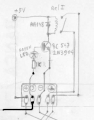
The LED's Wings Project and sensing circuit.

Thread Starter

q12x

Joined Sep 25, 2015
2,227
First off I don't see how Q1 could get hot unless "S" is shorted or very low resistance.
Excelent answer. Somewhat my thought was the same but not quite. Yours is better, im not in shame to say. :]
Start with R2. Measure voltage across R2 to find current: Ohm's Law says I = V/R where I = current, R = resistance, V = voltage.
Power or wattage is equal to current x voltage.
And this is the HOW that I'm looking for. Excelent again! Thank you. Though I know this also, I alwais get weird results that are not coinciding with the real behaviour. In reality, I use these formulas very rarely, only in extreme cases when I cant think on anything else to do. I thought I am doing it wrong.

Can't figure Q1, don't know what load "S" is.
Well, the general current for the entire circuit, read from my PSU, was somewhere like 150mA. When is in real short, + with -, it jumps way high, to 1A or around it. I think 1A is limited by my current knob that I set it to 1A as a general precaution. It goes to 30V and 5A my PSU that I have.
Ok so take this 150mA as a reference and add
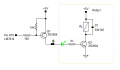
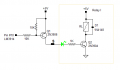
this : 1611099237344.png with this: 1611099283327.pngfor the full circuit.
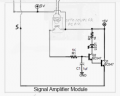
What is the fault in it? I dont know. Im not sure if it is a fault because I just built the other circuits and those worked fine. Most probably some sort of low resistance, as you put it. But I want to be able to calculate it by myself. My way of learning is to see other examples. So your example will be super fine.
If you can not take the 150mA as a reference, then take it as a short and calculate it from that perspective or/and as a low resistance as you mentioned. I really like the low resistance, i never thought of it. I was suspecting some weird kind of short as well, not full short but partial, being on cardboard and so many wires dangling around... but not like you put it, like a component(s) low resistance, if im getting you right.
 
Last edited:
Thread Starter

q12x

Joined Sep 25, 2015
2,227
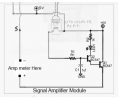
It would be a lot easier if you just open the connection between the emitter of Q1 and "S" and measure the current. You do have a meter correct?
Unfortunately i dont have that circuit anymore since it was on breadboard. Now is no more.
I can reconstruct it, but I wanted a short tutorial for calculation from you (all here). Also to see how you think on situations like these. More brains is better, is my saying. This was just an exercise. Nothing more. But I get your point now. Use the multimeter in the fault zone, which it didnt occur to me to do it at that time in the slightest. I really like your answers. Thank you !
 

dl324

Joined Mar 30, 2015
18,403
Step by step, as close as possible. If you can of course.
For LED1, R2, and Q2.
  1. Measure the voltage across the LED, R2, and collector-emitter
  2. Knowing the voltage across R2 allows you to calulate the current in those 3 components (ignoring the base current)
  3. Once you know the current, you can calculate power dissipation using P=IV for each component
 

dl324

Joined Mar 30, 2015
18,403
Use the multimeter in the fault zone
Inserting a meter in your circuit can perturb it enough to give you erroneous readings. It's better to insert small value resistors and measure the voltage drop across them and calculate current.
 

sghioto

Joined Dec 31, 2017
8,658
I wanted a short tutorial for calculation from you
OK. Assuming Q1 was drawing 150ma and all components are good the max voltage on the emitter of Q1 would be 3.6 volts because Q1 and Q2 are configured as a voltage follower. Therefore 3.6/.15 = 24 ohms. Meaning the "S" signal line was reading 24 ohms to ground.
BTW I tested this circuit on the breadboard with the LM3914 circuit without any problem.
Point being you don't need four transistors and an opto to activate a relay.
1611102033902.png
 

Audioguru again

Joined Oct 21, 2019
6,826
If the collector of the emitter-follower is 5V and its emitter is 3.6V then it has 1.4V across it. Then with a current of 150mA the emitter-follower heats with 0.21W and will be fairly warm but not hot.
 

Thread Starter

q12x

Joined Sep 25, 2015
2,227
It would be a lot easier if you just open the connection between the emitter of Q1 and "S" and measure the current. You do have a meter correct?
I got terrible curious now that you mentioned the multimeter, and I didnt thought for a second on using it at that time.
I rebuilt that circuit and I got the exact same result as before. Hot transistor and 150mA in my PSU display.
I measured as you said, between Q1 emitor and S, and I got 102mA when fully activated. When was not activated got down to 0.2mA.
 

Thread Starter

q12x

Joined Sep 25, 2015
2,227
For LED1, R2, and Q2.
  1. Measure the voltage across the LED, R2, and collector-emitter
  2. Knowing the voltage across R2 allows you to calulate the current in those 3 components (ignoring the base current)
  3. Once you know the current, you can calculate power dissipation using P=IV for each component
Inserting a meter in your circuit can perturb it enough to give you erroneous readings. It's better to insert small value resistors and measure the voltage drop across them and calculate current.
BRILLIANT explanations ! Thank you ! I just love it !
Especially the insertion of the small resistor and getting the voltage from it. Just brilliant. How small? 100R? 1k?
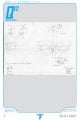
I am actually making an artpage right now with all your answers. For me. I wish there is a book for diagnostic stuff like we are treating here. Mmmm. But your solutions are gold to me ! Thank you so much !
 

Thread Starter

q12x

Joined Sep 25, 2015
2,227
BTW I tested this circuit on the breadboard with the LM3914 circuit without any problem.
Point being you don't need four transistors and an opto to activate a relay.
1611106389411.png
Ok, I thought the same as you that it should work with a single transistor. But my circuit is a bit more complex because it has that sensing circuit that is affecting the vibration of the signal to lm3914. If I had a normal osciloscope and put that signal under it, I would get a haystack of a signal from that sensing circuit alone. Then, the number of leds that lm3914 is driving, I kind of pushing, i think, to some extreme this little IC. Again, some residual is building up from this IC as well, until it reach the last pin from it. I am imagining all this. What it could be. I can't really know. I only have shit tools. I got to this circuit by trying and experimenting for months. I made numerous breadboard tests. Im building it for 7 months now, in fact. :] Is that hard. But i believe in it. So it will be awesome. It's a very experimental circuit. But i like it. It's my little child in a way. i love it. As hard as it is.
Another important fact that i highly suspect is the voltage. I think the whole circuit wants more voltage. THats why I get this erroneous behavior. But with a bit of work it can be domesticated. In other words, Im running it under-voltage. Again, is my impression.
And then, all the cardboard and the wires all one over the other, I highly guess they are creating some EM fields and resistive paths that are not intended. But in my mind they are negligible, so they can be overcome by a more serious circuit design.
I will try your new circuit now.
 

Thread Starter

q12x

Joined Sep 25, 2015
2,227
One thing I noticed I think is, I don't see any filter capacitors installed on your circuit boards, is that correct?
Yes is correct.
I just tested your last circuit with the PNP. The relay trembles like before, when pin10 is activated.
 

sghioto

Joined Dec 31, 2017
8,658
You should connect a 100uf filter cap across the 5 volt supply to the LM3914 right at the chip because your leads are long.
I would also try adding a .1uf cap from pin5 to ground on the LM3914.
 
Last edited:

Thread Starter

q12x

Joined Sep 25, 2015
2,227
Phui, what a journey... of learning! :]
I made the circuit board, and it didnt work. It worked for a short time but then it just stopped. I figure it out it was the pads I used, were super thin, and the solder was not really stick on it that well, and then if the board was bending a bit or just pressure on it from my touching it, some very fragile links to the components was broken. I couldnt find the broken ones but i have the experience with others in the past. In conclusion, I had to redesign and re-shape it with a bit larger pads than before and leave some room for the iron tip and the component to really step on the pad, and not near it. I developed a skill where I elongate the solder, like a spike, to link it from the pad to the pin component. That kind of link is sometimes weak. Im talking about SMD components here.
So... now I have the second version built. Both versions, by themselves, were trembling the relay as before. On the breadboard was working fine. But on my board, is trembling. I think you are right, its because the long tracks. It's the principal suspect.
BUT... I put a cap from first Q to the ground. First I put a 3.3uF electrolitic, and it was delaying very long between switches, but it was switching right. Then I put 1uF. A slight delay this time. Then I put a fixed 220nF. This time, no delays. As fast as I move the hand over the sensor, as fast the relay is switching.
Now is very good !
Next, I'll have to put it on the wall.
 
Top