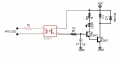
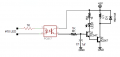
The LED's Wings Project and sensing circuit.

Thread Starter

q12x

Joined Sep 25, 2015
2,227
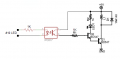
Making this circuit, on the breadboard:
1611026635243.png
LED1 is lit very brightly. The relay trembles.
Though the red led and the other blue leds are a bit more brighter now, and they dont show a visible trembling light. Before it was a subtle trebling light in them.

Another version controlled directly by Pin #10.
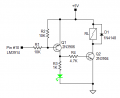
The version controlled directly by Pin #10 is interesting.
 

Thread Starter

q12x

Joined Sep 25, 2015
2,227
We will continue it tomorrow. Now im super tired.
If anything pops out, do put it here. Thank you for all your effort so far. Good progress.
 

Thread Starter

q12x

Joined Sep 25, 2015
2,227
Try adding cap.
1611061198435.png
Yes, my friend !!! it is working fine now in this configuration.
Now, I thought I will integrate a bit of redundancy which is always good for the soul. I took out the relay and gnd from Q1 pins. I put +5V in its colector, and S(signal) in its emitor, to my other relays already on the board. It didnt work at all, and Q1 got very hot. The current from power supply unit (PSU) jumped up to 150mA, from the usual 90mA. Its how I learned to monitor troubles.
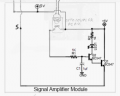
What im trying to make is a [signal amplifier module] as it was before with only the opto and the darlington transistor, module. Because in this way, I dont have to change anything else in the big circuit, you get me? So its a bit too much, adding this entire circuit in place of the small one before, but is cleaner and safer for the rest of the board.
I know, I know, I should make a big operation and cut and change everything with this working one. But... Im thinking on alternatives a little bit. If everything else fails, I will make the operation in the very end.
Let's try making this as a module in itself.
As always, thank you very very much for your involvement and dedication so far. You are great people !
 

Thread Starter

q12x

Joined Sep 25, 2015
2,227
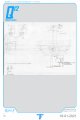
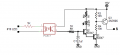
This is the idea I have, even if is not working at the moment.
It's the exact thing as your drawing ! I rotated a bit the opto, but thats it.
q20210119 A copy 1.jpg
 

sghioto

Joined Dec 31, 2017
8,641
I'm confused. I though you just wanted to activate a relay when #10 LED was on.

EDIT: OK you want to keep Relay 1 circuit as is and control with darlington configuration.

1611073902971.png
 
Last edited:

dl324

Joined Mar 30, 2015
18,395
I'd get rid of the 1k resistor you have in series with the optocoupler LED. The outputs from LM3914 are current sinks and the resistor serves no useful purpose.

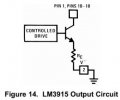
The LM3914 datasheet doesn't show the output circuit detail, but LM3915 does:
clipimage.jpg
 

Thread Starter

q12x

Joined Sep 25, 2015
2,227
to mister @Audioguru again and @sghioto :
Q1 gets hot when it its an emitter-follower with an output voltage of about +3.6V and feeds "S".
What load is "S"?
As far as I can tell it's going to a 1K resistor in series with a green LED in series with the base emitter junction of a 2N3904 in Relay circuit 1. It should not get hot unless "S" is shorted somewhere or there is another load on it.
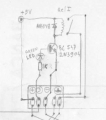
Mister sghioto, you explained it perfectly. It is exactly how you said. And the circuit I have drawn here is AFTER I made the circuit in reality, so it follows it closely, No other loads or shortcuts. Im trying my best to keep the drawing as close to the current real circuit despite numerous modifications.
I draw over (with an orange line) the signal track for you to see it more clearly.
q20210119 B copy 1.jpg


EDIT: OK you want to keep Relay 1 circuit as is and control with darlington configuration.
Exactly. As an alternative, before jumping and taking out everything and rewire and reshape it. I'm thinking, maybe I can make it work like this, with this new module, larger than I wanted but happy is resolving some problems.
I am starting your new circuit now, I'll update soon.

I'd get rid of the 1k resistor you have in series with the optocoupler LED. The outputs from LM3914 are current sinks and the resistor serves no useful purpose.
I already made the tests. If I will take out that resistor, the IR led inside opto and the red led that is originally driven, will not light at all. This way, with the 1k resistor there, is functioning perfectly. Mister @sghioto mentioned that without that resistor, the IR led in opto will shorten the red led outside since it's low voltage forward of 1.5V, while red led is 2.2V (i just look for both). Actually only the IR led will work, cutting the red led current.
 
Last edited:

Thread Starter

q12x

Joined Sep 25, 2015
2,227
EDIT: OK you want to keep Relay 1 circuit as is and control with darlington configuration.
1611089504927.png
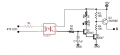
Ok, I built your circuit.
In the begining it didn't work, the 10k for R3 and R4, I lower them down both to 1k and still didnt work. But my fine jedi senses feel the force, and I lowered it further to 500 ohm. Now it works !
For Q3, your PNP, I use one, but then I change it to a NPN since it doesn't matter in this case what I use. They both give the same results. So I keep it with a NPN.
What is does so far:
1611089615512.png
When activated, it open rel1. BUT... after 1.5seconds rel1 closes back. It's like a temporizator(timer delay). It's because that capacitor in your circuit. Next, I took it out. And the circuit works beautifully. BUT... i still didnt check for overheating.
-At this stage, i think this module is complete and working fine.
BUT...I have a special request from you. I usually rely on luck and "the force from SW" (im joking). But I wish I would be able to "calculate" or to determine the consuming power through any component in my circuit. The wattage that is supporting it. That determines the heat and the nominal function of the component. Is there a trick to calculate it? For each component, doesnt matter what kind it is, a resistor, a transistor, a led, etc. That will be awesome to know. Especially for me that I like to experiment and build new things.
For now, I will build this new and working module and then test the board on the wall. I will update you after, what is happening. I want to believe that this module was the cause of previous malfunction and not the 50hz from the wall. I hope I'm right. What an experience so far. Heh.
 

Thread Starter

q12x

Joined Sep 25, 2015
2,227
Ok. As an EXERCISE, or tutorial for me !
How you calculate the power dissipated by Q1, Q2, R2 ?
This circuit is the bad one where the Q1 was getting hot.
Leave any value you think is important for me to understand your process.
Use any method you can think of, or any that you usually use at regular basis. More methods are always better than 1.
Thank you !
1611096265937.png
Unnecessary update:
I just finished the components dimension circuit drawing. Its on paper so i can't share it yet. But i will in the end.
Next, is making the board but im taking a short break to recharge my energy. Always I take short breaks between stages of execution. I burn out very quickly if im concentrating non-stop. Short breaks is the key for the long run execution and is keeping the morale high as well.
 

dl324

Joined Mar 30, 2015
18,395
circuit is the bad one where the Q1 was getting hot.
When the transistor was turned on, it was shorting the power supply. It should have been destroyed if your power supply wasn't current limited.

To calculate power dissipation for other components, use the following
\(P=IV=I^2R=\frac{V^2}{R}\)
 

sghioto

Joined Dec 31, 2017
8,641
How you calculate the power dissipated by Q1, Q2, R2 ?
First off I don't see how Q1 could get hot unless "S" is shorted or very low resistance.
Start with R2. Measure voltage across R2 to find current: Ohm's Law says I = V/R where I = current, R = resistance, V = voltage.
Power or wattage is equal to current x voltage.
Can't figure Q1, don't know what load "S" is.
 

Thread Starter

q12x

Joined Sep 25, 2015
2,227
To calculate power dissipation for other components, use the following
\(P=IV=I^2R=\frac{V^2}{R}\)
Thank you for your answer. The formulas by themselves are simple to find these days. What im more interested is How, to use them. I want your process. Step by step, as close as possible. If you can of course.
 
Top