Facebook
 Google
 GitHub
 Linkedin
Hi all,
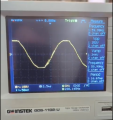
First, for you ADHD go-gettum problem solvers who like staring at funny graphs that aren't doing what they should be doing, the TL;DR: There's a funny electronic buzzing sound in all of my sensitive/expensive electronics and it's even gotten louder; please help me understand this reading on the oscilloscope, which I took on my 120v AC outlet. You will find it attached, please and thank you.
The "you got me I'm curious, I'll spend 15 minutes reading your 3 energy drink, 4 cold brew coffee inspired 11:00pm worknight post:"
The back story:
Loud (beyond normal) electronic buzzing sounds started to occur in all of my electronics that had any kind of main login board. These include, but are not limited to, LED lightbulbs, my oven, the refrigerator, both of my computer PSU's, TV's, Modem+Router, the list goes on. Please be aware that this sound is house-wide. Not just one circuit. Since I noticed this, I have been chasing electricians, I&C techs, the power company, my neighbors, and lately even the FCC/CC in circles trying to make heads or tales of the dratted electronic buzzing sound that has plagued my ears and, more importantly, my electronics.
What I've done:
I've been in and out of electrical help forums, student-engineer help-me-read-this-instrument pages, HAM radio operator and complainer pages, and at this point I feel like I've taken my first year of electrical apprenticeship online (kidding). Please send help, I'm an IT guy. We try NOT to touch the magic sparky stuff in the walls.
I've unplugged every item in the house trying to narrow down the source.
No, nothing was left plugged in (except the dryer, oven, and AC) when I finished.
Yes, everything still buzzed one by one as I plugged them each in to a different circuit in the house.
The electrician that I had out said that voltages across the house look fine. He also said that all of the breakers/protectors on the panel look and trip fine. For all purposes, he believes that the wiring and components of my house are not the issue, here. I don't know if I believe him, but he's the electrician, here, I just use the sparky zappy stuff.
Next, I had my power company out. Surprise, surprise, they found that voltages at the panel were fine. They said there's nothing more they can do and that the issue I was describing sounded like a power frequency issue and there's nothing they could do about that. Another dead end. The man left me at my doorstep to die a slow 30-year electrical buzzing induced death.
Next, I appropriated an oscilloscope from somewhere and decided to do my own testing on an outlet, during the daytime. Attached, you will find the day-time (problem existing) video. You will also find the video I took at dusk with the problem NOT being there, to capture a look at what my power usually looks like when not driving my senses nuts with infernal electrical whining.
Attached, you will also find a video of the sound as best I could capture it.
On that note, It's insanity to me that everywhere I turn has NO idea what I'm asking them to fix. No one seems to recognize that this IS an issue and it DOES need to be fixed. Am I the crazy one? I'm starting to think so. If you, dear helpful forum, have any advice on who/what I should turn to next, I'd definitely appreciate that, too.
Anyways, I think that's enough for this post. Please send help, I am not okay.
Edit: I have found that I cannot attach videos to forum posts.. As such, here is a link to a Google album containing the file: Oscilloscope Readings.
You can check the link before clicking it by hovering over it and looking in the bottom left of your screen. In that album, there is also the night-time reading that is normal (in my opinion) as well as the video/audio of what my buzzing electronics sound like.
Attached to the forum post will be a still of the oscilloscope reading, should you not want to trust the link. Please not that the graph itself is shifting rapidly left and right on my scope (I think this is indication of frequency?) and the jitter of voltage (?) in the line keeps moving up and down the diagonal portion.
My Request:
If nothing else, can someone please help me understand what I'm looking at on this oscilloscope? From my research, the yellow line = voltage. Peak to peak is the frequency. A moving peak = changing frequency. Jitters in the yellow line = voltage modulation?
Any advice is much appreciated.
Me and my aching eardrums thank you in advance,
Justin.
First, for you ADHD go-gettum problem solvers who like staring at funny graphs that aren't doing what they should be doing, the TL;DR: There's a funny electronic buzzing sound in all of my sensitive/expensive electronics and it's even gotten louder; please help me understand this reading on the oscilloscope, which I took on my 120v AC outlet. You will find it attached, please and thank you.
The "you got me I'm curious, I'll spend 15 minutes reading your 3 energy drink, 4 cold brew coffee inspired 11:00pm worknight post:"
The back story:
Loud (beyond normal) electronic buzzing sounds started to occur in all of my electronics that had any kind of main login board. These include, but are not limited to, LED lightbulbs, my oven, the refrigerator, both of my computer PSU's, TV's, Modem+Router, the list goes on. Please be aware that this sound is house-wide. Not just one circuit. Since I noticed this, I have been chasing electricians, I&C techs, the power company, my neighbors, and lately even the FCC/CC in circles trying to make heads or tales of the dratted electronic buzzing sound that has plagued my ears and, more importantly, my electronics.
What I've done:
I've been in and out of electrical help forums, student-engineer help-me-read-this-instrument pages, HAM radio operator and complainer pages, and at this point I feel like I've taken my first year of electrical apprenticeship online (kidding). Please send help, I'm an IT guy. We try NOT to touch the magic sparky stuff in the walls.
I've unplugged every item in the house trying to narrow down the source.
No, nothing was left plugged in (except the dryer, oven, and AC) when I finished.
Yes, everything still buzzed one by one as I plugged them each in to a different circuit in the house.
The electrician that I had out said that voltages across the house look fine. He also said that all of the breakers/protectors on the panel look and trip fine. For all purposes, he believes that the wiring and components of my house are not the issue, here. I don't know if I believe him, but he's the electrician, here, I just use the sparky zappy stuff.
Next, I had my power company out. Surprise, surprise, they found that voltages at the panel were fine. They said there's nothing more they can do and that the issue I was describing sounded like a power frequency issue and there's nothing they could do about that. Another dead end. The man left me at my doorstep to die a slow 30-year electrical buzzing induced death.
Next, I appropriated an oscilloscope from somewhere and decided to do my own testing on an outlet, during the daytime. Attached, you will find the day-time (problem existing) video. You will also find the video I took at dusk with the problem NOT being there, to capture a look at what my power usually looks like when not driving my senses nuts with infernal electrical whining.
Attached, you will also find a video of the sound as best I could capture it.
On that note, It's insanity to me that everywhere I turn has NO idea what I'm asking them to fix. No one seems to recognize that this IS an issue and it DOES need to be fixed. Am I the crazy one? I'm starting to think so. If you, dear helpful forum, have any advice on who/what I should turn to next, I'd definitely appreciate that, too.
Anyways, I think that's enough for this post. Please send help, I am not okay.
Edit: I have found that I cannot attach videos to forum posts.. As such, here is a link to a Google album containing the file: Oscilloscope Readings.
You can check the link before clicking it by hovering over it and looking in the bottom left of your screen. In that album, there is also the night-time reading that is normal (in my opinion) as well as the video/audio of what my buzzing electronics sound like.
Attached to the forum post will be a still of the oscilloscope reading, should you not want to trust the link. Please not that the graph itself is shifting rapidly left and right on my scope (I think this is indication of frequency?) and the jitter of voltage (?) in the line keeps moving up and down the diagonal portion.
My Request:
If nothing else, can someone please help me understand what I'm looking at on this oscilloscope? From my research, the yellow line = voltage. Peak to peak is the frequency. A moving peak = changing frequency. Jitters in the yellow line = voltage modulation?
Any advice is much appreciated.
Me and my aching eardrums thank you in advance,
Justin.
Attachments
-
 411.2 KB Views: 93