Technics SX-PR603 Digital Piano

MrChips

Joined Oct 2, 2009
34,866
R29, as predicted, is open circuited

R28 looks like 2 ohms
Ok. R29 is blown and needs to be replaced, 2 Ω / 2 W.

As a quick test, jumper across R29 and see if the digital part of the piano comes back to life. I think 0 Ω in place of 2 Ω will not make a difference.

You will quickly find out that either only R29 is blown or something else on the MAIN board is blown too.
If something else caused R29 to blow, then R28 too is going to blow this time.
 

Thread Starter

emmet422

Joined Sep 1, 2024
58
“As a quick test, jumper across R29 and see if the digital part of the piano comes back to life. ”

>>
didn’t have a suitable ceramic resistor so
I put 5 parallel 10 ohm resistors across R 29, no sign of life from the control board/ digital side of things. No excitement (flash, bang, smoke) R28 still reading 2 ohms
 

Thread Starter

emmet422

Joined Sep 1, 2024
58
post #57
R28a, R28b 40v
R29a R29b 40v
post #55
Vcc on main board (3 points) all 37-40v
post #53 test points should be 3.3 and 5, both are correct

OMG
display alive!!

just a few clicks from tweeter when demo pushed, but wonderful in headphones.

thank you soooo much for not giving up on me-
 
Last edited:

MrChips

Joined Oct 2, 2009
34,866
Having come this far, give yourself a reward and go buy an extra large pizza for dinner.
Enjoy the pizza with cold beer and in good company. Now save the pizza box.

Cut out the top of the pizza box to fit over the MAIN board as protection from further damage. We are done with testing the MAIN board for now.

For your next test, go back and do the tests on post #40 where we left off.
 

Thread Starter

emmet422

Joined Sep 1, 2024
58
seems to me you are the one that has earned pizza and beer- and a night off, so don’t worry if you’d rather not respond for a bit.

However, believe it or not, we had pizza last night. So…

I didn’t dare try both probes at once, but the signals at AMPL &AMPR are comparable, and 2-4V depending on volume setting (didn’t check full range).
(i think this is right - 10x probe set in menu, 1v/div, about 2-4 divisions. )
I don’t see noticeable noise on the 15 volt test points, though getting a good contact was a bit difficult.
 

MrChips

Joined Oct 2, 2009
34,866
seems to me you are the one that has earned pizza and beer- and a night off, so don’t worry if you’d rather not respond for a bit.

However, believe it or not, we had pizza last night. So…
Friday night is pizza night. We had pizza last night!
 

MrChips

Joined Oct 2, 2009
34,866
Look at the signals at LCH and RCH on the amplifier board. Do one at a time.
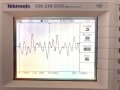
Technics SX PR603 amp LCH RCH.jpgHere is an example of a music waveform captured from a digital piano with quiet music.

With the oscilloscope input channel set to AC, you are looking for some symmetry about the 0 V axis, without clipping on the peaks. Your amplitude will differ.

Tek TDS 210.jpg
 

Thread Starter

emmet422

Joined Sep 1, 2024
58
both signals look reasonable, using demo. not clever enough to figure out trigger properly for a clean trace. Signals are pretty much symmetric and did not see clipping
(nice oscilloscope…:)
 

MrChips

Joined Oct 2, 2009
34,866
Let's have a look at the speaker signals SPL and SPR.
In this case, set the oscilloscope CH1 input to DC. This way we can see if there is any DC offset.

Technics SX PR603 amp SPL SPR.jpg
 

Thread Starter

emmet422

Joined Sep 1, 2024
58
SPL offset is 10V
SPR looks like 400???

btw, i have to go back to work midday EDT tomorrow (piano is at weekend place), then I may have to leave town for a week, so there will be a break … but happy to try things before then
 
Last edited:

MrChips

Joined Oct 2, 2009
34,866
SPL offset is 10V
SPR looks like 400???

btw, i have to go back to work midday EDT tomorrow (piano is at weekend place), then I may have to leave town for a week, so there will be a break … but happy to try things before then
You could be misreading your oscilloscope. 400??? could be 40 V. In which case 10V is actually 1.0V.
Are your probes set to x1 or x10?
Is the input channel set to match the probe setting?

In any case, we need to get to those four transistors on the heat sink. Are you up to the task?
Eventually, It could mean removing all four transistors from the board and testing them independently.
 

Thread Starter

emmet422

Joined Sep 1, 2024
58
oops
In any case, we need to get to those four transistors on the heat sink. Are you up to the task?
in for a penny, in for a pound.

though my courage quails a bit when i see it looks like i will have to remove the board? But if i do so, there are better resources at work for checking/replacing transistors.

CN2 is intimidating- i’ve not seen anything like if before.

btw, i checked the probe (10x) and the scope setting and you were right. 40V, not 400. phew!
 
Last edited:
Top